Bhagavad Gita Chapter 2 Verse 13 (Shlok 2.13) explains the relationship between the body and the soul across time — specifically, what really happens when a person is born, grows, ages, and eventually dies. Krishna tells Arjuna that the body moves through childhood, youth, and old age, and that death is simply the next stage in that same sequence: the soul leaving one worn-out body to take up residence in another. Nothing about the real self is lost in this transition; only the covering changes.
This verse is among the most well-known and frequently quoted verses of the Bhagavad Gita because it distils, in two crisp lines, the philosophical foundation for everything Krishna says afterward. It gives people a simple, memorable way to hold two ideas at once — that bodies are temporary and that we are not our bodies — without needing years of study to grasp it. It’s often the first verse people encounter when they’re introduced to the Gita’s teachings on death, which is part of why it has traveled so far beyond religious study into everyday consolation.
The question it answers is one almost everyone eventually asks in some form: if I am not this body, then what happens to me when this body dies? Krishna’s answer is that the “me” was never identical to the body in the first place — it only ever wore it, the way it wore a child’s body and later a young adult’s body. So the end of the body is not the end of the wearer, only the end of one stage in the soul’s journey through different bodies.
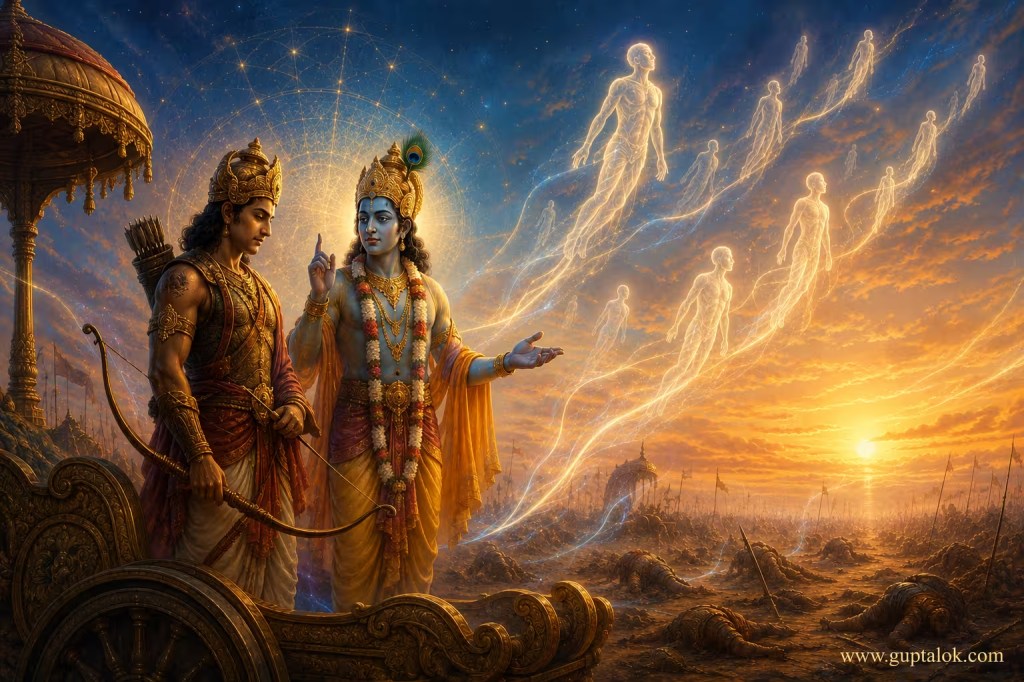
Krishna explains this to Arjuna at this exact moment because Arjuna is paralyzed by grief and fear at the thought of causing others’ deaths in the battle ahead. Krishna’s purpose isn’t abstract philosophy for its own sake — it’s to remove the fear of death as a reason for failing to act rightly. If death is not the destruction of the self but only a change of form, then acting out of fear for oneself or grief for others becomes a misunderstanding of what death actually is, and no longer a valid reason to abandon one’s duty.
In this detailed explanation of Bhagavad Gita Chapter 2 Verse 13, we’ll explore what Krishna teaches about the soul, death, rebirth, and why understanding this verse is essential for understanding the rest of the Gita.
Bhagavad Gita Chapter 2 Verse 13
Here is the 13th verse of the Bhagavad Gita chapter 2, in the original Sanskrit, followed by its English transliteration and translation.
Sanskrit Text
देहिनोऽस्मिन्यथा देहे कौमारं यौवनं जरा ।
तथा देहान्तरप्राप्तिर्धीरस्तत्र न मुह्यति ॥
English Transliteration
Dehino-asminyathaa Dehe Kaumaaram Yauvanam Jaraa |
Tathaa Dehaantarpraaptirdheerastatra Na Muhyati ||
English translation
Just as the bodies of living beings pass through childhood, youth, adulthood, and old age (death), similarly, the life (soul) within those bodies travels into newer bodies. Those who are wise and steady don’t get attached to them (types and stages of the body).
Meaning, Central Idea, and Life Lessons
In continuation of the previous Shlok where Krishna mentioned that the real self of any one of us can’t ever die, he further explains the truth of body, soul, and death. He says that the body continuously keeps on changing, and then comes a day when it becomes completely useless for the soul, and therefore it has to leave the body. In some cases, the soul knows that it will get a new body soon, but most of the souls are so attached to that time-worn body that they can’t realize that they are still alive and are in the transition process of moving into another body. In order to make this concept easily understandable, Shri Krishna exemplifies different stages of the current body of the living being. His examples make us understand the following.
If you consider yourself just a body, then understand that you die and are born every moment. Many old cells of your body die, and many new cells of your body are born every moment. So the person who dies every day and comes out as a new person every day doesn’t make you unhappy with his/her death. Why? Because you see them being born again in front of your physical eyes.
On the contrary, when all their cells die together and are reborn in a different form, you can’t recognize them. And that is the reason why you cry at the death of a person but not at the regular cellular death of him. It means you don’t cry due to his death but due to your inability to recognize him after one of his deaths and births.
So you need to do one of two things: develop the ability to recognize the new forms your loved ones take after death, or understand that they haven’t died at all — they have simply changed form. Let’s examine both ideas, though Krishna wants us to focus on the second, as that is the absolute truth.
You or Your Loved ones don’t die but just expand or change their shape
This aspect is for those who think that they are bodies and there is nothing like a soul. Such people may not be very intelligent, but they don’t consider themselves anything less than an intelligent scientist. They would always ask you to provide scientific proof of everything, including God, unaware of the fact that science came into the picture only after God created the earth, the universe, etc. So, such people, who are believers or blind believers of only physical and material science and close their eyes beyond it (beyond it are many sciences like spiritual science, etc.), should focus on this aspect to understand that no one ever dies.
Understanding Death Through Science
We, the bodies, are made of atoms and molecules. During your birth, particles, atoms, molecules, etc., were brought together to make a single body that is known as you.
These elements were there even before you came into existence, perhaps, in the form of blood in your mother’s or father’s body that was used to make your initial form of egg and sperm. If you go before, you may find that the elements that were alive as blood in your parents were, perhaps, alive earlier as parts of different types of food they consumed. Even when you were about to become a baby from an egg and sperm combination in your mother’s womb, the additional elements (particles, atoms, molecules, etc.) needed for your development were still alive in the form of blood in her body and the food she was consuming.
If you can continue contemplating similarly, you would get to know that the elements (particles, atoms, molecules, etc.) in you always existed with different names and forms, they never perished. It means when they, which are currently known as you would not be known as you, obviously after your death, would be known as something else, perhaps soil for the buried body, water for the dissolved body, electrons for the burnt body, etc.
What happens next?
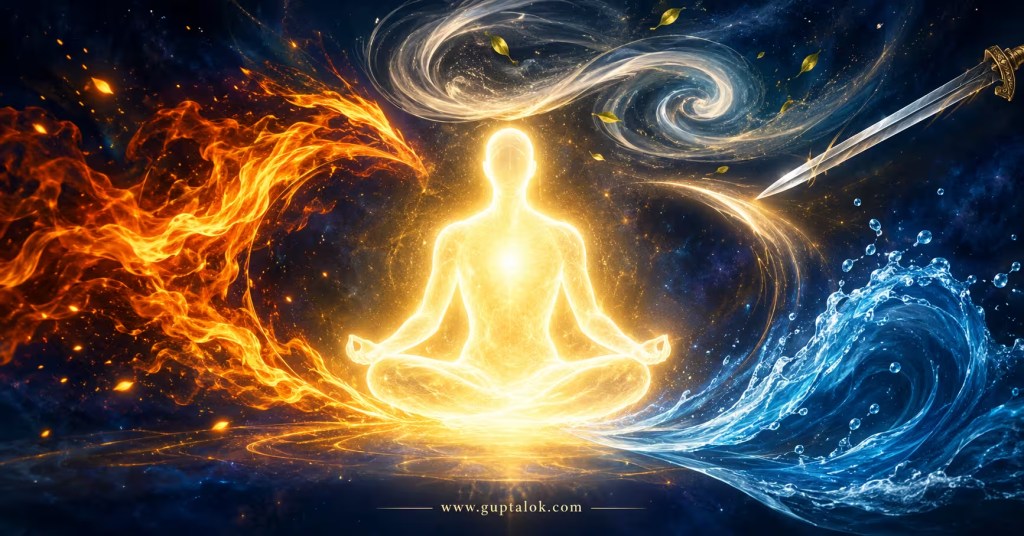
These elements (particles, atoms, molecules, etc.) that were earlier known as you become anything like water, fire, soil, air, etc. After that, they are known as them and consumed by plants, animals, and other humans, becoming them. Thus, they are always available in different forms in the same universe where you are. It means that you or your loved ones don’t lose their existence after an event that is often known as death, but they still exist in the form of something else. If you really love them, you should start loving everything that’s around you, including trees and plants, water and water bodies, earth and soil, air and environment, animals and humans, and many more such beings and things around you.
You should love and protect them similarly as you do your parents, children, and other loved ones, because they are different forms of the same elements (particles, atoms, molecules, etc.) that earlier existed as a form recognized as your loved ones. Also, remember that pure love doesn’t suggest expecting anything from the loving, therefore, don’t expect anything from these newer forms of your loved ones, just keep them protected.
You or Your Loved ones don’t die but just move to another body
Now let’s understand this Shlok of Bhagavad Gita in context with the most authentic form of us, the soul. So, when you understand or just accept the fact that the real self of you is the soul but not the body, you must start behaving like the soul but not the body. Now:
- You should not fear from the loss to your body because you are not the body.
- You should not fear from the loss of your prestige that’s related to your body-based identity because that’s not yours but your body’s.
- You should not attain arrogance of being bigger or better, because that bigger and better is about your body but not you (soul).
- You should not engage in any action or enjoyment that causes exploitation of another embodied being, because the real you, that is, your soul, may have to reside in the body of that species in the future. And it is foolish to plan to have your soul (the self) oppressed in the future.
Anyways, let’s move on to the topic, which is that you always exist even if your body doesn’t. It is very important to understand that our body keeps changing its form every moment of life. When you were born, you were small in size with softer body parts with a soul (the real you) within, that kept that body functioning. Later when you get a little older, many aspects in your body change especially size but the soul (the real you) within, is still the same. Afterwards, when you reach your youth, many other aspects change, like your breasts, beards, etc., depending on the female or male body types, the soul (the real you) still remains the same. Similarly, as you get older, your different body parts start to indicate malfunctioning, and many other aspects also change, but your soul (the real you) still remains the same.

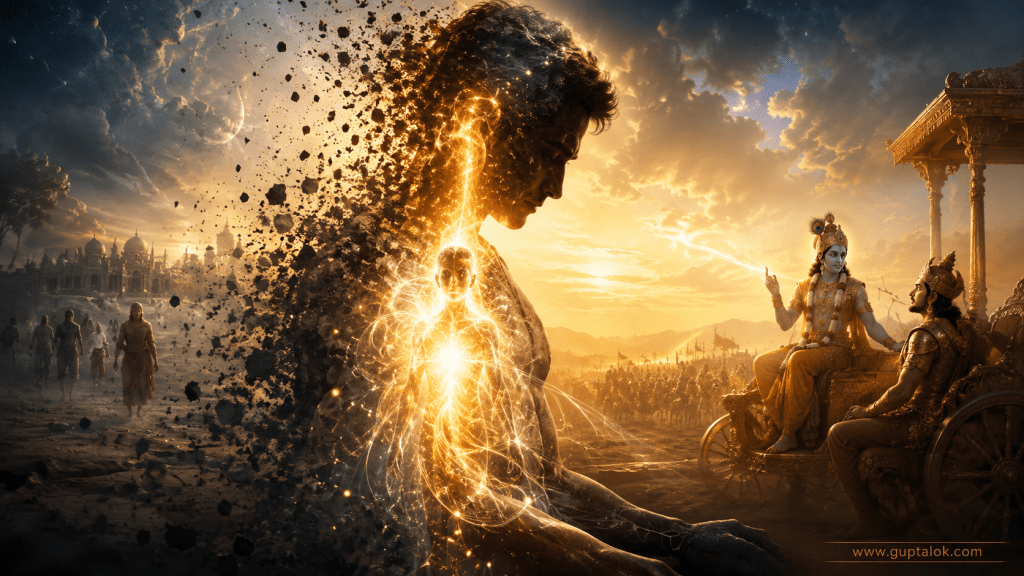
The body changes through every stage of life — but the soul within remains the same, carrying forward into a new form after death.And finally, when one or many important aspects of your body become inoperative, God, through its automated systems, forces your soul (the real you) to leave that body and wait until the next body is arranged. And later, you (the soul) are provided another body to display your existence in the material world. Thus, there never comes a time when you don’t exist, but it’s just that everyone can’t see and/or identify your existence.
Can We Recognize a Soul in Another Body?
Let’s now fill up the leap that occurred after the death event. There might arise a question that the changes in the human body before death and the soul’s transition to a new body after death are not the same. The argument could be that, even after many changes, the body still allows for recognition of the person. In contrast, when the soul gets an altogether new body, it doesn’t provide the opportunity to recognize which body the exited soul got into.
This point is logical, so let’s find out the answer to this question. The claim that you can recognize the person after multiple changes in the body is incomplete. Why? Because not everyone can recognize the young person whom he/she saw during the young person’s childhood or infancy. Only those two-types of people can recognize this person:
- Who are so close to him/her that they see all the body changes happening in front of them?
- Who are precise observers of faces, eyes, attitudes, and face-cuttings.
No one other than these two types of people can recognize you in a stage they haven’t seen you in before. Why? Because your face changes in every state, and they’re neither close enough to you to recognize your body language well enough, nor do they have the ability to observe, analyze, and recognize faces and other physical features.
Similarly, only those can recognise you after your soul’s (the real you) complete transition to a new body:
- Who are so close to your spiritual character that they can recognize your words and actions even when you do not physically perform them in front of them, but someone narrates them.
- Who are rich with spiritual understanding, which means they have the capability of understanding all the aspects of spirituality. (Those who are spiritual people, that is, those who know about themselves and the beginning of the world and on that basis they contemplate on all aspects of the world and perform all actions accordingly.)
As humans today are highly indulged in materialism, they neither focus on attaining spiritual understanding within nor on understanding spiritual characters of others. They just keep searching, re-searching, learning, understanding, studying, and working for material things, and spend their entire life in attaining, enjoying, and securing materialistic aspects.
They become so busy in materialism that they don’t get to understand even a single aspect of spirituality. That is why they can’t recognise their loved ones after their (souls of loved ones) transition to an altogether new body. If they train their brains everyday on spirituality, they’ll surely develop the capability to recognise souls. that too, without visualizing it as a body where the soul resided at any point of time. Thus, they would know where the soul, exited from an old body, go. And therefore, they shall not be sad on the death event of them or their loved ones.
Note: Studying the Bhagavad Gita thoroughly, without any expectations, is also an effective way to learn spirituality. Remember, having no expectations in your mind and heart about any person, thing, knowledge, situation, etc. is your first step towards spirituality.
Key Teachings of Bhagavad Gita Chapter 2 Verse 13
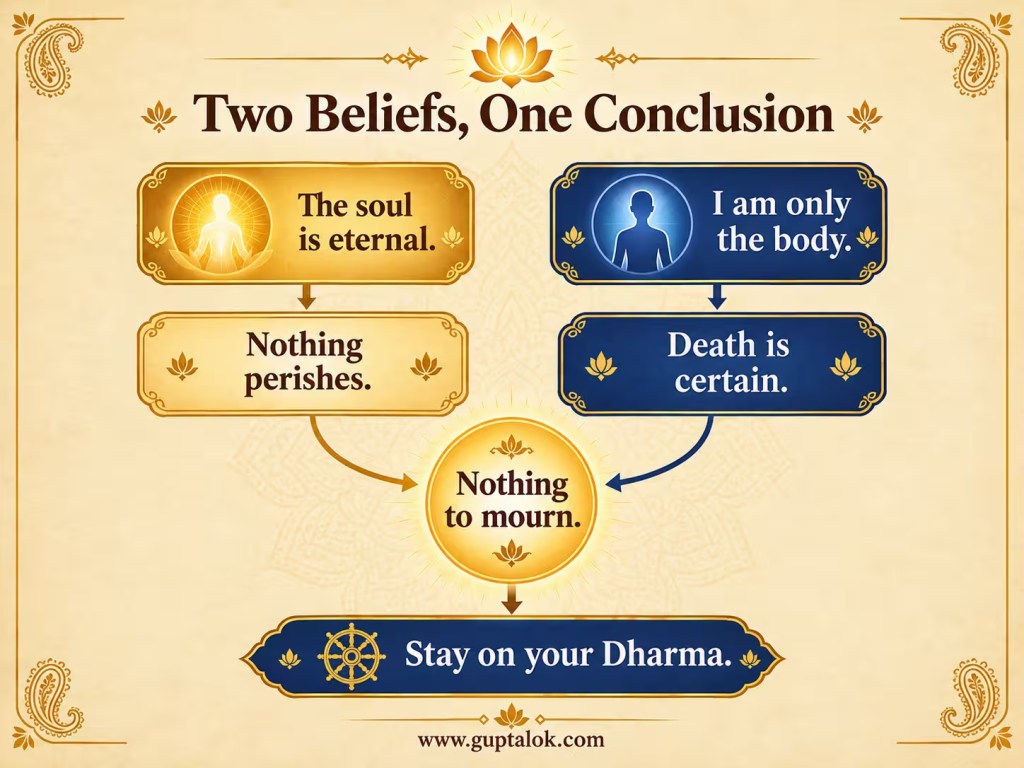
The central teaching of Bhagavad Gita Chapter 2 Verse 13 is that the soul never ceases to exist, while the body constantly changes. Through this truth, Krishna helps Arjuna understand that fear of death should never become a reason to abandon Dharma or neglect one’s righteous duty. Instead, people should recognise the eternal nature of the self and make decisions that promote the welfare of all.
The key teachings of this verse are:
- The soul is eternal, while the body is temporary. Just as the body naturally passes through childhood, youth, and old age, the soul continues its journey beyond the death of the body by attaining another one.
- Death is a transformation, not the end of existence. What appears to be death is only a change of bodily form; the real self remains unchanged.
- Fear of death should not prevent righteous action. Whether the fear concerns oneself or loved ones, it should never become a reason to commit wrongdoing or abandon one’s duty.
- Dharma protects the long-term welfare of everyone. Even when difficult decisions must be made to uphold Dharma, Krishna teaches that the true existence of all beings continues beyond the physical body.
- Adharma ultimately harms everyone. A society that tolerates exploitation or injustice eventually creates suffering for all, because every living being is subject to the same cycle of birth, death, and rebirth. Everyone will change the form someday, and if society gets habitual of exploiting one or the other being, everyone’s (including those whose protection led to sacrifice Dharm) turn to be exploited would surely come. Therefore, work and fight to eradicate the habit and habituals of exploiting women and other innocent beings, without having fear of death in mind. Thus, you’ll contribute to create an exploitation-free future for all, including those who are dead, who are still alive, who will be born in the future, and even those exploiters whom you had to kill to make the world free from exploiters.
- One should work for the welfare of all beings. By courageously opposing the exploitation of women and other innocent beings, people help create a more just and compassionate world for present and future generations.
Ultimately, Krishna’s message extends far beyond removing Arjuna’s fear of the battlefield. He teaches that understanding the eternal nature of the soul should inspire people to act with courage, wisdom, and compassion. When decisions are guided by Dharma rather than attachment or fear, they contribute to an exploitation-free future that benefits everyone—the living, those who have passed away, future generations, and even those who have lost their way through Adharma.
Conclusion
Shlok 13 of Chapter 2 leaves us with a simple but life-altering truth: nothing about us ever truly ends — it only changes form. Whether understood through the lens of matter, where our elements live on as soil, water, and air, or through the deeper truth of the soul, which simply moves from one body to the next, death is revealed to be a transition rather than an ending. What we grieve, in truth, is not loss itself but our own inability to recognize what has changed form in front of us.
This understanding is not meant to be a comforting abstraction — it is meant to change how we live. Once the fear of death loses its grip, it can no longer be used as an excuse to abandon what is right. Krishna’s teaching to Arjuna, and to us, is this: perform your duty, protect the exploited, and act with courage — not because death doesn’t matter, but because it was never the ending we feared it to be.
FAQs: Bhagavad Gita Chapter 2, Verse 13
1. What is the meaning of Bhagavad Gita Chapter 2 Verse 13?
This verse explains that just as the body passes through childhood, youth, and old age within a single lifetime, it eventually passes into death as well — and the soul within simply moves on to a new body. Krishna’s point is that death is not an ending but another transition, no different in principle from the changes the body has already gone through many times before. Those who are wise understand this and are not disturbed by it.
2. Does Bhagavad Gita say the soul never dies?
Yes. The verse builds on the idea, stated just before it, that the real self — the soul — can never die. The body changes and eventually becomes unusable, but the soul that inhabits it continues to exist. What we call death is the body’s end, not the self’s.
3. Why does Krishna compare childhood, youth and old age?
Krishna uses these familiar life stages because everyone has already lived through several of them without losing their sense of self. The body you had as a child looked nothing like the body you have now, yet you never stopped being “you.” Krishna extends this same logic one step further: if you survived those changes as the same self, death is simply one more change in the same pattern — not a fundamentally different event.
4. What happens after death according to Bhagavad Gita?
When the body becomes unable to serve the soul any longer, the soul leaves it and, in time, takes up residence in a new body. The self does not cease to exist in the gap between one body and the next — it simply isn’t visible in a form others can recognize yet.
5. Does Bhagavad Gita support reincarnation?
Yes, this verse is one of the foundational statements of reincarnation in the Gita. It describes the soul’s movement from one body to another as a natural continuation of the same process the body already undergoes within a single life — aging and change — just carried across the boundary of death into a new physical form.
6. Can people recognize souls after rebirth?
Yes, this is possible, but only for a specific kind of person: someone who is either very closely attuned to another’s spiritual character — able to sense their essence beyond physical appearance — or someone with deep spiritual understanding in general. Most people, being focused on material life, don’t develop this ability, which is why they experience the loss of a loved one as final rather than as a transition they simply can’t yet perceive.
7. What practical lesson does Bhagavad Gita 2.13 teach?
The lesson is that fear of death — one’s own or someone else’s — should never be a reason to abandon what is right. Since the real self survives every bodily change, including death, acting out of fear or grief over physical loss is based on a misunderstanding of what we actually are. Recognizing this frees a person to act with courage and integrity rather than being ruled by fear.








Leave a Reply