Bhagavad Gita Chapter 2 Shlok 12 contains one of Lord Krishna’s most profound teachings. In this verse, Krishna tells Arjuna that our true identity is not the physical body but the eternal soul (Atman). This timeless wisdom forms the foundation of many teachings in the Bhagavad Gita. When we understand that the soul is immortal and exists beyond birth and death, fear begins to fade, ego loses its hold, anger becomes easier to control, and attachment and greed gradually diminish. The verse offers not just spiritual insight but also practical guidance for living with greater peace, clarity, and contentment. Let us explore the meaning, central idea, and life lessons of Bhagavad Gita Chapter 2 Shlok 12.
Sanskrit Text
न त्वेवाहं जातु नासं न त्वं नेमे जनाधिपाः |
न चैव न भविष्याम: सर्वे वयमत: परम् ||
English Transliteration
Na Tvevaaham Jaatu Naasam Na Tvam Neme Janaadhipaa |
Na Chaiv Na Bhavishyaamah Sarve Vayamatah Param ||
English Translation
It is not that I did not exist at some point in time. Nor did you, nor did these kings. And it is not that any of us will cease to exist afterward.
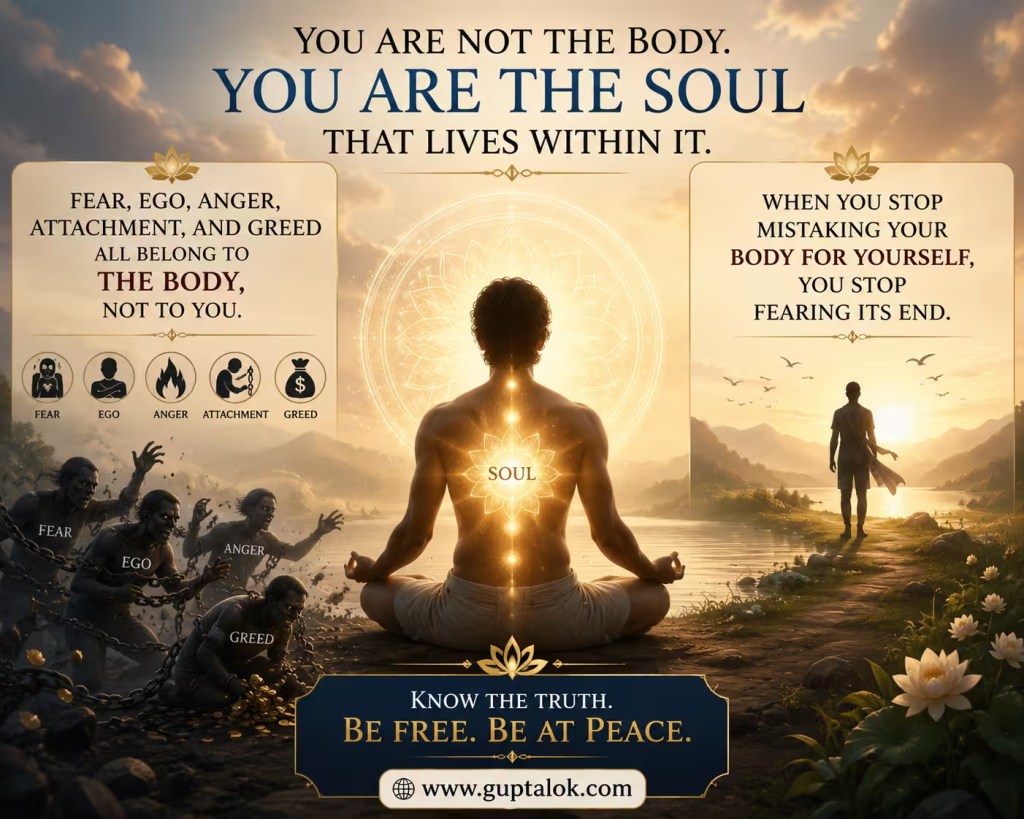
Bhagavad Gita Chapter 2 Shlok 12 teaching that the soul is eternal and beyond fear, ego, anger, attachment, and greedMeaning, Central Idea, and Life Lessons:
This shlok holds a deep meaning about the existence of all living beings. It helps people realize the truth of their real selves. And this realization helps them win over ego, fear, anger, greed, attachment, and many other internal pollutants.
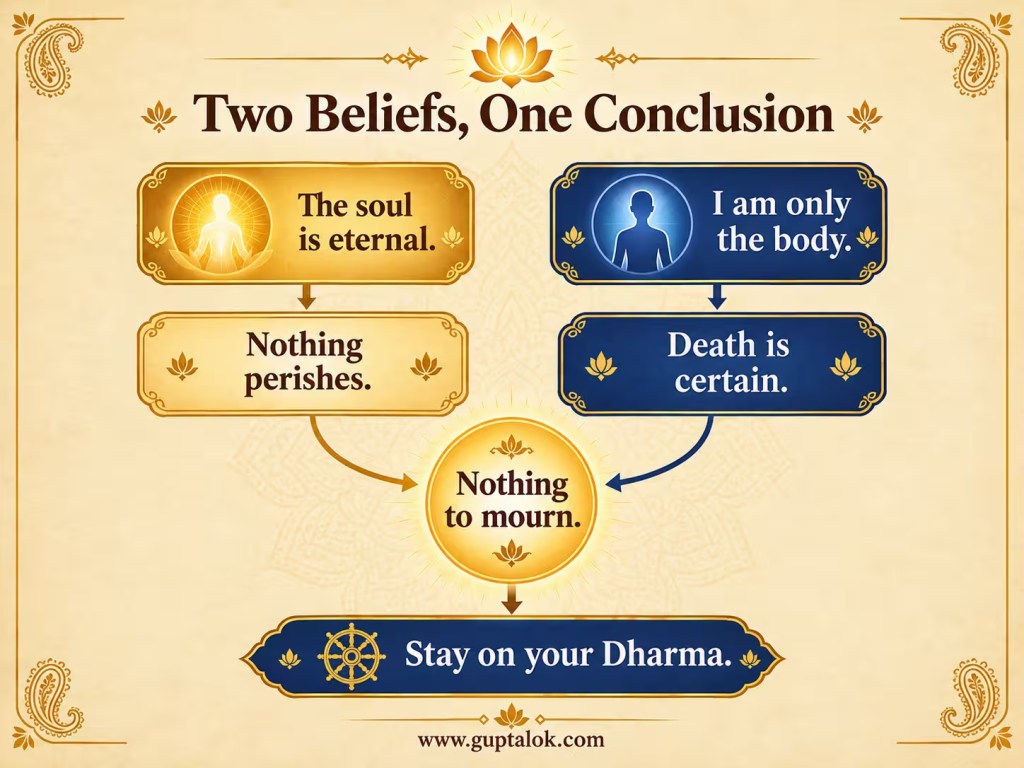
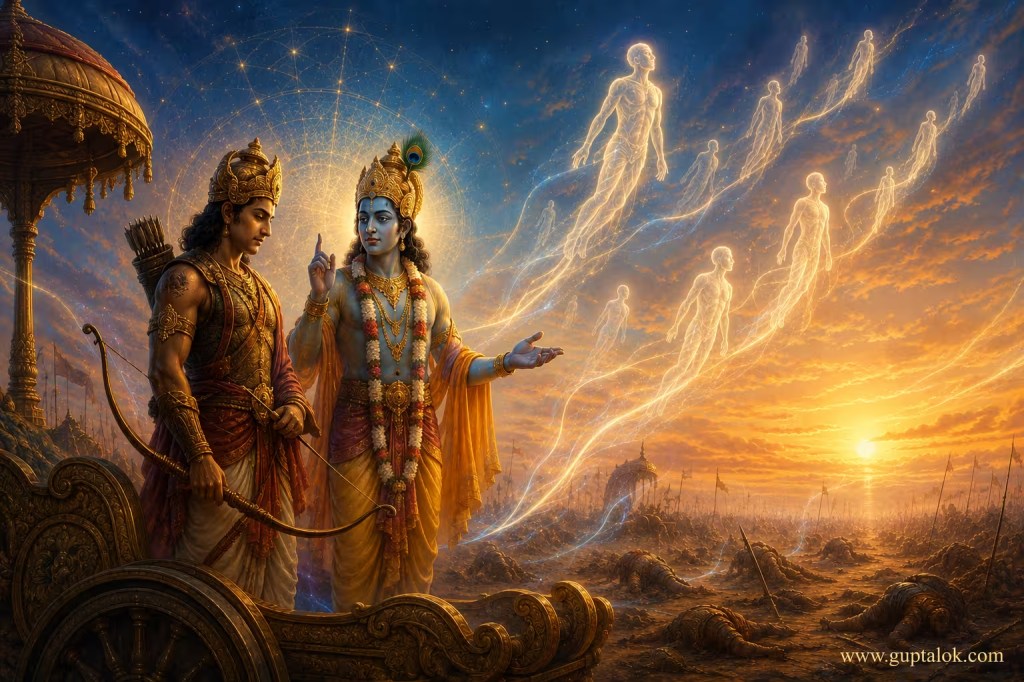
Through this shlok, Shree Krishna tells us that our bodies are not our real existence. Our souls, or internal energy, are. He further explains that this internal energy, which powers our bodies, cannot be destroyed. It always exists in one form or another, within his own creation (the universe, the group of universes, Srishti, and every other place that exists anywhere). Krishna, the supreme lord, gave this esoteric knowledge to Arjun, and to us, so that the fear of death (our own, or that of others) does not weaken us emotionally and stop us from doing Dharm (righteousness).
This realization does more than help us resist fear and other internal pollutants like ego, anger, greed, and attachment. It also fills humans with absolute pleasure and satisfaction. And once that is achieved, it grants salvation.
How does Bhagavad Gita Shlok 2.12 Help Defeat Fear?
In this shlok, Krishna gives humans clarity about their real self. He teaches that we are not just bodies, but souls residing in bodies.
Now, let’s understand fear. Why does it happen? Fear happens only because of the body, the temporary home of the soul, which most humans mistake for their real self. Humans feel fear when they think, hear, know, or sense that the body is about to be destroyed. Once they sense this coming harm or destruction, fear takes hold of them. They lose touch with their own strength, and forget their Dharma, their duty. Why does this happen? Because humans misunderstand themselves as bodies. They forget that they are souls residing within those bodies.
On the other hand, if they realize they are not bodies but souls within bodies, they would stop fearing oppressors, adharmis, terrorists, religious clerics, and other anti-human elements. They would understand that such forces can only harm their body, their temporary residence, not their true self. With this understanding, they could fight wrongdoers with full strength, becoming protectors of the innocent. In this way, they would fulfill their Dharma, their duty to protect and nurture all innocent living beings.
So when humans understand and accept that they are souls, not bodies, they stop fearing those who oppress them through threats of bodily harm or death. A powerful example of this is seen in women who endure sexual exploitation, often out of fear for their bodies or their body-based sense of dignity.
How Does Bhagavad Gita 2.12 Help Eradicate Ego?
Ego is the biggest problem that worsens human character. It is the root cause of all evils found in human nature. But why does ego arise? It comes from deep indulgence in our physical being. Ego dominates those who believe their real existence is the body they live in. And in today’s world, nearly everyone holds this belief. They may talk a lot about soul, spirituality, God, and the oneness of all humans with God. But they act and behave like those who consider themselves bodies, not souls.
Ego happens only when a person becomes possessive about physical, visible things, and grows highly attached to them. Once attached, that person tells their mind, “These are mine.” Slowly, this possessiveness grows so strong that they start telling their mind, “These are me.” As this possessiveness deepens, they begin feeding their mind a new thought, “I am the best.” From there, the next step is, “Because I am the best, no one should question me, no one should criticize me, no one should correct me. I am always right.” This is what ego is. And this is what leads people down the path of Adharma, of unrighteousness.
If we study and understand this shloka well, we come to see that we are not bodies, but souls. With this understanding, we stop forming attachments to bodies, to anything physical and visible, including the human body itself. This breaks our obsession with our physical being. And as that obsession fades, so do the pollutants born from it, anger, greed, excessive attachment, and more. Slowly, we become less egoistic, and gradually, we move toward becoming an egoless person.
How Does Bhagavad Gita 2.12 Help Overcome Anger?
The biggest reason for anger in most humans is ego. And ego comes from believing we are bodies, not souls. People get angry simply because their ego is hurt. They even say it out loud. I have heard people say, when angry, “My ego is hurt. I won’t leave him/her now. Do whatever you want, but don’t hurt my ego.” This shows that ego drives their anger. And ego itself is driven by the belief that we are bodies, not souls, as we discussed earlier.
There are other reasons too. Most humans get angry when their feelings are hurt or their thoughts are challenged. Many get angry when they lose something material, or when they feel insulted. No matter the reason, the root cause of anger is always something physical, visible, or material. These are all qualities of the body, because only the body is physical, visible, and material. As per physics, every physical object is a body. Every visible thing is a body. Every form of matter is a body. As per biology, and even basic logic, the only physical thing in humans is the body. It is visible. It is made of matter.
Now, if you reflect on this with a bit of spiritual understanding, you will see that humans get angry only because of one body or another.
- Every loss that makes us angry is the loss of some body.
- Every insult that makes us angry is based on the body.
- Every self-centric thought that gets challenged is based on the body.
- Every bit of ego we carry is based on the body.
- Every religion for which humanity is sacrificed is based on the body.
- Every kind of hate people show each other is based on the body.
The only difference is this: sometimes the body involved is the one called you, and sometimes it’s the one you think belongs to you.
If you understand the truth that you are not a body but a soul, you are far more likely to rise above anger. When you react from spiritual understanding instead of bodily impulse, anger has little room to take hold. If you realize that an insult lands on the body, not on you (the soul), there’s no reason to feel angry. If you realize that hurt feelings and challenged thoughts belong to the body, not to you (the soul), why would you get angry? And if you realize that the people or things you lost were loved by your body, not by you (the soul), there would be no anger left to feel.
How Does Bhagavad Gita 2.12 Help Reduce Attachment?
Humans are always attached to one or the other body because attachment is the subject of visibility and materialism. You cannot be attached with something/someone which cannot be seen by your eyes, touched or felt by your skin, heard by your ears, smelled by your nose, or tasted by your tongue. You cannot feel the pain of losing your son/daughter, your spouse, your parents, or any other relative, if you have never seen them or have seen them so long ago that you don’t have a clear memory of them. What does it mean? It means that attachment happens due to the body, and if you accept the fact that you and your loved ones are not the bodies but souls, you are least likely to be excessively attached to them. This would help you with many positive things, such as:
- You’ll not accept their bodily or physical unrighteous demands because all the demands are accepted only due to one or the other kind of attachment.
- You’ll also feel negligible pain when they leave the body that they used to communicate, connect, and behave with you.
There are millions of other benefits which you may learn about by self-contemplation, but for that, you first need to separate yourself from excessive attachments as they lead to biases.
How Does Bhagavad Gita 2.12 Help Rise Above Greed?
Like attachment, greed also arises for things related to the body, not the soul. You can’t be greedy for something that cannot be seen by your eyes, touched by your skin, heard by your ears, smelled by your nose, or tasted by your tongue. People get greedy for money and luxuries because these can be seen and felt and used to satisfy the body’s desires. No one gets greedy for knowledge and wisdom, because these don’t focus on material or bodily things. They offer internal satisfaction instead.
However, if you examine a person who seems greedy for knowledge, you’ll often find something else going on. He wants that knowledge in order to gain something material, something tied to the pleasure of the body. Why does this happen? Because greed can only exist for things that are material or bodily. It cannot exist for anything that brings satisfaction to the soul. And what satisfies the soul is a single realization: “I am not a body, but a soul.” The soul needs nothing material. So once you reach that understanding, greed has no place to grow. Yes, people might casually call this a “greed for knowledge,” but that’s not greed. That’s curiosity.
Remember this: your chances of becoming greedy rise sharply when you chase material and bodily things. And those chances fall when you pursue the satisfaction of the soul instead, because the soul only seeks knowledge, truth, God, and selflessness. None of these are material. None of them can make you greedy.
How Does Bhagavad Gita 2.12 Guide Us Toward a Righteous Life?
When you know that you are a soul, not a body, you gain a new kind of strength. You can stand against those who work against humanity and harm other living beings, without being driven by anger or sadness. This is because oppressors can no longer control you through your bodily feelings and emotions. They cannot use those feelings to keep you on their side, or to keep you inactive and silent.
Conclusion
Shlok 2.12 offers more than ancient wisdom. It offers a way to live. Once we understand that we are souls, not bodies, fear loses its grip. Ego has nothing left to feed on. Anger fades, because the insult was never ours to carry. Attachment softens, and greed finds no ground to grow in. This single realization touches every part of how we think, react, and relate to the world.
But this knowledge is not meant to make us passive or detached from life. Krishna gave it to Arjun so he could act with courage, not in spite of his fears, but because he had moved beyond them. The same applies to us. When we stop mistaking the body for the self, we gain the strength to stand for what is right, to protect the innocent, and to live with purpose instead of fear.
This is the true gift of Shlok 2.12. It does not ask us to give up the world. It asks us to see it clearly, and to live in it with a steady heart.














Leave a Reply