Dharma is one of the most misunderstood concepts in the modern world. It is often equated with religion, sect, or tradition, but its actual meaning goes far beyond rules, rituals, and beliefs. Dharma has many aspects, and the major ones are listed below.
- Duty.
- Righteousness.
- Property or Characteristic.
We can’t walk on the dharma-path unless we understand the correct meaning of each of them and put the correct logic in our decision-making. Let’s understand these three aspects of Dharma one by one.
Duty aspect of Dharma
Almost everyone understands what duty means, but they don’t know which duty is the priority. Dharma means duty too, but it means one’s prior duty as a Human, not any random one. There are three types of duty as listed below.
- Temporary Duty.
- Semi-Permanent Duty.
- Permanent or Absolute Duty.
Temporary Duty
Temporary duty is your duty for a short span of time, such as hours, days, months, or years. It may be your duty as an employee, your duty as a watchman, or any other such tasks you are accountable for. It could be the duty of a teacher, a politician, a soldier, a social worker, a society chief, etc. These are temporary duties because they hold you responsible only until you hold that position. The moment you are relieved from that position, you are not responsible for the tasks of that position.
Semi-Permanent Duty
Semi-Permanent Duty is your duty for probably a lifetime. It includes your duty towards a relationship, towards your varna, your clan-based duty, and towards any identity that defines you. Digging more will suggest the following.
- Your duty towards your parents, family, children, and other family members is your semi-permanent duty.
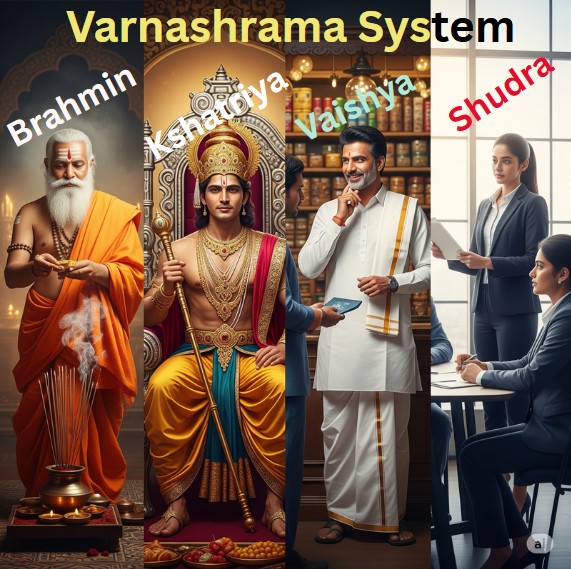
- Your duty as a hermit, Brahman, Kshatriya, Vaishya, Shudra, etc., is also your semi-permanent duty.
- Your duty as a great donor, as a kind being, as a peaceful person, and any other such character-based identity is also your semi-permanent duty.
These are a few examples to understand what kind of duties fall into the semi-permanent category.
Permanent or Absolute Duty
Permanent or absolute duty is your duty as a human or as the son/daughter of God. It includes your duty, which you must perform as a human being. It includes your duty to protect those who are smaller or weaker than you. It includes your duty to seek the welfare of all living beings. It also includes your duty to make the earth a great place to live for all living beings. These and many other such duties, which don’t need you to hold any position or any identity, are examples of Permanent or absolute duty.
Which duty is the priority to follow dharma?
Based on the aforementioned description, it becomes clear that humans should prioritize their permanent duty to be on the dharma path. However, you should follow your semi-permanent and temporary duties too. The only thing you need to ensure is that you don’t overlook your permanent duty while performing semi-permanent duty. Similarly, you should not overlook your semi-permanent and permanent duties while performing your temporary duty. In all the cases, keep in mind that your temporary duty is the least important and your permanent duty is the most important. Let’s understand it with an example.
Suppose you are employed in a food processing company, and you are responsible for bringing in the raw material. This is your temporary duty. Now, suppose your family needs you, as you are accountable for their well-being – it is your semi-permanent duty. In this case, if your duty in the company stops you from fulfilling your duty towards your family, you should skip the former. Why? Since your family is your semi-permanent duty, and the company is your temporary duty, semi-permanent has priority over temporary.
Another case could be one of the following:
- Your company wants to start non-veg food-processing and employs you to bring in animals to be killed.
- Your son rapes a woman, and wants you to protect him and fight against the Victim.
In case 1, your temporary duty forces you to go against your duty as a human, which is your permanent duty. (Protecting all living beings is our duty as humans.) In this case, your priority should be to protect innocent animals by not killing them, as that is your permanent duty.
In case 2, your semi-permanent duty as a father wants you to go against your duty as a human – your permanent duty. (Raping a woman is violating the duty of humans, and protecting a rapist is the same thing.) In this case, your priority should be to fight against your son because protecting and supporting the rape victim is your permanent duty. Ensuring punishment for the rapist is also a human’s permanent duty. To perform this, you can sacrifice your semi-permanent duty as a father if you have to.
Let’s now talk about the second aspect of Dharma – the Righteousness.
Righteousness aspect of Dharma
Righteousness is the essence of truth, morality, justice, and the universal good. It means examining all the aspects of the situation and doing only what is right in all conditions. The aforementioned example of an employee at a food-processing company is an example of righteousness. He did not stick to his duty as an employee or father, but looked at his duty towards innocent animals and the woman, too. That’s how you take care of your universal responsibility – by having a multidimensional approach and performing what is absolutely right.
So, the essence of righteousness is not to limit yourself to any religion, breed, caste, family, etc., but to keep your mind open to think for the universal well-being, and then perform the action accordingly.
Property or characteristic aspect of Dharma
The property of anything is the character of its original being, and that is known as the Dharma of that being/thing. A few examples of this are as follows:
- The dharma of uranium is to be radioactive.
- The dharma of a female body is to produce the next generation.
- The dharma of a male body is to provide seed to the woman to produce the next generation.
- The dharma of water is to quench the thirst of living beings.
- The dharma of earth is to attract everything towards its centre.
These are a few examples of property or characteristic aspects of dharma, and they don’t need things and beings to put any effort into them. This aspect of dharma happens by itself; you cannot change the dharma of a body/thing unless you pollute it by one of the other means.
Which dharma should we follow as humans?
You don’t need to do anything to perform the property aspect of dharma, as this doesn’t need your decision-making. You only need to focus on the duty and righteousness aspect of dharma wisely, so that you can take the decision for universal welfare without being biased towards anything or anyone.
Performing Dharma is not about following quotes or rules blindly. Instead, it demands inner honesty, situational awareness, and deep wisdom. To truly follow Dharma:
- You must analyse the situation with neutrality.
- Speak to your inner self with honesty, not with bias or ego.
- Eliminate selfishness, personal benefit, emotional attachment, or prejudice toward any person or outcome.
- No work should be done motivated by emotional attachment or prejudice towards any person. Also, in the outcome of that work, one should keep in mind the welfare of everyone (humans and animals) rather than just seeking personal gain or selfishness.
- You should not do anything out of fear, greed, or partiality towards relationships, or by placing blind faith in written words or books.
Keeping these things in mind, you should establish clarity in your thoughts, give priority to your permanent duty, and act by taking universally just decisions. That’s how you can walk on the path of dharma.
Dharma means neither religion nor Madhab.
One of the most important clarifications we must make is this:
- Dharma is not religion.
- Dharma is not madhab.
Religion is often associated with a set of prescribed rules, beliefs, or community-based rituals. Dharma, on the other hand, has nothing to do with religious leaders or clerics, religious structure, or external practices. Dharma is not a rulebook but a living principle — something that must be realized through wisdom, truthfulness, and conscience.
Only when you make decisions with pure intent, fairness, and selflessness are you performing Dharma. No fixed set of rules can define what is right in every situation. The physical world is very complex, and identifying Dharma here requires contextual understanding. What might be right in one circumstance could be wrong in another. Thus, Dharma cannot be codified — it must be realized.
You must pause, think deeply, be truthful, and then act. This is how real righteousness works. Dharma is the Foundation of Truth and Divinity. In a world full of divisions based on religion, caste, politics, and belief systems, we must return to Dharma — the path of righteousness. It is not something that relates you to some religious or communal identity but rather it is something that identifies you as a human being and as intelligent.
If your actions, your beliefs, or the names whom you think are Gods are disconnected from universal righteousness (being fair to all humans and creatures), then they are disconnected from truth itself. Let Dharma be your compass, not religion, not rulebooks, not traditions. Seek the truth honestly, recognize the Dharma, and act accordingly – that is where the real God resides.
There is a lot to share about Dharma, and the Pages listed below might help illuminate Dharma within you. So, stay tuned!
-
Futile to Mourn the Immortal, Worse to Mourn the Mortal – Bhagavad Gita, Chapter 2, Shlok 26-30
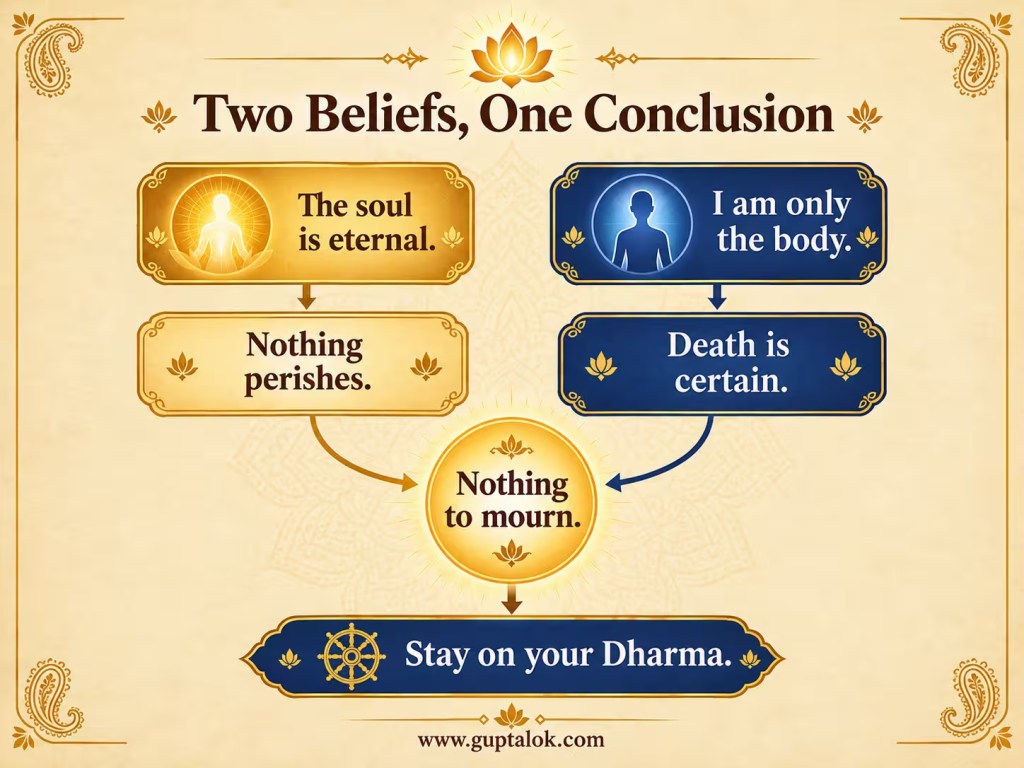
Whether you believe the soul is eternal or that we are only bodies, Krishna’s reasoning in Bhagavad Gita Chapter 2, Shlokas 26 to 30 leads to the same conclusion: there is nothing to mourn. Explore the verses, translation, and meaning.
-
Attributes of the Soul – Bhagavad Gita, Chapter 2, Shlok 22 to 25
The soul never dies — so why does it leave the body, even a child’s? Krishna’s answer in the Bhagavad Gita will change how you think about death and grief forever.
-
Why Should We Know that the Soul is Immortal? – Bhagavad Gita, Chapter 2, Shlok 19 to 21
Krishna’s teaching to Arjuna reveals a profound truth: the soul can never be killed, for it was never born, never dies, and remains eternal beyond the body’s destruction. But if the soul is indestructible, why must Arjuna still fight? This exploration unpacks the deeper logic behind righteous action against non-righteousness — showing that killing a…
-
Understanding Sat, Asat, Maya, and Tatva-Darshi – Bhagavad Gita, Chapter 2, Shlok 16 to 18
Explore Bhagavad Gita Shlokas 2.16, 2.17 and 2.18: Maya and Satya, the nature of Sat and Asat, Tatvadarshis, and why the soul is eternal while the body perishes.
-
Bhagavad Gita Chapter 2 Shlok 14 and 15: The Secret to Righteous Decision-Making
Bhagavad Gita Chapter 2, Shlokas 14 and 15 teach that happiness, sorrow, fear, and other sense-based feelings are temporary. Shri Krishna explains that by tolerating these emotions instead of acting on them impulsively, we can make righteous decisions, uphold humanity, and move towards salvation.
-
Bhagavad Gita Chapter 2 Verse 13 Meaning Explained: Soul, Death, Rebirth and Real Self
What does Bhagavad Gita say about death and the soul? A deep dive into verse 2.13 — reincarnation, the body’s stages, and why the soul never dies.
-
Bhagavad Gita Chapter 2 Shlok 12: Defeat Fear, Ego & Anger
Discover the meaning of Bhagavad Gita Chapter 2 Shlok 12 and learn how Lord Krishna’s teaching on the eternal soul helps overcome fear, ego, anger, attachment, and greed.
-
Bhagavad Gita Chapter 2 Shlok 11 Explained: Sankhya Yoga, Wise Thinking, and Who Truly Deserves Your Grief
Most people mourn the dead. Wise people do not — and Krishna explains exactly why. Bhagavad Gita Chapter 2 Shlok 11 reveals the truth about the immortal soul, the real meaning of Dharm, and why emotional thinking in the name of righteousness is one of the most dangerous traps a human being can fall into.
-
Bhagavad Gita Chapter 2 Verses 7 to 10 Explained: Arjuna’s Confusion and Silence
Explore the meaning of Bhagavad Gita Chapter 2 Verses 7 to 10. Learn how Arjuna’s feelings overpowered his reason, what true surrender to God means, and how Krishna’s Sankhyayog can free us from the slavery of emotions.
-
Bhagavad Gita Chapter 2 Verse 6 Explained: Arjuna’s Confusion, Param Dharma, and Multidimensional Thinking
Explore the meaning of Bhagavad Gita Chapter 2 Verse 6. Learn why Arjuna was confused about Absolute Dharma, how Krishna guided him through multidimensional thinking, and what Param Dharma means for human beings today.
-
Bhagavad Gita 2.5 Simplified: Understanding the Meaning of Blood-Tainted Wealth and Luxuries
Explore Bhagavad Gita 2.5: Arjun’s dilemma, true Dharma, and the meaning of ‘blood-tainted’ luxuries with real-life examples and moral insights.
-
What Bhagavad Gita 2.4 Teaches About Morality, Ethics, and Fighting Religious Extremism?
Bhagavad Gita Chapter 2 Shloka 4 raises a profound ethical dilemma faced by Arjuna on the battlefield. This article explains the meaning of the verse, clarifies the difference between morals and ethics, and explores why the teachings of the Gita encourage standing firmly against injustice, religious extremism, and terrorism while upholding Dharma.
-
How Bhagavad Gita Shlok 3 of Chapter 2 guides inner courage? What is Purush, Purushatva, and Prakriti according to Geeta?
Explore the meaning of Bhagavad Gita 2.3 with insights on Purush, Purushatva, the Soul, Dharma and Adharma, and Krishna’s call to awaken true inner strength.
-
Understand Love, Attachment, Dharma, Heaven, True Nobility & Real Fame – Geeta, Shlok 2.1 and 2.2
Discover the real message of Bhagavad Gita Shlok 2.2. Why love is uplifting, attachment is binding, Dharma defines true nobility, heaven is for the righteous, and real fame comes from good deeds.
-
True Meaning of Hell, Non-Violence, Self-Defense, and Righteous War: Geeta, Chapter 1, Shlok 44 to 47
This article explores Bhagavad Gita Chapter 1 through Arjun’s moral conflict—examining clan-based Dharma, karma, self-defense, false non-violence, and attachment. It reveals how ignoring righteous duty leads to inner suffering, social chaos, and spiritual downfall.
-
Reasons and impacts of Varna-Sankar: Geeta, Chapter 1, Shlok 42 and 43
Learn the meaning of the Verses 42 and 43 of Bhagwadgeeta, Chapter 1. Also learn who are responsible for Varna-Sankar in any family? What acts of Arjun could made him the reason of Varna Sankar? What is declination of Ancestors? What is caste-based Dharm? What are family-based Dharm?
-
Decline of Clans, Varn-Sankar, and Varna System: Geeta, Chapter 1, Shlok 39, 40, and 41
Learn the meaning of the Verses 30, 40, and 41of Bhagwadgeeta, Chapter 1. Also learn How does VarnaSankar happen? Which of your kinsmen are the real ones? What does decline of Great Clans mean? Who can’t be the part of any Varnashrama? What is essential for any Varna?
-
Duty as Human is Beyond all Other Duties: Geeta, Chapter 1, Shlok 30 to 38
Learn the meaning of the Verse 30 to 38 of Bhagwadgeeta, Chapter 2. Also learn how to prioritize your Dharm (duty) for family, loved ones, or other relations. There are plenty of Dharmas in life, which one should be prioritize? Should we protect our family and loved ones in all the cases.
-
Hrishikesh, Gudakesh, and Kuru-Warriors: Geeta, Chapter 1, Shlok 21 to 29
Learn the meaning of the Verse 21 to 29 of Bhagwadgeeta, Chapter 2. Also learn why Arjun is referred to as Gudakesh and Krishna as Hrishikesh.
-
The Bugle of War – Geeta, Chapter 1, Shlok 12 to 20
Understand the meaning of Kapidhwaj that symbolized presence of Dharma and God on Arjun’s side while blowing of conch shells at Kurukshetra echoed across the field.
-
Key Warriors of Mahabharat: Geeta, Chapter 1, Shlok 3 to 11
Learn about Duryodhana’s strategic briefing to Dronacharya on warriors, army strengths, and morale in Bhagavad Gita Chapter 1, Shlok 3-11, before the battle begins.
-
Understanding Dhritrashtra’s Choices – Geeta, Chapter -1, Shlok 1 to 2.
Answers to the questions like, Was Dhritrashtra right or wrong? Did he know Dharm? Why did he think that he was right? Why did Sanjay refer to Duryodhan as King?
-
What is Bhagvad Geeta? How to Learn its Real Meaning?
Introduction of Bhagvad Geeta. What is the right way to read it? How to understand its real meaning? List of Shloks with their real meaning.
-
What Takes You Off the Path of Dharm (Righteousness)
Discover the inner and outer forces that lead you away from the path of Dharm (righteousness). This insightful article explores how ego, desire, fear, and attachment can cloud judgment and disconnect you from your true self.
-
Understanding the Roots of Hatred – Q&A
This page answers the questions on hatred among people. You can share your views here and also you can ask new questions.
-
Caste System vs Varnashram: The Truth Behind Identity and Dharm
The caste system misrepresents identity through birth-based classification, while the ancient Varnashram system defines a person by their intellect, capabilities, and dharmic actions. Discover the real difference and its spiritual and societal implications.
-
What is Adharm or Sin?
Adharm is doing everything that is against righteousness and universal principles. This pages lists the Adharm-ness happening or ever-happened globally.
-
What are Dharm Granth?
This page provides the information on Dharm Granth. Many people think that a Dharm Granth are same as religious books which is not true.
-
Relation between Hindus and the Dharm.
Dharm has no relation with any community, including Islam and Christianity, except the Hindu community. All other religions are governed by a rule-book.












Leave a Reply