The Bhagavad Gita begins not with a battle cry, but with a question. As the armies of the Kauravas and Pandavas stand ready to clash on the field of Kurukshetra, it is the blind king Dhritrashtra who speaks first — anxious, uncertain, and eager to know what his sons and his brother’s sons are doing on that fateful battlefield. This opening exchange between Dhritrashtra and his advisor Sanjay sets the stage for one of the most profound philosophical dialogues in human history, one that will unfold between Lord Krishna and Arjuna in the chapters to come.
But before Krishna speaks a single word of wisdom, these first two verses quietly introduce us to deeper themes that run throughout the entire Gita: the difference between knowing one’s duty and understanding true righteousness, the danger of self-serving interpretations of Dharma, and the way our attachments can cloud our judgment about what is right. Dhritrashtra’s blindness is not merely physical — it mirrors a deeper blindness of perception, one shaped by love for his sons and a lifetime of misguided counsel. Meanwhile, Sanjay, blessed with divine sight by Ved Vyas, becomes our narrator, the eyes through which this timeless story is told.
In this piece, we explore the meaning behind these opening verses, unpacking not just what was said, but why it matters — and what it reveals about human nature that remains true even today.
Bhagavad Gita Chapter 1 Shlok 1 and 2
Let’s start this journey of Bhagavad Gita with the first and second shlokas of Chapter 1 in Sanskrit, along with their English transliteration and translation.
Sanskrit Text
धृतराष्ट्र उवाच ।
धर्मक्षेत्रे कुरुक्षेत्रे समवेता युयुत्सवः ।
मामकाः पाण्डवाश्चैव किमकुर्वत सञ्जय ॥1॥
सञ्जय उवाच ।
दृष्ट्वा तु पाण्डवानीकं व्यूढं दुर्योधनस्तदा ।
आचार्यमुपसङ्गम्य राजा वचनमब्रवीत् ।। 2।।
English Transliteration
Dhritraashtra Uvach,
Dharmkshetre Kurukshetre Samveta Yuyutsavah |
Mamkaah Pandavashchaiv Kimkurvat Sanjaya ||1||
Sanjay Uvach,
Drishtwa Tu Pandavaneekam Vyoodham Duryodhanastada |
Acharyamapasangamya Raja Vachanamabraveet ||2||
English Translation:
Dhritrashtra Said – Hey Sanjay, what are mine and Pandu’s children, who have gathered in the battlefield – the place of Dharm – with the will of war, doing? ||1|| Sanjay Said – After seeing the strategically placed army of Pandavas, King Duryodhan went to Acharya (Dronacharya) and said these statements. ||2||
Meaning, Central Idea, and Life Lessons:
Dhritrashtra is the blind king of the Hastinapur kingdom and father of the Kauravas (Duryodhan, Dushasan, etc.). Sanjay is Dhritrashtra’s advisor, who has been awarded the science of seeing the battlefield from the palace itself by one of the greatest sages, Ved Vyas.
Why Is Kurukshetra Called Dharmakshetra?
In this Shlok (Verse), Dhritrashtra asks Sanjay about what is happening in the battlefield. He asks what his and Pandu’s sons were doing at that moment.
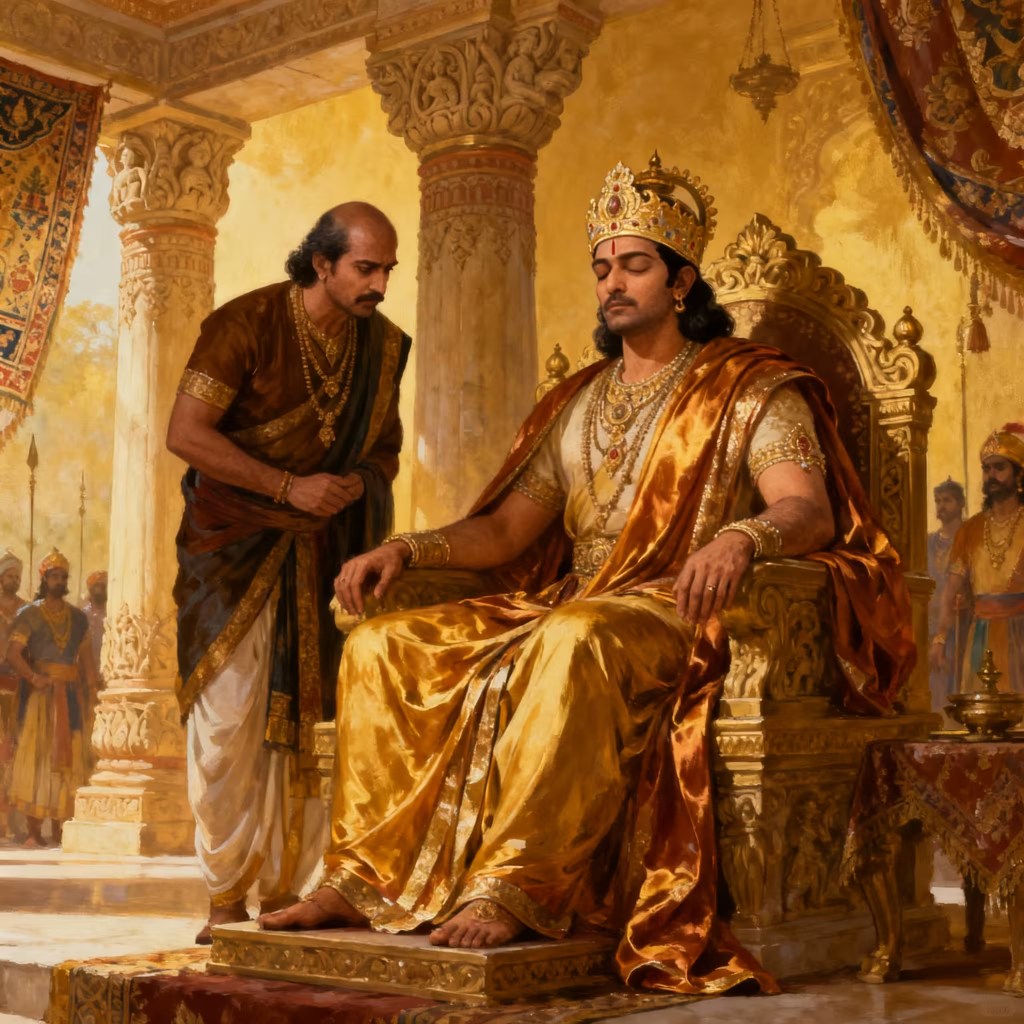
Depiction of Dhritrashtra conversating to SanjayIn his question, he mentioned the battlefield as the field of Dharm. He said that because he considered himself as Kshatriya and a Kshatriya goes to the battlefield to establish Dharm by eradicating Adharm and Adharmis. Now, you may ask the following question.
When Dhritrashtra knew Dharm, why did he support Duryodhana?
Actually, he was well informed about duty aspect of Dharm – Responsibility of a Kshatriya – but misinformed about the meaning of Righteousness aspect of Dharm. If he would have had the complete understanding of Dharm, he would know that:
- Misbehaving with a woman is an extreme level of Adharm (Sin).
- Awarding the throne of a kingdom to an Adharmi (Sinner) is an Adharm (Sin).
If he would know these basic concepts of Dharma, he would not have stood with his sons. On the contrary, he would have stood with the sons of Pandavas who were fighting with those:
- Who tried to strip off a woman publicly.
- Who considered the throne of the kingdom as their right but not their responsibility.
- Who were not the righteous people to rule over the people of the kingdom.
Common Misconceptions That Misled Dhritarashtra
Let’s have a look at the perspective of Dhritarashtra. Why was he so convinced that he and Kauravas were on the side of Dharm? It was because:
- His misconception was that the throne of the kingdom was his right, but because he was blind, he was not initially given that right of him. However, the truth is that the kingdom is not a right, but a responsibility, and therefore should only be given to the capable one.
- He also thought that his son (Duryodhan) was not offered to be the king for being his (Dhritrashtra’s) son. While the truth is that Duryodhana was not worthy of becoming a king.
- He also thought that Yudhishthir (A Pandav) was being offered the kingdom just because he was the son of Pandu. While the truth was that Yudhishthira had a greater knowledge of Dharm than Duryodhana, so he was being made king.
He may have thought this way, perhaps, because he was taught to think that way by the people around him. Another possibility is that no one took the time to provide him with a proper understanding of Dharma (righteousness), and so he came to consider Dharma as whatever acts he found fruitful or favorable for himself. Even today, people think this way — they are more focused on doing things that satisfy their material desires, and they rarely care about what is universally right. However, if people closely study and understand Shri Krishna’s Gita, they can come to understand what is right and what is not.
In the next verse, Sanjay refers to Duryodhana as King because Kauravas were fighting this battle to ensure the position of King for Duryodhana. It was also because Duryodhana was leading the battle from the King’s (Dhritrashtra’s) side.
Sanjay informs Dhritrashtra that Duryodhana looks or analyses the strategic placement of Pandavas’ Army and then goes to Dronacharya, who was chief of Karuva’s army, and says,
What he said to his Army chief would be explained in the following Shloks (verses).
Key Teachings
- Dharma has two dimensions — responsibility (duty) and righteousness (universal correctness). One can understand duty while completely misunderstanding what is actually right.
- A kingdom (or any position of power) is a responsibility, not a right. It should be given to the most capable person, not claimed on the basis of birth or entitlement.
- Attachment distorts perception of right and wrong. Dhritrashtra’s love for his sons made him see Adharma as Dharma — a reminder that personal bias can corrupt our sense of justice.
- Supporting a wrongdoer out of loyalty or family ties is itself Adharma. Standing by someone simply because they are “yours” — rather than because they are righteous — is a failure on the path of dharma.
- Mistreating or disrespecting a woman is a grave sin (Adharma), and those who commit or support such acts forfeit their standing in the world of dharma.
- True capability and character matter more than birthright when it comes to leadership — Yudhishthira was favoured not because of favouritism, but because of his superior understanding of Dharma.
- Flawed upbringing and lack of guidance can shape a person’s entire worldview. Dhritrashtra’s misunderstanding of righteousness may have stemmed from poor counsel throughout his life — highlighting the importance of receiving the right teachings early on.
- People often define “right” as whatever benefits them personally, rather than what is universally just — a tendency the Gita challenges readers to rise above.
- Sanjay’s divine vision symbolizes clarity and objectivity — a contrast to Dhritrashtra’s literal and figurative blindness — suggesting that true insight requires rising above self-interest.
- Studying the Bhagavad Gita closely can help cultivate genuine wisdom, enabling a person to distinguish between what merely feels right and what truly is right.
Conclusion
These first two Shlokas may seem like a simple scene-setting introduction, but they carry the seeds of everything the Bhagavad Gita will go on to teach. Dhritrashtra’s confused understanding of Dharma — mistaking personal attachment and self-interest for righteousness — is a mirror held up to all of us. How often do we, too, convince ourselves that what benefits us or the people we love must also be the right thing? Dhritrashtra’s tragedy is that he had access to the truth but chose, consciously or unconsciously, to see only what he wanted to see.
As Sanjay begins his narration and Duryodhan surveys the Pandava army before approaching Dronacharya, we are reminded that the Gita is not just a story of war — it is a story about perception, duty, and the choices that define who we are. Understanding these opening verses lays the groundwork for the wisdom Krishna will soon impart to Arjuna, wisdom that speaks not only to a warrior on an ancient battlefield, but to anyone striving to distinguish between what merely feels right and what truly is right. As we move deeper into the verses ahead, this distinction will only grow more important — and more illuminating.
Frequently Asked Questions (FAQs)
Q: What is the meaning of Dharmakshetra in Bhagavad Gita?
A: Dharmakshetra means “the field of Dharma.” In the article, Dhritrashtra refers to the battlefield of Kurukshetra by this name because he saw it as a place where righteousness would be established through battle. For a Kshatriya, going to war was a way to eradicate Adharma (unrighteousness) and uphold Dharma.
Q: Why was Dhritarashtra blind?
A: These verses don’t specify the cause of Dhritrashtra’s physical blindness. However, it draws attention to a deeper, symbolic blindness — his inability to clearly perceive true Dharma, which was shaped by attachment to his sons and by the poor guidance he received throughout his life.
Q: Why did Dhritarashtra support Duryodhana?
A: Dhritrashtra supported Duryodhana because he was misinformed about the true meaning of Dharma. While he understood his rule-based responsibility as a Kshatriya, he failed to grasp that awarding the throne to an unrighteous person, or standing by someone who mistreated a woman, was itself a sin. His attachment to his son clouded his judgment of right and wrong.
Q: Why did Sanjay call Duryodhana king?
A: Sanjay referred to Duryodhana as “king” because the Kauravas were fighting the battle specifically to secure and protect his position as king. Additionally, Duryodhana was leading the army on behalf of his father, King Dhritrashtra, which further justified the title in that context.
Q: What is the lesson of Bhagavad Gita Chapter 1 Shlok 1?
A: The first Shlok teaches that understanding one’s duty (Dharma) is not the same as understanding true righteousness (also Dharma). Dhritrashtra knew his socially talked responsibility as a Kshatriya but misunderstood what righteousness actually meant, leading him to support his sons despite their wrongdoing. This verse reminds us that attachment and self-interest can distort our sense of what is truly right.
Q: What is the lesson of Bhagavad Gita Chapter 1 Shlok 2?
A: The second Shlok introduces the idea of strategic assessment and action — Duryodhana surveys the Pandava army’s formation before seeking guidance from Dronacharya.
Q: Why did Duryodhana approach Dronacharya first?
A: Duryodhana went to Dronacharya because he was the chief of the Kaurava army. As the army’s leader, Dronacharya would need to be informed of the situation and consulted on the strategy going forward.
Q: What is the spiritual meaning of Kurukshetra?
A: While these verses primarily refer to Kurukshetra as the physical battlefield, it also frames it as “Dharmakshetra” — the field of righteousness. Spiritually, this suggests that Kurukshetra represents more than a literal battleground; it symbolizes the larger struggle between Dharma and Adharma that plays out both externally and within a person’s own understanding of right and wrong.
Q: Why does Dhritarashtra say “my sons” and “Pandu’s sons”?
A: Dhritrashtra distinguishes between “my sons” (the Kauravas) and “Pandu’s sons” (the Pandavas) because, despite both being part of the same family, he identifies more closely with his own children. This distinction subtly reveals his personal bias and attachment, which the article suggests influenced his skewed understanding of Dharma.
Q: What is the symbolism of Dhritarashtra in the Bhagavad Gita?
A: Dhritrashtra symbolizes attachment-driven blindness — both literal and figurative. He is someone who understood his socially talked duties but was blinded by love for his sons and by a lack of proper guidance, causing him to misinterpret righteousness. He represents how personal bias and misplaced loyalty can distort one’s ethical compass, even when the underlying knowledge of right and wrong is available.









Leave a Reply