Continuing from the previous shlokas, Krishna explains further why we should not grieve over death. In Chapter 2, Shlokas 26 to 30 of the Bhagavad Gita, he discusses several ideas: the certainty of death for all who are born, the fact that no being becomes completely non-existent but only remains unmanifest after death until the next birth, and the truth that the soul dwells within the body and can never be killed. Because he does not want to leave those who are skeptical or non-spiritual without an answer, he also offers a logical reason not to mourn death, even for those who do not believe in the soul.
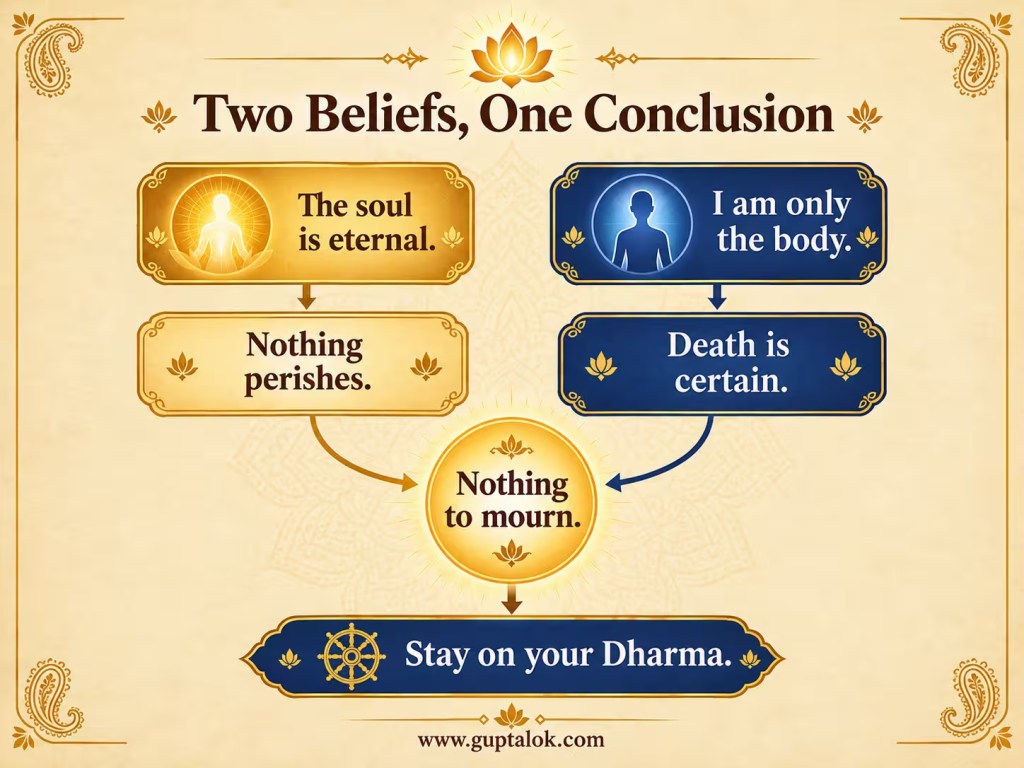
Whether you believe the soul is eternal or that you are only the body, Krishna's reasoning in Gita 2.26-2.30 leads to the same conclusion: there is nothing to mourn.In this article, we will explore each of these ideas in turn. Let us begin with the original verses, followed by their transliteration, translation, and explanation.
Bhagavad Gita Chapter 2 Verses 26 to 30
Here are Shlokas 26, 27, 28, 29, and 30 in their original Sanskrit, along with the English transliteration, and translation.
Sanskrit Text
अथ चैनं नित्यजातं नित्यं वा मन्यसे मृतम् ।
तथापि त्वं महाबाहो नैवं शोचितुमर्हसि ॥ 26॥
जातस्य हि ध्रुवो मृत्युर्ध्रुवं जन्म मृतस्य च ।
तस्मादपरिहार्येऽर्थे न त्वं शोचितुमर्हसि ॥ 27॥
अव्यक्तादीनि भूतानि व्यक्तमध्यानि भारत ।
अव्यक्तनिधनान्येव तत्र का परिदेवना ॥ 28॥
आश्चर्यवत्पश्यति कश्चिदेनमाश्चर्यवद्वदति तथैव चान्य: ।
आश्चर्यवच्चैनमन्य: शृ्णोति श्रुत्वाप्येनं वेद न चैव कश्चित् ॥ 29॥
देही नित्यमवध्योऽयं देहे सर्वस्य भारत ।
तस्मात्सर्वाणि भूतानि न त्वं शोचितुमर्हसि ॥ 30॥
English transliteration
Atha Chainam Nityajaatam Nityam Vaa Manyase Mritam |
Tathaapi Tvam Mahaabaaho Naivam Shochitumarhasi ||26||
Jaatasya hi Dhruvo Mrityurdhruvam Janma Mritasya Cha |
Tasmadaprihaaryerthe Na Tvam Shochitumarhasi ||27||
Avyaktaadeeni Bhootaani Vyaktamadhyaani Bharata |
Avyaktanidhanaanyeva Tatra Kaa Paridevnaa ||28||
Aashcharyavatpashyati Kashchidenamaashcharyavadvadati Tathaiva Chaanyah |
Aashcharyavachchainamnyah Shrinoti Shrutvaapyenam Veda Na Chaiva Kashchit ||29||
Dehee Nityamavadhyoayam Dehe Sarvasya Bharata |
Tasmaatsarvaani Bhutaani Na Tvam Shochitumarhasi ||30||
English translation:
However, if you consider it (the soul) something that always takes birth and always dies. Oh, mighty armed (Arjun)! It is still not right for you to grieve for it. ||26||
The one who is born is sure to die, and the one who has died is sure to be reborn. Therefore, it is not right for you to grieve over this inevitable truth. ||27||
Oh Bharat (Arjun)! All living beings were unmanifest in the beginning (before their bodily birth), became manifest in between (after getting bodily birth), and indeed become unmanifest again upon (bodily) death — so what is the grief in this? ||28||
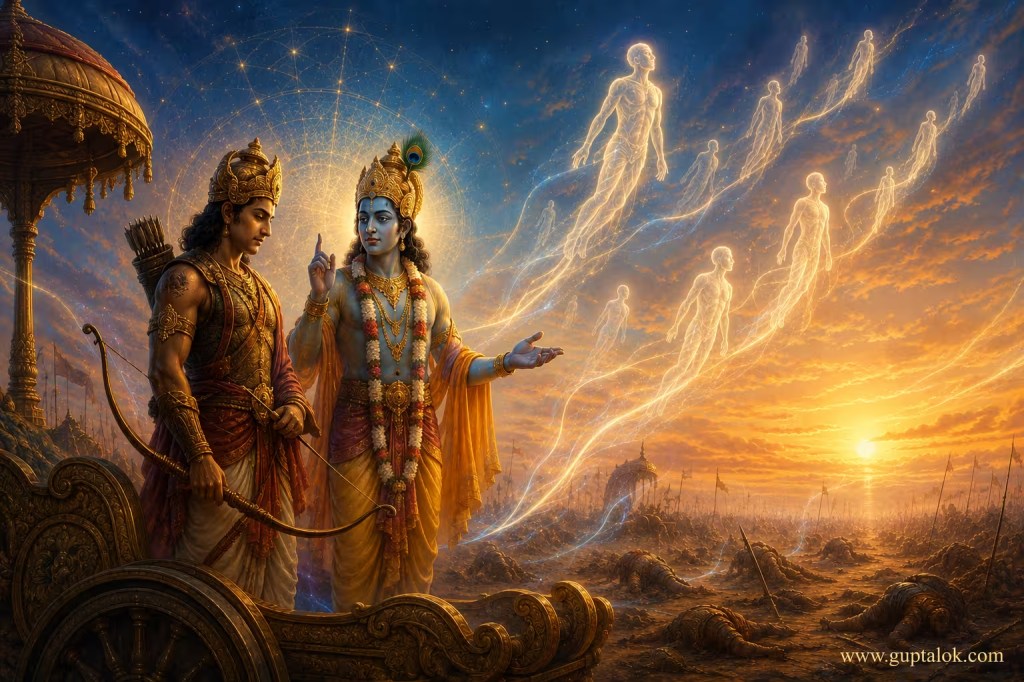
Some perceive the soul with astonishment and some others speak of it with astonishment and some others hear of it with astonishment and some others fail to understand it even after hearing about it. ||29||
Oh Bharata (Arjun)! This bearer of the body (the soul), in every living being, is forever unkillable. Therefore, you should not grieve for any living being. ||30||
Meaning, Central Idea, and Key Teachings:
In the previous few shlokas, God taught his believers that the soul is eternal — it neither takes birth nor dies. In these verses, he seeks to guide those among his children who cannot grasp spirituality to act wisely. Therefore, he gave a valid reason to not mourn over death, even for those who believe the soul takes birth and dies, and for those who believe there is no soul at all and that we are merely bodies.
Do Not Mourn Over Death Even If You Think You are Just the Body.
In verse 2.26, Shree Krishna says that if you think that the soul takes birth and dies, even then there is no point of grieving. Here he simply addresses those who do not believe in the existence of the soul. He enlightens such a population by giving another logical reasoning. In the next verse, he said that everything that is born has the fixed characteristic of dying. Now, because you know that everyone around you would die a day, what are you grieving for? Grieving for something that wasn’t supposed to happen but did is legit. But grieving for something that was sure to happen and did happen isn’t legit. Death is not an event that is not supposed to happen; it is bound to happen. Therefore, it is not proper to neglect or abandon one’s duty out of sorrow over death.
Another point he makes is that everyone who dies gets reborn in one or another form. Now, because you know that the dead is actually not gone forever, and will be back in some other form, it is pointless to mourn over his/her death.
Along with offering a reason to not grieve over death, this verse also raises the following question.
Why must everyone born die?
Everyone born must die because if they don’t, there will be chaos all over the world. Why? Because, then the population will be so much that humans and other living beings will have to be piled up over one another. Life would resemble a stampede—yet one devoid of death, where the situation never changes. In such a scenario, living creatures, especially humans, will be wilder than now. They would attempt to kill one another, but since death would not exist, no one would actually die; instead, everyone would be forced to endure ceaseless physical and mental agony. Life will become so agonizing that they would want their own life to end. Considering this, death becomes the essential need of all living beings. That is why death is destined for all living beings from the moment of their birth.
Being Manifest and Unmanifest
In shloka 28, Krishna says that all humans and other creatures were unmanifest before death, and they will become unmanifest after death. They remain manifest only between their birth and death. What does that mean? Manifest means the corporeal, and unmanifest means the incorporeal. Thus the verse means that everyone living with you becomes just incorporeal after his/her death, and remains incorporeal until the next bodied birth. No one becomes nonexistent. They were always there and will always be there, but you can see them only in the period when they are in corporeal form. And that period starts from their body-based birth and ends at their body-based death. Therefore, there is no point in mourning much, thinking that these people will become nonexistent. They will never be nonexistent but will just become unmanifest for the duration between death and rebirth.
The Soul is Perceived, Talked, and Heard Astonishingly
In order to understand Shlok 2.29, we must refer to Shlok 2.24. In this, Krishna says that the original form of everyone is the soul, which is unimaginable, untouchable, and invisible. It is that which cannot be experienced by any physical means or sense. The terms used to explain the soul’s nature here suggest that its true essence cannot be understood by drawing an analogy to anything, because nothing is similar to it. Since human understanding is primarily geared toward the material world, people are often amazed when they perceive, discuss, or hear about the real essence of the soul. When they contemplate to understand it, they are filled with wonder because they perceive something they could never have imagined existed. When they speak about it—explaining the attributes that prove it actually has no attributes—their amazement grows even deeper. When they hear about the soul from someone, they get astonished to know the true nature of it.
Conclusively, learning about the soul always amazes humans because its nature is completely beyond human comprehension. However, there are still many people whose minds are not open to accepting new ideas, meaning they can never truly understand what the soul is. Such individuals remain spiritually and psychologically weaker, making them easily influenced by external opinions, shifting emotions, and outside ideologies.
Through this Shloka, God wants to tell us that understanding the soul is amazing, and those who fail to know it fall prey to evil. Therefore, keep yourselves open to learning about this extraordinary and important aspect of life. This will help you act without fear when making decisions for the greater good.
Fighting for the Right Fearlessly and Unflinchingly
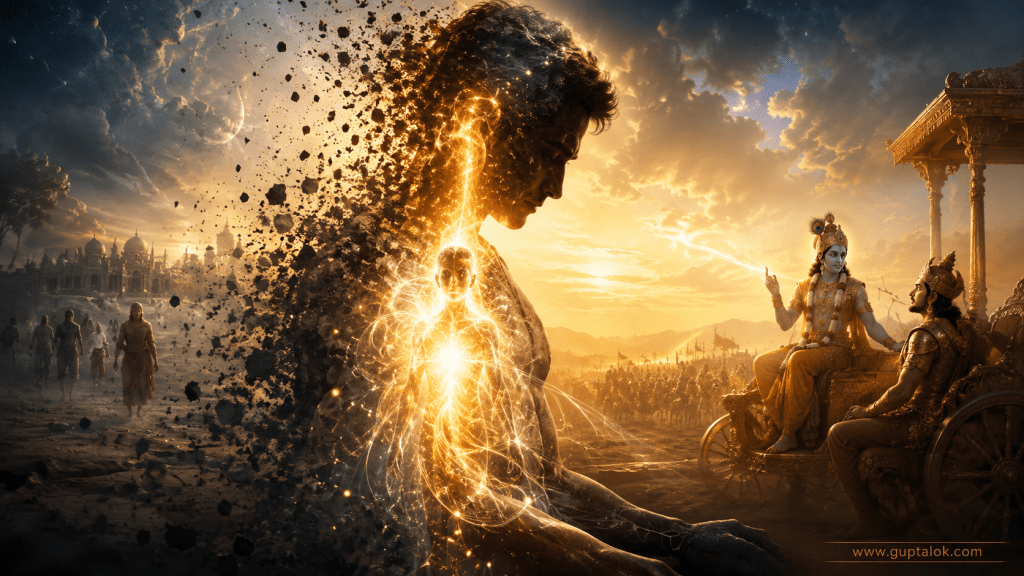
In shloka 2.30, Shree Krishna says that the real self of everyone is the soul, which is the bearer of the body. No one can kill that bearer — only the body can be killed. Therefore, we should not grieve over the impending death of those close ones who are practitioners of Adharma. This shloka helps us overcome that sorrow by teaching us that only their body will die — they themselves, as the soul, cannot be killed. Grieving over something that cannot truly die is a weakness that would also stop us from taking necessary action against them, pulling us away from our real dharma (duty).
In conclusion, this Bhagavad Gita shloka suggests that we should neither grieve nor fear death, because these are associated with the body, and not with the real being (the soul).
Key Teachings
The key teaching of Bhagavad Gita Shlokas 26 to 30 is that we should not step back from the path of Dharma due to fear or grief of impending death, because:
- Death is sure to happen
- Death happens to the body but not the real self (the soul)
- Every living being is actually a soul that resides in the body, and it does not die when the body dies.
Conclusion
Across these verses, Shree Krishna builds a complete case against grief — one that holds true no matter what you believe about the soul. If you understand the soul as eternal, there is nothing to mourn, because nothing truly perishes. If you see death as final, there is still nothing to mourn, because death was never avoidable to begin with. Between these two possibilities lies every belief a human being could hold, and Krishna addresses them all.
What emerges from these shlokas is not just comfort, but clarity. Every being that becomes visible to us was always there, unmanifest, before birth — and simply returns to that same unmanifest state after death. Nothing is lost; only the form changes.
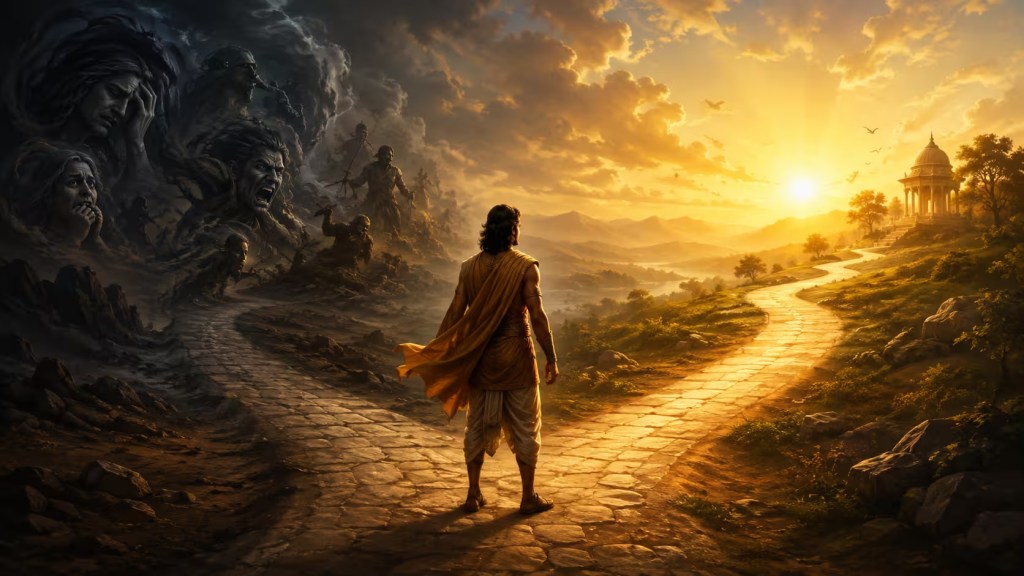
Therefore, avoid becoming controlled by the sorrow or fear of death; for the death that causes you such grief or dread is an illusion regarding the soul, yet an inevitability for the body. Thus, your sorrow and fear are futile in either case. Moreover, this pointless grief and fear divert you from your Dharma and impair your ability to make sound decisions. Therefore, recognize this truth, and prevent fear and sorrow from becoming obstacles on your path of Satya.
FAQs (Frequently Asked Questions)
Why does Krishna say “even if you think the soul is constantly born and dies” when He previously said the soul is immortal?
He says this to address those who completely deny the existence of the soul. Since Krishna’s aim is to teach people that they should not grieve excessively or step back from the path of dharma out of fear of death, he addresses both types of people. The first type consists of those who understand that there is a soul, which is the real self of all living beings; the second type consists of those who don’t accept the concept of the soul at all. Therefore, he says that even if you believe the soul is born and dies along with the body, you should still not mourn — because everything that is born must eventually die. Death, then, is not some tragic exception to the natural order; it is the rule.
Does this verse mean liberation (Moksha) is impossible?
No, it does not mean that liberation (Moksha) is impossible — it simply means that the soul always remains in existence. The example of the birth-and-death cycle has been given because it is easy for people who grieve excessively over death, or the impending death of someone, to understand.
What is the difference between the death of the body and the death of the soul?
The death of the body means the soul has left it, while the death of the soul is a myth.
What is the difference between Deha and Dehi?
Deha is the body, and Dehi is the bearer of the body – the soul.
How do you apply verse 2.27 to overcome anxiety?
Anxiety arises from overthinking, and overthinking happens from continuously thinking about something you cannot influence. Verse 2.27 talks about not grieving over something that is sure to happen — death. If we understand this concept and stop overthinking about matters that are beyond our control, we can more easily overcome anxiety.










Leave a comment