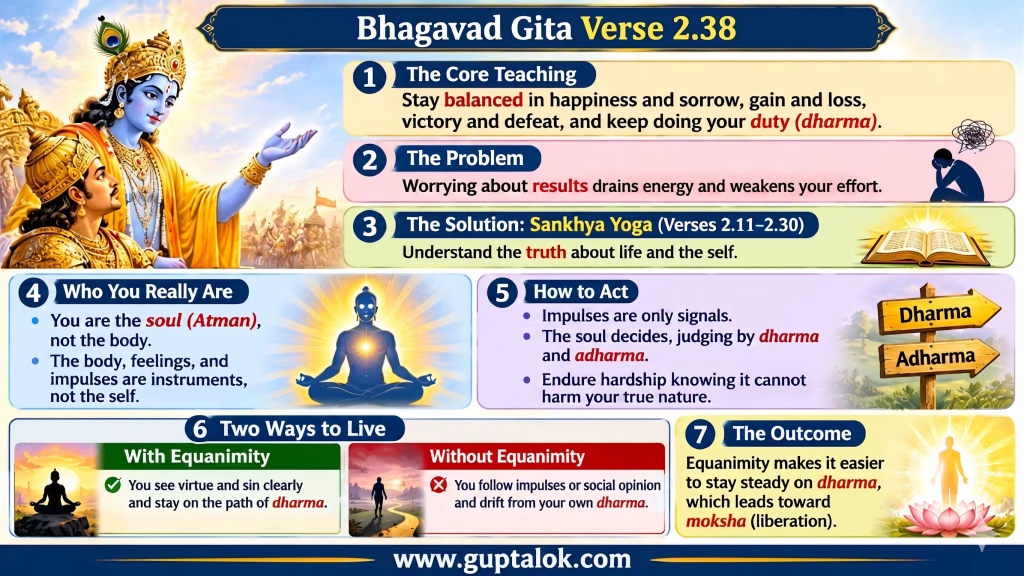
Know the soul as your true self, stay balanced in life’s dualities, and stay steady on the path of dharma.
In Bhagavad Gita 2.38, Krishna sums up Sankhya Yoga and describes the state of mind we should cultivate. He explains the attitude with which one can act without incurring sin. This article takes a close look at the verse and explores the relationship between Sankhya Yoga and samabhava (equanimity), as well as why both matter in spiritual life.
Bhagavad Gita Chapter 2 Verses 38 (Sanskrit Text)
सुखदु:खे समे कृत्वा लाभालाभौ जयाजयौ ।
ततो युद्धाय युज्यस्व नैवं पापमवाप्स्यसि ॥ 38॥
English transliteration
Sukha-duhkhe Same Kritvaa Laabhaalaabhau Jayaajayau |
Tato Yuddhaaya Yujyasva Naivam Paapamavaapsyasi ||38||
English translation:
Engage in battle with a mind that stays equal in happiness and sorrow, gain and loss, victory and defeat. By acting in this way, you will incur no sin.
Meaning, Central Idea, and Key Teachings:
In Chapter 2, verses 11 to 30, Shri Krishna introduces Sankhya Yoga, the philosophy that builds resilience. Sankhya gives an accurate understanding of every element of life and the ultimate reality behind creation. It empowers an individual to remain mentally steady amid life’s dualities: happiness or sorrow, gain or loss, victory or defeat. God explains this further in verse 38, stating:
- Do not give up your param dharma (your fundamental duty as a human being) for worldly gains or worries.
- Do not let the joy of gaining things, or the sorrow of losing them, unsettle you.
- Do not get caught up in whether you will win or lose while performing righteous actions (dharma-yukta karma). Do not stray from the righteous path by dwelling on the joy or sorrow that might follow.
- Accept whatever outcome comes with a calm, balanced mind, and stay committed to dharma. Here, dharma means confronting the gravest injustice and those who carry it out.
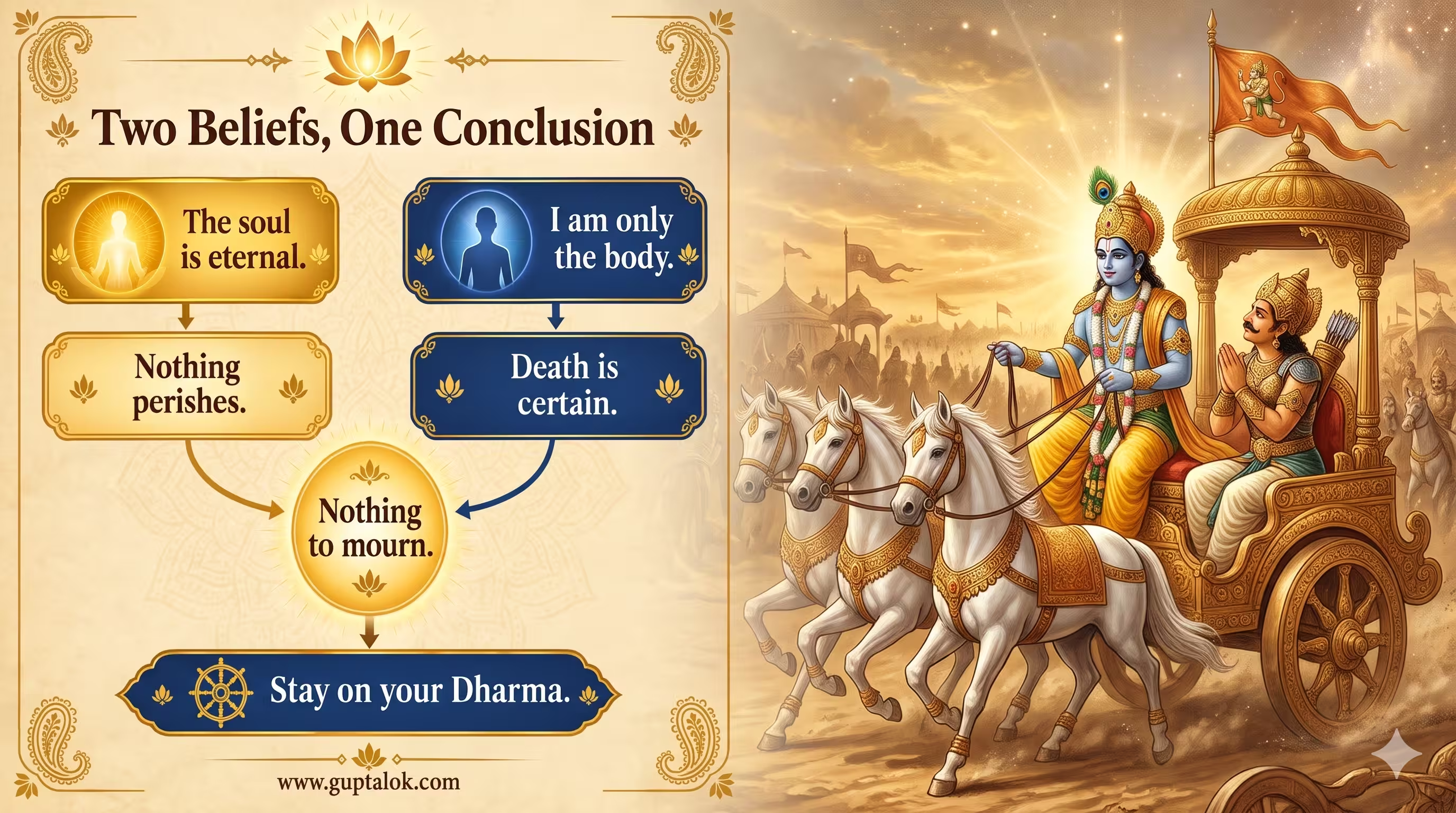
On hearing or reading these words of Shri Krishna, an ordinary person might ask how one can stay equanimous in the face of gain or loss, victory or defeat, when life after one outcome is necessarily different from life after the other. If the resulting lives are different, how can one’s attitude toward each outcome be the same? Moreover, if one can truly be at peace with any outcome, why make an effort to achieve a desired one at all? To answer these questions, the Lord first explains the philosophy of Sankhya Yoga in verses 11 through 30 of the second chapter.
In these verses, Krishna reveals the true nature of a human being: the soul as the real self, the body as its instrument, and the feelings and impulses that engage the body in action. The impulses drive the actions of the ignorant (Ajnaani or Agyaani), whereas a wise person must judge whether an action prompted by such an impulse is dharma (righteousness) or adharma (unrighteousness). However, this does not mean one can claim ignorance (Ajnaan or Agyaan) as an excuse to act impulsively without reflection. The goal of human life is to attain wisdom and then act as a wise person would. This is precisely why the Divine assumes a human form to enact leelas (divine play) and to deliver teachings such as the Gita.
The purpose of the discourse on Sankhya Yoga is to teach us three things:
- You are the soul, not the body. Since the soul cannot act without a body, you must take care of the body and perform righteous (dharmic) actions. Remember never to abandon righteousness or act unrighteously because of the body’s needless, pleasure-seeking desires.
- Bodily impulses may prompt you to act, but the choice is yours. Assess every situation carefully and act only when the action is in line with dharma.
- The soul feels the body’s pain, but that pain cannot harm the soul itself. If you endure physical and emotional hardships with this awareness, you are much less likely to stray from the path of righteousness.
Once a human being grasps the essence of Sankhya Yoga, the possibility of attaining equanimity, as described in verse 38, increases. This is because knowing the truth about one’s own existence reduces fear and similar emotions that arise within. As bodily impulses weaken, and as the individual keeps reminding himself or herself that the true self is the Atman (the Self or Soul), these impulses stop being the sole deciders of action. Instead, they serve merely as signals that an action may be needed.
In this state, the Atman residing in the body evaluates the situation in terms of dharma (righteousness) and adharma (unrighteousness). It then decides whether to act on the signal and, if so, what precautions to take. When the Atman acts through the body on the basis of such reasoned decisions, it is using the body correctly. But when, out of ignorance, the Atman acts under the influence of intense bodily impulses and sets dharma aside, it becomes a puppet of the body’s urges and tendencies. As a result, it strays from its ultimate goal and may fail to attain moksha (liberation).
Because Krishna wants every human being to attain liberation, in the first part of verse 2.38, He encourages the pursuit of equanimity (Sambhaav), a state that can be reached through understanding Sankhya Yoga. In the second part, He explains that when people act from this state of equanimity, they become capable of discerning the true nature of virtue and sin. Conversely, when people lack equanimity, they tend to judge virtue and sin only by the beliefs and customs of society, and as a result they stray from their own dharma (true duty or path).
Key Teachings and Conclusion
The core teaching of Bhagavad Gita 2.38 is that a person should cultivate equanimity. This means that when faced with life’s dualities, such as happiness or sorrow, gain or loss, victory or defeat, one should not become so mentally unsettled that one leaves the path of dharma (righteousness) and falls into adharma (unrighteousness).
In conclusion, by studying Sankhya Yoga (Gita verses 2.11-2.30), we come to understand the elements of life and the truth about the self. This makes it easier to attain equanimity, and once equanimity is attained, it becomes easier to remain steadfast on the path of dharma (righteousness).
FAQs (Frequently Asked Questions)
If I don’t care about victory, profit, or gain, what motivates me to work hard?
Any undertaking involves several stages. The very first step is to assess all aspects and decide to proceed with the task. Once the decision is made, you must commit yourself to the work. If, upon starting, you begin to worry about potential losses, a significant amount of your energy is wasted in overthinking—specifically, fretting over what you would do if things went wrong. As a result, you are unable to dedicate your full attention and effort to the task at hand. Consequently, driven by the fear of failure, you might leave the work incomplete, or—due to a lack of full focus and effort—fail to bring it to a successful conclusion. Therefore, once you have decided to undertake a task and have begun working on it, you should set aside thoughts of profit or loss and instead find joy in the process itself; this will enable you to give 100% toward its completion.
What does Gita verse 2.38 mean in simple words?
It means doing your duty with a calm, balanced mind. Don’t let worry about gain or loss, or victory or defeat, distract you from doing the work well. Be ready to accept both favorable and unfavorable outcomes, and you can work without anxiety and without straying from dharma (righteousness).
Can I give my full effort while holding the outcome lightly?
Yes. Constant worry about how things will turn out drains energy and pulls your attention away from the task. Verse 2.38 advises staying balanced in gain and loss, victory and defeat, so that you can give your full effort to the work in front of you.










Leave a Reply