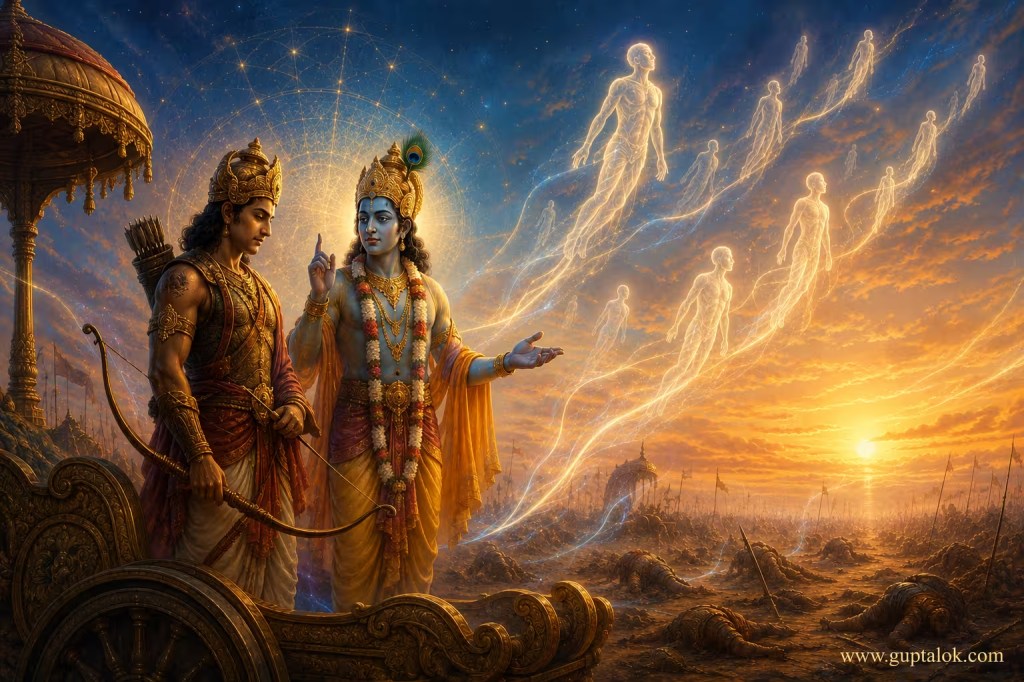
Bhagavad Gita Chapter 2, Verses 22–25, are among the most quoted shlokas in the entire scripture — and for good reason. In these four verses, Shree Krishna gives Arjun (and every reader since) a direct answer to one of humanity’s oldest questions: why does the soul never die?
Using the now-famous metaphor of changing old clothes for new ones, Krishna explains that the soul doesn’t perish when the body does. It simply moves on, the way a person discards a worn-out garment and puts on a fresh one. He goes further, describing the soul as something no weapon can cut, no fire can burn, no water can dissolve, and no wind can dry. It is nitya (eternal), sarva-gatah (all-pervading or been-everyone), achala (unmovable), and sanatana (everlasting).
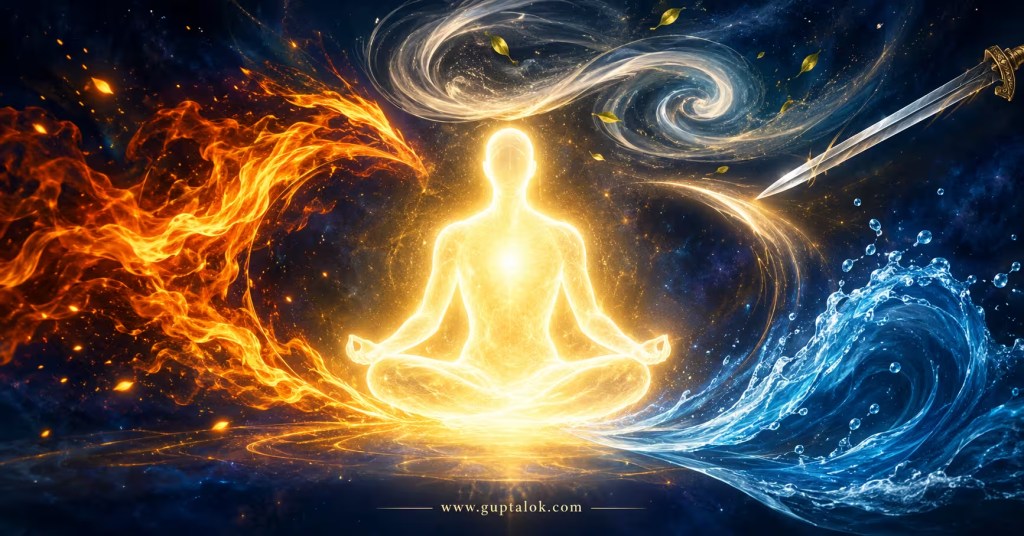
The soul cannot be cut, burned, wetted, or dried — untouched by fire, water, wind, or weapon. (Bhagavad Gita 2.23)But taken on their own, these verses raise as many questions as they answer. If the soul is untouched by death, why does it ever leave a body at all? Why do souls sometimes stay trapped even when the body has already failed them? And why does a soul depart from a child’s body — one that hasn’t even had the chance to “wear out”?
This article breaks down Bhagavad Gita Shlok 22 to 25 line by line — the original Sanskrit, the English transliteration, the English translation, and a detailed explanation answering these questions. This explanation also unpacks the soul’s relationship with the body, karma, salvation, and grief. Whether you’re here to understand the literal meaning of “Vaasaansi Jeernaani Yathaa Vihaay Navaani Grihnaati Naro-aparaani” or you’re searching for spiritual clarity after a personal loss, this article speaks to both. It takes you deeper into one of the Gita’s most comforting teachings: what you’re grieving was never the real thing to begin with.
Bhagavad Gita Chapter 2 Verses 22 to 25
Here are Shlokas 22, 23, 24, and 25 in their original Sanskrit, along with the English transliteration, and translation.
Sanskrit Text
वासांसि जीर्णानि यथा विहाय नवानि गृह्णाति नरोऽपराणि ।
तथा शरीराणि विहाय जीर्णान्यन्यानि संयाति नवानि देही ॥ 22॥
नैनं छिन्दन्ति शस्त्राणि नैनं दहति पावक: ।
न चैनं क्लेदयन्त्यापो न शोषयति मारुत: ॥ 23॥
अच्छेद्योऽयमदाह्योऽयमक्लेद्योऽशोष्य एव च ।
नित्य: सर्वगत: स्थाणुरचलोऽयं सनातन: ॥ 24॥
अव्यक्तोऽयमचिन्त्योऽयमविकार्योऽयमुच्यते ।
तस्मादेवं विदित्वैनं नानुशोचितुमर्हसि ॥ 25॥
English transliteration
Vaasaansi Jeernaani Yathaa Vihaay Navaani Grignaati Naro-aparaani |
Tathaa Shareeraani Vihaay Jeernaanyanyaani Sanyaati Navaani Dehee ||22||
Nainam Chhindanti Shashtraani Nainam Dahati Paavakah |
Na Chainam Kledayantyaapo Na Shoshayati Maarutah ||23||
Achchhedyoayam Adaahyoayam Akledyo Ashoshya Ev Cha |
Nityah Sarvagatah Sthaarun Achalo-ayam Sanaatanah ||24||
Avyakto-ayam Achintyo-ayam Avikaaro-ayamuchyate |
Tasmaadevam Viditvainam Naanushochitumarhasi ||25||
English translation:
Just as humans abandon their old, worn-out clothes and put on new ones, the dweller of the body — the soul, the true self — abandons its old and decrepit body and enters a new one. ||22||
Neither it can be broken [or cut] through weapons, nor it can be burnt through fire. And, it neither can be moistened by the waters nor it can be dried out through air. ||23||
It is non-pierceable [or unbreakable]. It is non-combustible, non-wettable, and undoubtedly un-dryable. It is everlasting, been-everyone, unchangeable, unmovable, and permanent. ||24||
It is unmanifested. It is unimaginable. And it is said to be flawless (free of all impurities). Therefore, knowing it to be so, it is not appropriate to be grieved. ||25||
Meaning, Central Idea, and Key Teachings:
In the Gita Shlok 19, 20, and 21, Shree Krishna explained that the Soul – the real self of everyone – always existed. It exists without having ever been born. It doesn’t die or get destroyed. It is permanent, everlasting, and ancient. In the following shlokas, he answers many essential questions about the soul. His rationales provide a clear understanding to Arjun and other Humans about life (soul) and its manifestation (body). Let’s have a look at what kind of questions he answered in Bhagavad Gita Verses 22, 23, 24, and 25.
Why doesn’t the soul die?
In Shlok 25, Shree Krishna said that the soul is unmanifest. This means that the soul has no physical form to begin with and, therefore, cannot die. Death, by its very nature, applies only to things that exist physically. It applies to things that can be seen, touched, heard, or otherwise perceived through the senses. And anything perceivable in this way is necessarily composed of one or more of the four classical elements: water, fire, air, or earth. The soul, however, is made of none of these. It has no shape, no substance, no sensory presence — it cannot be seen, felt, or heard by any living being. Because it lacks this physical composition, it cannot be experienced directly at all. And because it cannot be experienced, it cannot be subject to death — for death is something that happens only to that which exists in physical form. The soul, being free of all elemental composition, simply falls outside the category of things that can perish.
What happens to the soul after one’s body-based death?
In Shlok 22, God explained that the soul attires another body after its previous body becomes useless or formally dies. The way we, humans, abandon our useless old clothes and buy new, our real self – the soul – abandons the old useless body and enters into a newer one.
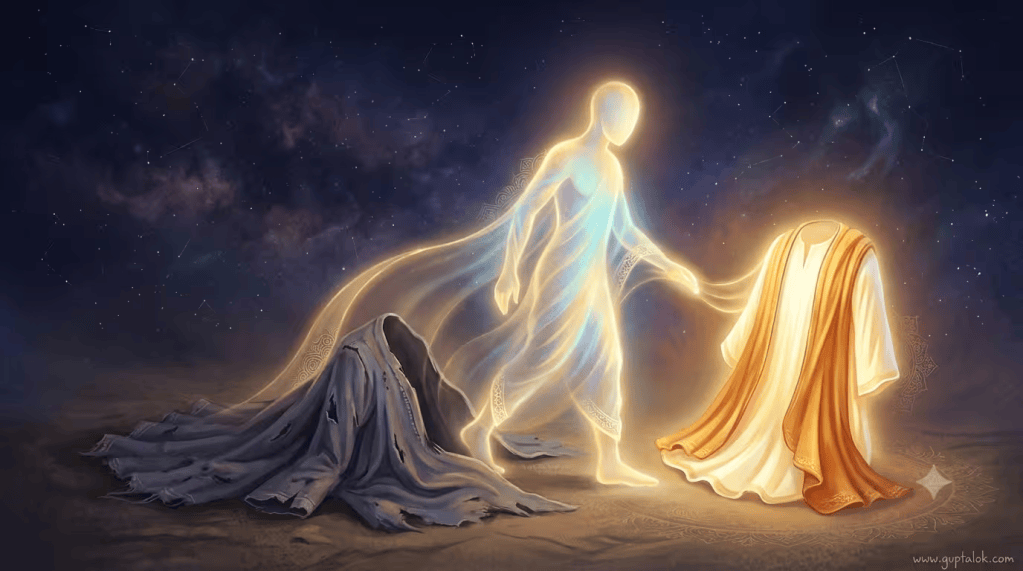
As old clothes are cast off for new — so the soul discards one body for another. — Bhagavad Gita 2.22This concept brings many questions along, and a few of them are following.
- A body becomes useless after the soul leaves it. So why does the soul abandon it?
- Does every soul leave its old, worn-out body on its own — by its own will or choice?
- Why does the soul leave a child’s body, even though that body is still new and not yet worn out?
A body becomes useless after the soul leaves it. So why does the soul abandon it?
It is human perception that the body becomes useless only after the soul’s departure. But the truth is different. The body becomes useless long before the soul abandons it.
Humans don’t recognize this. Their way of analyzing is different from that of the soul. When humans look at the body, they judge its usability by two factors. They consider the body useful if it is breathing and not fully decayed.
The soul, on the other hand, looks at only one factor. It checks whether the body can still perform the actions needed to fulfil its purpose. What is the purpose the soul wants to fulfil through this body? Each soul has a single purpose to fulfil through its designated body: attaining salvation.
This salvation is attained by performing dharma (actions that seek the welfare of all living beings). It is also attained by not indulging in material pursuits. So, when the soul sees that the body can no longer perform the actions needed for salvation, the body becomes useless to it. In such a case, the soul abandons the body.
There is another case. Sometimes, the soul has already performed all the actions needed to attain salvation, using the designated body. The soul then has no task left to complete through that body. The body becomes useless to it. So, the soul abandons it.
So, the body doesn’t become useless because the soul leaves it. The soul leaves because the body has already become useless. Its only purpose was to help attain salvation. Once that purpose is fulfilled, or can no longer be fulfilled, the body has nothing left to offer the soul. So the soul moves on.
Does every soul leave its old, worn-out body on its own — by its own will or choice?
We talked about the fact that the soul leaves the body when it becomes incapable of performing the actions it was meant to do. You may now wonder whether every soul leaves the body by choice. When it’s said that the soul leaves a body that’s no longer useful, it doesn’t always mean the soul leaves voluntarily. It simply means the soul leaves the body, either willingly or out of compulsion.
In some cases, it is the soul’s own choice. In others, the soul’s choice is overridden by God’s. Why? Because not every soul breaks free of the trap of Maya (illusion) while residing in the body. Many remain trapped in this illusion even long after they’ve left the body. Such souls become so deeply immersed in the body that they forget their own reality. These souls keep considering their bodies as their real existence, forgetting that they themselves are their true reality.
These are the souls who don’t leave the body by their own choice, even after it has become useless to them. They keep believing the body still serves them, even when it no longer fulfills that purpose. In such cases, God intervenes and forces them to leave the body that can no longer help them carry out the work they were meant to do.
Why does the soul leave a child’s body, even though that body is still new and not yet worn out?
The soul leaves a child’s body for the same reason it leaves an adult’s or an elderly person’s — because that body can no longer serve the purpose for which the soul wore it.
We often witness newborns and young children die. In such cases, people curse God, asking what the child did wrong to deserve death. In spiritual terms, they are really asking: why does the soul leave a brand new body?
The answer lies in a difference of perspective. Humans judge a body’s usefulness by its age. The soul judges it by its core purpose — salvation. Age is not the soul’s criterion. The soul leaves the moment it realizes that its purpose cannot be fulfilled through that particular body.
There is another possibility too. Sometimes the soul’s purpose is fulfilled within that short span of life. In that case, the soul leaves not because the body failed — but because the work was already done.
You may here have a question, what could a soul in an infant’s body do that can offer it salvation. Here is the answer:
Receiving and Being Reason for Something is also a form of doing
Salvation doesn’t always require action in the conventional sense. Sometimes the soul needs to experience something — even suffering, even love, even the pain of a short life — to balance its karma. The infant may not act, but it gives others around it something to experience — grief, attachment, awakening, etc. That too serves a spiritual purpose.
Allow me to share an experience from my own life that brings this to light. I will let my wife describe it in her own words:
“During my pregnancy, I devoted myself to spiritual practices — listening to devotional hymns (bhajans), attending spiritual discourses (satsang), performing worship (puja), and reading the ancient scriptures (Puranas). These practices had such a profound impact on my life that when I learned that the soul in my womb had passed away, I was able to accept that reality without much difficulty. I felt that the soul had attained liberation.
After losing the baby, I also realized that our responsibility is only to perform our actions (karma); the results are entirely in God’s hands. However, accepting reality and choosing to remain happy despite it is something that lies within our own control. Since then, I have never truly felt negativity in my life.”
Her words reveal something that philosophy alone cannot fully express. The soul that resided briefly in her womb may not have spoken a word or taken a single step — yet its presence transformed her. It drew her toward spiritual practice, deepened her understanding of karma, and left her with a peace that has stayed with her ever since. That, perhaps, was its purpose. Not to live long — but to awaken something in those around it before it left.
Can the soul be impacted by any of the worldly means?
The soul cannot be impacted by any worldly means in its original form. Shree Krishna touched upon this fact while describing why souls can’t be killed or destroyed. He said the following through Shlokas 23 and 24:
- No weapon can break or cut the soul because it is non-pierceable.
- Fire can’t burn the soul, which means it is non-combustible.
- Water can’t moisten the soul, which means it is non-decomposable by water.
- Air can’t dry the soul, which means it doesn’t deteriorate even after being in an open, dry environment.
You may wonder why Krishna spoke of only these four elements as things that cannot impact the soul — why not anything else? The answer is simple: there is nothing else in his material creation beyond these four. Everything in existence is contained within them. Weapons, for instance, represent earth. Fire, water, and air stand for themselves. Any physical impact a human being can cause must come through one or more of these four elements. This is precisely why Krishna spoke of only these four — because all physical influence over the material world flows through them alone.
Why and How Do These Four Elements Impact Material Things but Not the Soul?
These four elements impact material things by entering them and altering their composition. It is this ability to penetrate and change the internal makeup of a thing that gives them their destructive power. A body, being material, allows these elements to enter it — and once inside, they disturb its composition, ultimately destroying it.
Consider the following:
- Water destroys a body by entering it and disrupting its internal balance.
- Fire destroys a body by entering it and breaking down its composition.
- A weapon — which represents earth — destroys a body by piercing it and damaging its internal structure.
- Air, in its harmful form, destroys a body by entering it and disturbing its natural state.
In each case, the destruction happens not merely because the element is present around the body, but because it enters and changes what the body is made of from within.
The soul, however, is an entirely different case. These elements may pass through the soul (they are not blocked by it), but they cannot alter its composition, because the soul has no material composition to begin with. There is nothing in it for these elements to penetrate, disrupt, or change. This is why fire cannot burn it, water cannot moisten it, air cannot dry it, and no weapon can pierce it.
Why Does Krishna Say You Should Not Grieve Over Death?
As Krishna has already established that the soul – the real self – doesn’t die, it’s inappropriate to grieve for the death of the body. He explains this further by offering more clarity on the existence of the soul – the real being. He said the following:
1. The soul is everlasting and permanent,
It means that the soul was always there and will always be. Therefore, your grief for the death is unreal because you are mourning for the one who can’t ever become the past. Who can’t ever die.
2. The soul is sarv-gatah — been everyone
The soul has been every living being. It has existed in countless manifestations across time, inhabiting every kind of life there is. Now, when you grieve over someone’s death, ask yourself: which manifestation of the soul are you mourning? If you are mourning this one person, why are you not mourning every other living being the soul has ever been? And if you were to mourn all of them, you would find yourself grieving for an endless number of manifestations — none of which represent the soul’s true self. Because beneath all those forms, the soul itself never died. You are mourning the shells, while the real self remains untouched and alive.
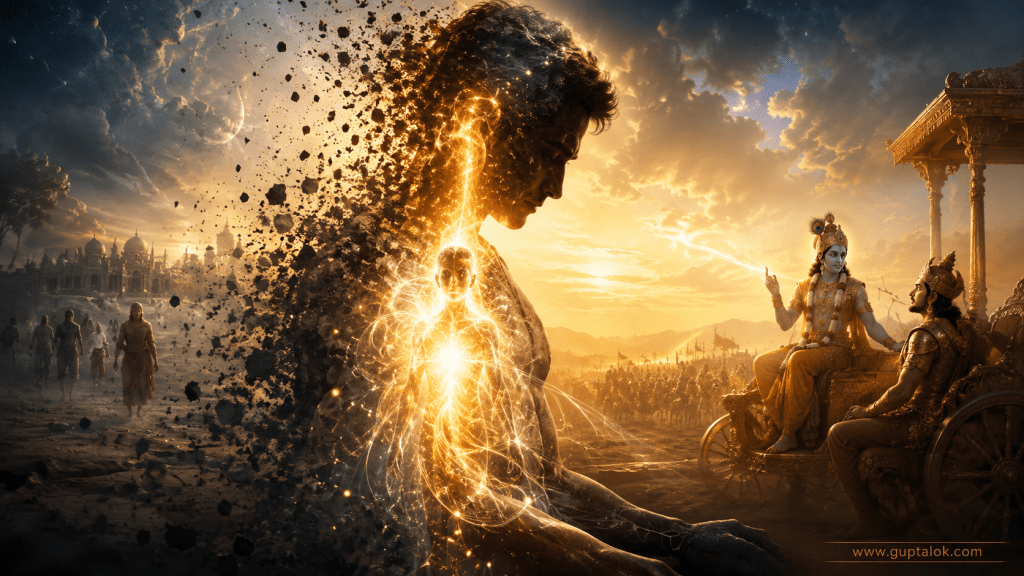
This is precisely why Krishna concludes that grief over death is not appropriate. You are grieving for something that was never real to begin with, while the only thing that is truly real never died.
3. The soul is unchangeable and flawless
The soul always remains in its original form — a form that cannot be altered in any way. It may enter different bodies, but its own composition never changes. And because its original form is unchangeable, there is no possibility of any flaw or impurity ever entering it. It was perfect from the beginning and remains perfect always.
Since no flaw can penetrate it and its composition can never be disturbed, the soul is beyond all forms of deterioration and destruction. This is why Krishna says that grieving over death is inappropriate — because the real self of every living being remains exactly as it always was, untouched, flawless, and imperishable.
4. The soul is unmanifested and unimaginable
The soul is unmanifested — it has no physical existence, only an incorporeal one. Because it exists beyond the physical, it cannot be described in worldly terms. And because it cannot be described, it is impossible to imagine what it looks like, where it resides, or what its attributes are. And if something cannot even be imagined, it cannot be located. And if it cannot be located, it cannot be targeted — neither to destroy it nor to love it in any physical sense. And if the soul, which is the true self, can neither be harmed nor reached through worldly means, then grieving for it serves no purpose. Grief, in this case, is directed at something that was never truly there to begin with — the body. Not the self.
Key Teachings
The soul never dies — it only changes bodies.
Just as we discard old clothes for new ones, the soul abandons a worn-out body and takes on another. Death is a transition for the soul, not an ending.
The soul cannot be touched by the material world.
Fire cannot burn it, water cannot moisten it, air cannot dry it, and no weapon can pierce it — because these elements act only by entering and altering physical composition, and the soul has no physical composition to alter.
Grief over death is grief over an illusion.
Since the soul is everlasting, has been every living being, remains unchangeable and flawless, and is beyond all physical description — mourning it is mourning something that was never truly lost. What we grieve is only the body, never the self.
A body becomes useless to the soul before the soul ever leaves it.
The soul doesn’t measure usefulness by breath or physical decay, as humans do. It measures usefulness by one purpose alone — whether the body can still help it move toward salvation.
Not every soul leaves the body by its own will.
Some souls remain trapped in Maya, mistaking the body for their true self. When such souls cling to a body that can no longer serve its purpose, God intervenes and compels the soul to leave.
Age has no bearing on when a soul departs.
Whether in an infant or an elder, the soul leaves the moment its purpose in that body is fulfilled or can no longer be fulfilled. Salvation, not lifespan, is the deciding factor.
Salvation isn’t always about action — sometimes it is about experience.
A short life can still fulfil the soul’s purpose by giving others something to feel — grief, love, awakening — which becomes part of their own spiritual journey.
Conclusion
Bhagavad Gita Verses 22 to 25 don’t just make a philosophical claim about the soul’s immortality — they change how death itself should be understood. The soul is not bound by the four elements that govern everything physical: earth (weapons), fire, water, and air. It cannot be pierced, burned, dissolved, or dried, because it was never made of matter in the first place. And because it is nitya (eternal), sarva-gatah (present in every being across time), achala (unchanging), and avyakta (unmanifest), it lies permanently beyond the reach of anything that can destroy a body.
This is the foundation of Krishna’s core message in this section of the Gita: grief over death is grief misdirected. What dies is the body — a temporary vessel the soul wears only until its purpose, ultimately the pursuit of salvation, is fulfilled or can no longer be fulfilled. The soul itself, the real self of every living being, was never touched by that ending.
Whether you’re studying these shlokas for spiritual growth or coping with the loss of a loved one, verses 22–25 offer real clarity. They explain what the Bhagavad Gita says about the soul and death in plain terms. These teachings have comforted seekers for thousands of years. They remain just as relevant today. If you found this breakdown useful, explore the rest of our verse-by-verse Bhagavad Gita series. It offers a deeper understanding of Krishna’s teachings on karma, the self, and the nature of existence.
FAQs (Frequently Asked Questions)
How does the soul choose its next body?
The soul doesn’t get to choose its next body; it is pre-decided. However, what it would experience in its next body depends on the Karmas performed by it while being in its previous body and its thought process at the time of death.
Does the soul retain its memories or identity in the next body?
No, the soul does not carry memories of material facts or identity into the next body; however, if it has attained supreme knowledge (Gyan or Jnan) in the previous body, that knowledge remains with it. Supreme knowledge (Gyan or Jnan) does not refer to factual information, but rather to a clear understanding of right and wrong, God, spirituality, rationality, and the truth of one’s own self.
What happens to the soul in the gap between leaving the old body and entering a new one?
In the interim between leaving the old body and entering a new one, the soul remains within the physical realm. Souls that practiced spirituality while embodied exist in a liberated and peaceful state when devoid of a physical form. Conversely, souls that remained immersed solely in materialism while embodied—unable to perceive their existence beyond the body and the material world—remain trapped in the bonds of Maya (illusion) and in a state of distress, even without a physical body. It is these souls that are referred to as wandering spirits, ghosts, specters, and the like.
If the BG shlok 2.22 says the soul leaves when the body is “old and worn out” (jirnani), why do young people or children die?
Because the soul has fulfilled the purpose for which it was given that particular body. The key point to understand is that in verse 2.22, ‘jirnani’ is used in the analogy of ‘jirnani’ clothes, referring to old, worn-out, or no longer useful clothes. The same three meanings apply to the body as well. So even if a body is young in years, if it has become ‘useless’ for the soul’s purpose, the soul leaves it — and this is what we call death. Please see the article above, where we’ve explained how and why a young body can become useless.
Does the Bhagavad Gita verse 2.22 justify violence or war?
Not exactly. Bhagavad Gita verse 2.22 doesn’t justify war or violence based on material biases. Rather, it promotes war against those who are wrongdoers, violent toward innocent living beings, and non-righteous (fanatics, those who perpetrate atrocities against people in the name of God, etc.). While non-violence is good in principle, it also suggests that letting violent individuals or communities survive makes you complicit in spreading violence further. Letting rapists and non-righteous people survive unchecked is idiotic, illogical, inhuman, cowardly, and a sin.
If the human population is increasing, where are the “new” souls coming from?
As the soul is a fraction of the incorporeal form of God, new souls originate from that very source. Remember, God is limitless, and therefore an unlimited number of souls can emanate from Him. Additionally, while the human population is increasing, other living creatures are becoming extinct — which also helps balance the overall supply of souls available for human bodies.
How can I use these verses to overcome my own fear of death?
By realizing that your body is not you, but an instrument given to you to perform actions and experience material joy and pain. So, when you die, it is not your end — it is merely the end of the period during which you perform actions and experience those joys and sorrows. You continue to exist, either without form or in a new material form. And if you continue to exist even after death, what is there left to fear?
Why does Krishna specifically list weapons, fire, water, and wind? Why is space (Akasha) left out of the Bhagavad Gita verse 2.23?
Krishna specifically mentions weapons, fire, water, and wind because everything material is composed of these physical elements (weapons representing earth). It is only these elements — in one form or another — that have the power to destroy the body. Space (Akasha), on the other hand, is left out because it has no destructive capability at all — it cannot even harm the body, let alone the soul. By listing the only elements that can impact the body, Krishna makes the point that even they cannot touch the soul; and since space fails to meet even the first condition — impacting the body — there was no reason to include it.
Do these verses describe “Energy” in modern physics?
No, these verses don’t describe ‘energy’ as understood in modern physics. The soul is not the same as the energy represented by the formula E=mc². We use the analogy of energy for the soul only because its attributes come closest to describing the soul. However, energy is not the soul — energy arises from the four material elements that form the body, whereas the soul neither arises from nor consists of any of these elements. Energy is also produced and constantly converted from one form to another, while the soul is neither created nor subject to such transformation. Furthermore, the soul is unmeasurable, while energy is measurable.
If water cannot wet it and wind cannot dry it, what is the soul’s actual form?
The actual form of the soul is the same as Space (Akasha).
If the soul cannot be harmed, why do we feel pain?
Because it is the body that gets harmed, and pain is a sensation experienced through the body — not the soul. The soul, being the true self, remains unharmed. However, since the soul is closely associated with the body while embodied, it perceives or experiences the body’s pain through that association, even though the pain doesn’t actually touch the soul itself.
What happens to the soul of someone who dies in a fire or explosion?
The soul of someone who died in fire or an explosion either enters another body or merges back into its original form (the incorporeal form of God), depending on the karma it accumulated in its previous body. The same holds true for all types of deaths.
Do these Bhagavad Gita verses mean ghosts or spirits cannot be destroyed either?
Yes, spirits cannot be destroyed because they are simply another name for the soul. The same applies to ghosts, since they too are essentially souls — specifically, souls that remain unliberated and trapped in illusion (Maya). They cannot be destroyed either; they can only be liberated. This is why true exorcists and godmen invoke God in such cases — so that these souls can realize the truth and attain liberation. Once liberated, they stop disturbing the living.
What do the terms “Sthanu” and “Achala” mean in this context?
“Sthanu” means constant and “Achala” means immutable or firm in the context of Bhagavad Gita Shlok 2.24. Through these terms Krishna explains the soul as an unchangeable, unalterable aspect.
If the soul is “all-pervading” (Sarva-gatah), are we all the same soul?
In my understanding, ‘Sarva-gatah’ means ‘has been present in every being,’ not ‘all-pervading’ in the sense of existing everywhere at once. Thus, Krishna’s point is that a soul passes through all species found on earth over time — meaning it has inhabited every type of body at some point in its journey. It means that we all are not the same soul, but all the souls have lived in all kinds of bodies.
If we take it as ‘all-pervading’ in the sense of existing everywhere at once, the meaning still comes out to be right. In this case, the soul and God are not considered as two separate entities but as one single entity. This approach is also right because the soul is just a fraction of the incorporeal form of God. And God is omnipresent because everything and everyone is situated within himself. Since God is all-pervading and the soul is no different from him, it is also all-pervading. It still doesn’t mean that we are the same soul but it means that we all are parts of the same supreme soul – God.
If the soul is “immovable” (Achala), how does it travel to a new body?
In the context of Bhagavad Gita Shlok 2.24, ‘Achala’ doesn’t literally mean something that cannot move — rather, it means something that is firm or unchanging in its original form. Through this, Krishna wants to convey that the soul’s form remains permanently intact, unchanged from what it has always been. Its essence cannot be altered in any way.
Can the soul be detected by modern scientific instruments?
No, modern scientific instruments cannot detect the soul itself, because science can only access material aspects of existence. At best, instruments may detect indirect signs of the soul’s presence — such as life or consciousness in the body — but they cannot detect the soul directly, especially when it is not associated with any body.
Do these verses imply that the soul has no emotions?
You can say that, because emotions arise from material aspects, and since the soul is non-material, it neither produces nor possesses emotions.
How do I meditate on an “unchanging and immovable” self?
To meditate on “unchanging and immovable” self, we should focus on ourselves in a way that we are not focused on any of our body parts and physical possessions. This should be like focusing on nothing.
If the soul is unthinkable, how can I ever understand it?
The term ‘Achintya’ is generally translated as ‘unthinkable,’ but in the context of BG Shlok 2.25, it more precisely means ‘unimaginable.’ This means the soul cannot be perceived as anything physical or material, because it is incorporeal. However, one can still come to understand it — not through sensory imagination, but through deep thought and contemplation.







 Gupt Alok
Leave a comment