In the previous shlokas, Krishna explained what Sat and Asat are. He also explained which one is Maya and which one is satya. He further explained that the body is Maya or Asat, and the soul is the Sat or Satya. Starting from Shlok 19, God describes the key characteristics or basic nature of Atma (the Soul). He explained how the soul is beyond materialism and why it is unkillable.
In this article, we will learn why we need to know that the soul is immortal. We’ll understand why it is wrong to kill innocents even when their real self (the soul) can’t be killed. We’ll also understand why we should not let the oppressors live freely, even though their real selves (the souls) can’t be killed. Let’s start with the original Sanskrit versions of Bhagwad Geeta Chapter Two’s Verses 19, 20, and 21, and move forward with their English transliteration, translation, and detailed explanation.
Bhagavad Gita, Chapter 2, Shlok 19, 20, and 21
Below are the verses 19, 20, and 21, followed by their English transliteration and translation.
Sanskrit Text
य एनं वेत्ति हन्तारं यश्चैनं मन्यते हतम् ।
उभौ तौ न विजानीतो नायं हन्ति न हन्यते ॥ 19॥
न जायते म्रियते वा कदाचिन्नायं भूत्वा भविता वा न भूय: ।
अजो नित्य: शाश्वतोऽयं पुराणो न हन्यते हन्यमाने शरीरे ॥ 20॥
वेदाविनाशिनं नित्यं य एनमजमव्ययम् ।
कथं स पुरुष: पार्थ कं घातयति हन्ति कम् ॥ 21॥
English Transliteration
Ya Enam Vetti Hantaaram Yashchainam Manyate Hatam |
Ubhau Tau Na Vijaaneeto Naayam Hanti Na Hanyate ||19||
Na Jaayte Na Mriyate Vaa Kadaachinnaayam Bhootvaa Bhavitaa Vaa Na Bhooyah |
Ajo Nityah Shaashvato-ayam Puraanona Hanyate Hanyamaane Shareere ||20||
Vedaavinaashinam Nityam Ya Enamajamavyayam |
Katham Sa Purushah Paarth Kam Ghaatyati Hanti Kam ||21||
English translation:
The one who knows (considers) it a slayer and the one who considers it killable, they both do not know [the truth of it] that it neither can be slayed nor does it slay. ||19||
It (Soul) is neither born nor does it ever die. It never has been produced, neither is being produced, nor will ever be produced. It is unborn, eternal, everlasting, and ancient. It is not destroyed even when the body is destroyed. ||20||
One who knows that this (Soul) is imperishable, eternal, unborn, and undiminishing, Parth! Whom can that person kill and whose death-cause can he/she be? ||21||
Meaning, Central Idea, and Key Teachings:
Through shlok 19, Krishna is addressing the sensitive humans like Arjun who often avoid fighting against evil and sinners. They avoid doing so because they see humans in the sinners too, and they fear being called a killer. God wants them to understand the fact that they can’t kill anyone completely because no-one is just the body. Everyone is a blend of body and soul, and soul is the only life while body is the manifestation of that life. Humans can only kill the manifestation but not the real life. Not only humans, but nothing can kill the real life (soul), it can kill only the manifestation of that life.
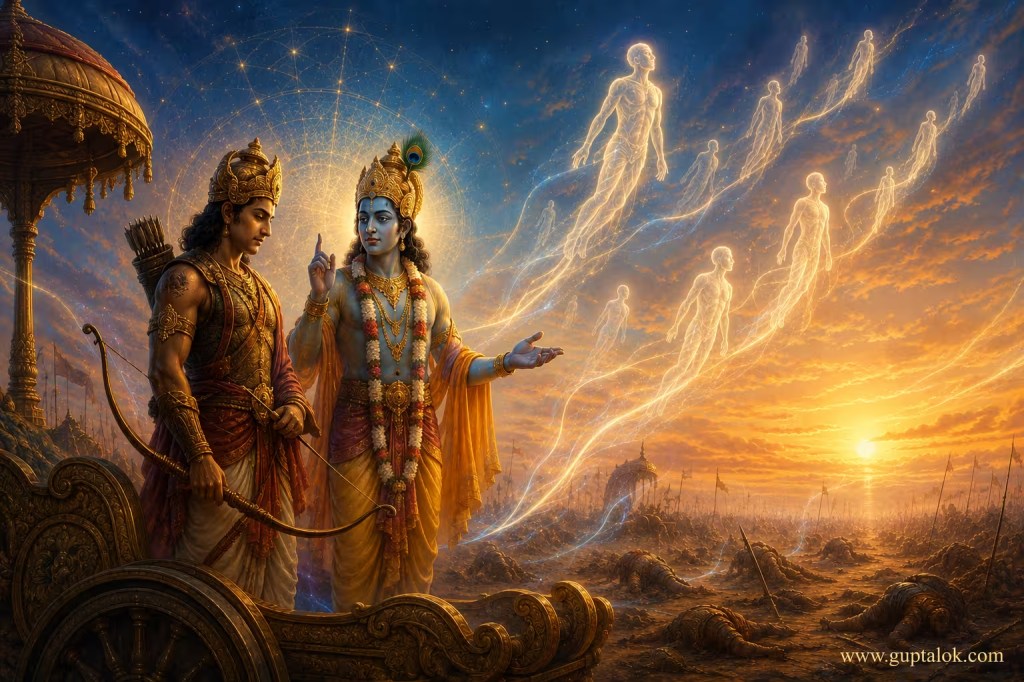
Krishna explains to Arjun on the battlefield that the soul is eternal and cannot be destroyed.In the next two shlokas, Shree Krishna provides further clarity on the existence of one’s real self – the soul. He explains more about why no one’s real self (soul) can be killed. He says that the soul can’t be killed because:
- It was never born.
- No soul is being born currently.
- No soul will be born ever in the future.
- No soul ever died.
- No soul went out of existence when its body died or was destroyed.
- Each soul is unborn, eternal, everlasting, and ancient.
Thus, Krishna makes Arjun and other humans understand that the soul exists without ever having taken birth. And it is well-known that only those things can decay or be destroyed which are born or produced. Since the soul does not take birth nor is it produced, it can’t have the property of being decayed or destroyed. Since it does not have the property to decay or be destroyed, there is no possibility of destroying or finishing it off.
Therefore, those who are sensitive and gentle humans should not feel the guilt of having killed a sinner, because:
- They can’t kill the real self (soul) of anyone. And,
- Those who call them killers are nescient as they don’t know that the real being of someone – the soul – can’t be killed.
As the soul can’t be killed, are killers of innocents also not guilty?
Soul can’t be killed is the absolute truth; therefore, saviours of innocents should not consider themselves guilty if they have to kill non-righteous people. However, this logic doesn’t apply to the non-righteous people when they kill innocent beings. Why? Because killing a body is not sin but killing innocence, righteousness, universal justice, and compassion for innocents is a sin. Righteous and non-righteous, both types of people, are blends of souls and bodies. And, they both should behave as their real self – the soul. The purpose of the soul being given a body is to be able to act. As per Dharma (the wish of God), the actions performed by every soul should only be for the smooth operation of God’s creation.
Ensuring smooth flow of God’s creation means letting all the living beings live peacefully and freely. Not only that but it also means to ensure that the future generations also behave the same and also receive the same treatment. How will that happen? By training the next generations the concepts of spirituality and universal welfare, and dismantling the bodies that act as resources in exploiting innocent living beings. Spirituality would make them wise enough to keep themselves away from material indulgence and biases. And dismantling the non-righteous bodies would prevent the spread of non-righteousness and material bias in future generations.
Material biases and indulgence are the basis of all non-righteous activities performed by anyone anywhere. Therefore, it is important to ensure that the actions of soul-body blends are not biased by material considerations but based on human integrity towards universal justice. And those who act based on material bias but not for every innocent living being’s welfare are guilty of disrupting the smooth flow of God’s creation. Therefore, when such people kill the innocents, they become guilty.
If we examine carefully, we find that the people who kill the innocents do this to attain some kind of material satisfaction. They do this for their personal benefit, family-based benefits, communal benefits, or other similar benefits. When they work based on this mindset, they ignore the concept of universal righteousness. This is what brings people into the fraternity of sinners and guilty people.
Thus, those who kill someone to ensure the welfare of all living beings without any material bias are not guilty. On the contrary, those who kill someone based on material bias, ignoring universal welfare, are guilty.
The concept of ‘soul can’t be killed’ suggests that no one can kill anyone; therefore, killing anyone (A body) is not a sin. However, if you kill someone who is innocent and is contributing to the flow of God’s creation, it is an absolute sin or guilt. On the other hand, if you killed someone (A body) and that slaying led to protection and welfare of innocent living beings, that killing is no sin.
Conclusively, the key focus area of humans should always be universal justice but not safeguarding or slaying a body. Their job is to do whatever is needed for the welfare of all innocent humans and animals, including future generations.
Therefore, when a non-righteous person kills any innocent being, he/she becomes a sinner. But when a righteous person kills a non-righteous person, he/she is not guilty or a sinner.
Why is there a need to kill the non-righteous if their actual self can’t be killed
You may have a question: why should a righteous person kill the non-righteous when his real self cannot be killed?
There are two points which have been mentioned above.
- Any soul can perform actions (whether good or bad) only when it has a body. It can’t act without having a body.
- Killing a body is not a sin, but disrupting the flow of God’s creation is a sin.
Thus, the righteous people, when they kill the non-righteous, don’t perform sin. They just stop the non-righteous activities from continuing to happen. How? They just separate the souls from bodies so that those souls can’t perform non-righteous actions.
Since non-righteous people’s actions always disrupt the smooth living of the innocent beings, they disrupt the flow of God’s creation. And disrupting the smooth flow of God’s creation is a sin. Therefore, righteous people destroy the bodies of the souls which are involved in non-righteous activities. Thus they obstruct the non-righteous actions from being performed. That is the actual purpose of all humans living anywhere.
So, when a righteous (benefactor of all living beings) person slays the non-righteous (Those who torment all living beings, with the exception of a few), he ensures the establishment of universal righteousness (spirit of concern for the well-being of all humans and animals, and an inclination to act accordingly) on the earth. His motto is not to kill someone but to ensure that resources that help in non-righteous action are dismantled. In the case of non-righteous people, the resource that helps in performing non-righteous actions to the soul is the body. By formally killing a non-righteous person, a righteous person just dismantles the resource (the body) that manifests the non-righteous actions. That’s why they should formally kill the non-righteous person even if his/her real self can’t be killed. Their motto is to just snatch the resources involved in performing non-righteous actions but not to kill the people.
Key Teachings
This article decoding the Bhagavad Gita shlokas 19,20, and 21 brings out the following learnings for humans:
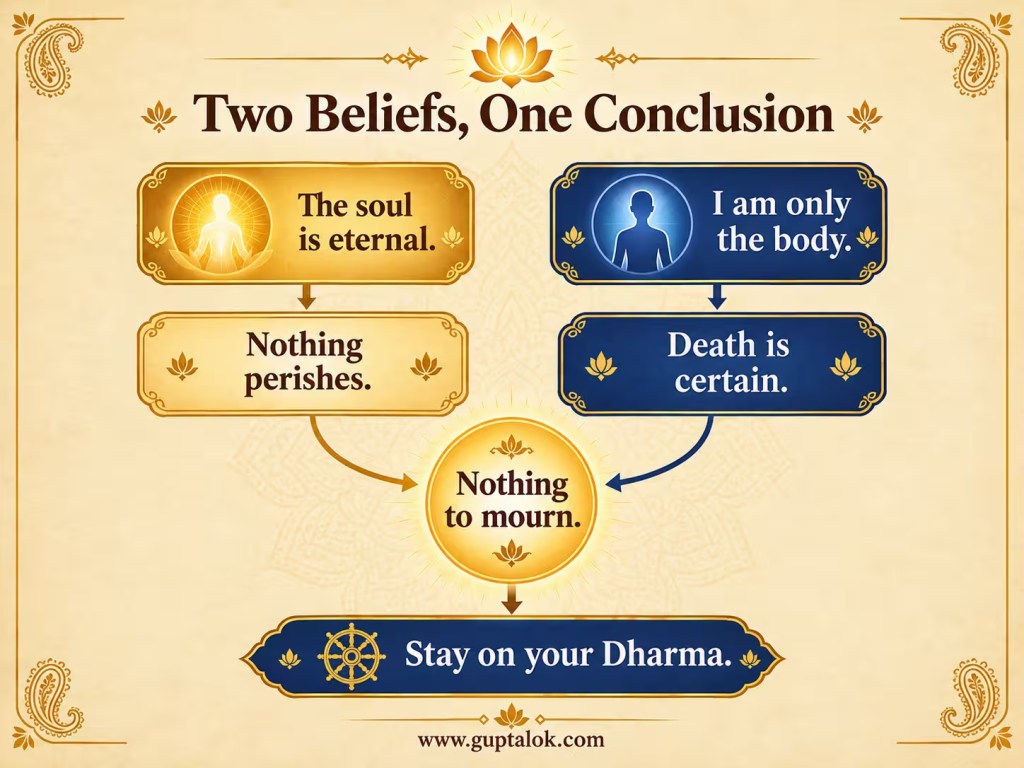
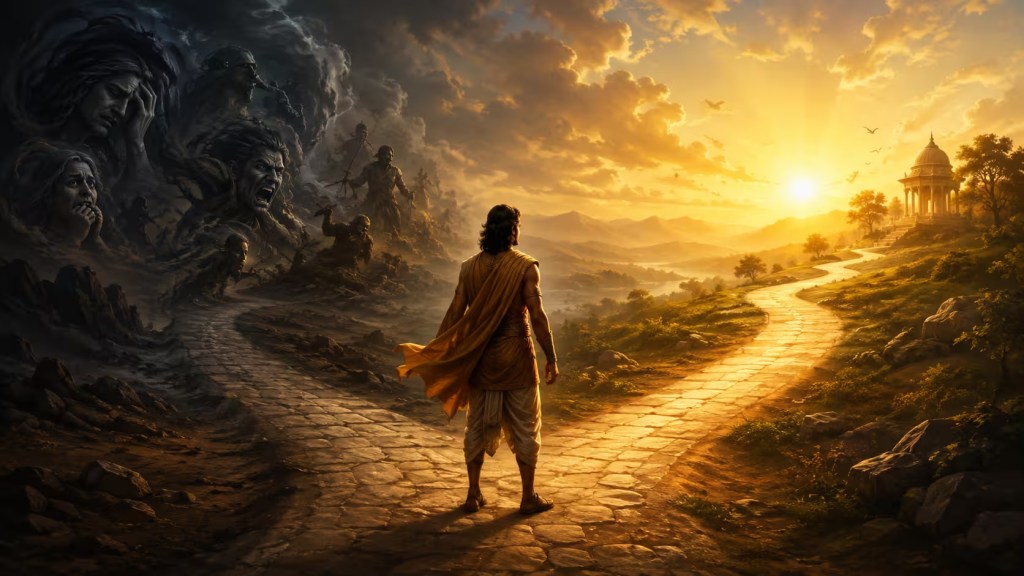
- The soul is immortal and everlasting; therefore, neither fear nor grieve due to death. Just stay focused on dharma (welfare of all living beings)!
- The soul is unborn, indestructible, and everlasting, but this fact must not be used as an excuse to kill innocent living beings. Because if you do so, you kill the dharma (tendency of seeking welfare of all living beings) within yourself, which is a sin.
- The fact that the soul is unkillable must not be an excuse to let the sinners keep killing and torturing innocents. Because if you do so, you let the dharma (tendency of seeking welfare of all living beings) vanish from the larger part of society, which is a sin.
Conclusion
These shlokas have given us the clarity that the soul is unborn and unkillable; therefore, we should not fear killing those who work to eliminate dharma (tendency of seeking welfare of all living beings) from the earth. Though the soul is indestructible, it is still advisable not to kill or torture innocent living beings because that is against dharma (tendency of seeking welfare of all living beings), and if you do so, you fall into the same category killing whom isn’t a sin.
In the following shlokas, Krishna is defining more of how the soul actually is. Why doesn’t it die? What happens to the soul after one’s body-based death? Can it be impacted by any of the worldly means? So stay tuned!
FAQs (Frequently Asked Questions)
What does BG 2.20 say about death?
Verse 2.20 of the Bhagavad Gita states that death applies to the body (the manifestation of life), not to the soul (the true self). This means that upon death, only the body changes or perishes, not the soul (the true self of every living being).
What really happens after death?
After death, the soul (the true self of a living being) either enters another body or merges back into its original form (incorporeal form of God), from which it was separated in the first place. Those souls enter another body that have done ordinary or bad deeds to attain something for themselves while being in a body. On the contrary, those souls who have acted based on Dharma without willing anything for themselves while being in a body merge back into the incorporeal form of God. It means they attain liberation.
Is it good to sacrifice animals before the Deity?
No, it is neither good nor right to sacrifice animals before a deity, because a deity does not demand the life of an innocent animal in exchange for granting your wishes. If you are undeserving of something, the deity may ask you to give up something you believe you cannot live without — but never the life of an innocent animal. Those who demand that you sacrifice innocent animals are ill powers.
If we speak of God specifically, he will not want you to kill his own children, because every living being, not just humans, is a child of the same God. Remember: someone who is father to only a few cannot truly be God. If he is God, he must be the father of all living beings.
Since the soul cannot be slain, what is wrong with slaughtering animals?
It’s true the soul can’t be killed — but that’s not the point. What’s wrong is not the killing of a body, but snatching the body from an innocent soul.
The body is merely a vehicle for the soul to act in the world. As per Dharma, every soul’s actions should serve the smooth functioning of God’s creation. A righteous person defending the innocent, even if it means killing a non-righteous aggressor, is acting in line with this purpose. But slaughtering an innocent, defenseless animal serves no such purpose — it is an act against righteousness, universal justice, and compassion. By doing so, you disrupt the smooth existence of that part of creation embodied by the animal.
So the crime was never about ending a life because the soul survives anyway. It’s about betraying the very reason the soul was given a body in the first place. And that is why killing innocent animals is absolutely wrong—it is monstrous.
Does the acknowledgment of the soul’s eternity trivialize life?
No, the acknowledgement of the soul’s eternity doesn’t trivialize life — rather, it trivializes fear, greed, ego, attachment, and other pollutants of human character. Once these pollutants are trivialized, you stop acting on their impulse and instead start acting on wisdom, seeking what is right for all living beings. And when this happens, you enhance the humanity within yourself.
Can you really KILL someone?
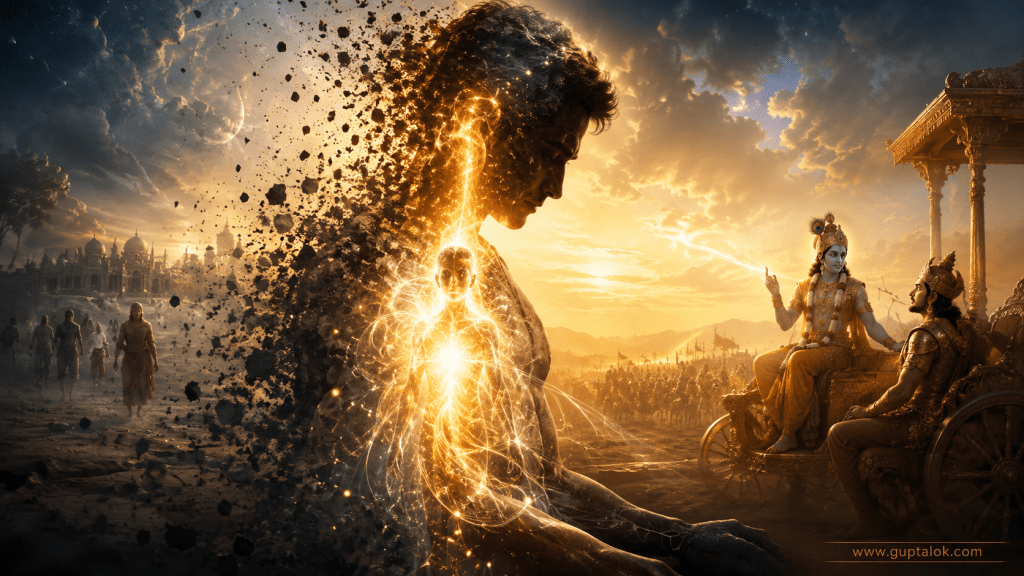
Yes, people can be killed, but that doesn’t make them non-existent because death happens to the body, but the bearer of that body (the soul) remains as it is.
What is the proof of the presence of the soul?
The proof of the presence of the soul lies in observing and examining the dead body. If you observe carefully, you’ll realize that there is nothing physical that leaves the body at the time of death. Just after death, every organ remains as it was right before death, be it the heart, be it blood, be it lungs, or anything else. The body still stops breathing because something invisible leaves the body, which is what the soul is.










Leave a Reply