
Choosing wisdom over temporary emotions—the path to righteous action and salvation, as taught in Bhagavad Gita Chapter 2, Shlokas 14 and 15.
Bhagavad Gita chapter 2, verses 14 and 15 teach us how a person can attain the ability to make the righteous decision. They suggest how a person can attain salvation without becoming a hermit. They give us a clear idea of the reasons that make people perform sinful or inhuman activities or let them prevail. This article starts with a word-by-word meaning of these Gita verses, and then it decodes their core essence, key learnings, and the entire workflow of the concepts taught in the verses. Before we dive deeper into the ocean of Bhagavad Gita shlokas 2.14 and 2.15 teachings, let’s have a look at the original verses and their literal meaning.
Bhagavad Gita, Chapter 2, Shlok 14 and 15
Below are the Geeta Shlokas 2.14 and 2.15 in Sanskrit with their English transliteration and translation for better understanding of pronunciation and meaning.
Sanskrit Text
मात्रास्पर्शास्तु कौन्तेय शीतोष्णसुखदु:खदा: ।
आगमापायिनोऽनित्यास्तांस्तितिक्षस्व भारत ॥ 14॥
यं हि न व्यथयन्त्येते पुरुषं पुरुषर्षभ ।
समदु:खसुखं धीरं सोऽमृतत्वाय कल्पते ॥ 15॥
English Transliteration
Matraasparshaastu Kaunteya Sheetoshna-sukhdukhadaah |
Aagmaapaayino-Anityaastaanstitikshasva Bharata ||14||
Yam Hi Na Vyath-Yantyete Purusham Purusharshabh |
SamDukkhasukham Dheeram So-Amrit-Tvaay Kalpate ||15||
English Translation
Oh, Son of Kunti (Arjun)! Heat, cold, happiness, and grief are just matters of the senses. They come and go; they don’t last forever. You (humans) must tolerate them. ||14|| Oh, transcendent human! Those who do not distress at all from them, remain undisturbed from happiness and grief, [and] are patient, attain salvation. ||15||
Meaning, Central Idea, and Life Lessons
These are two of the very significant Geeta shlokas where Shree Krishna tells Arjun and us the main reasons for one’s deviation from the path of righteousness. He says that humans feel happy and grieved just because of bodily sense-based feelings, and that’s why they can’t identify sensible paths. The Krishna form of God says that humans should tolerate bodily feelings such as happiness, grief, fear, ego, etc., and act based on wisdom. He says that the people whose decisions are not driven by the body-based senses, but by wise contemplation of the situation, are the ones who are eligible for salvation.
How indulgence in sense-based feelings distract from the path of Humanity
When humans are stuck or heavily indulged in any bodily sense-based feeling, they wish the situation to remain likeable for themselves, irrespective of universal righteousness. To ensure the situation remains likable, they start compromising on what is right, and act based on what pleases them. They sometimes dominate the right and sometimes favour the wrong, and avoid situations of conflict. However, the unrighteous people or demonic people don’t compromise, because they neither have compassion for the innocents nor do they want others to survive. It results in worsening of the situation again because non-righteous demonic people continue doing ill deeds with even more power.
Thus, the person who compromises with evil to avoid conflicts, out of a wish to keep the situation conflict-free, is again exploited. And this circle keeps going on, and on and on, where insensitive and demonic humans continue committing atrocities, and sensitive humans continue compromising with them. This leads to empowering the evil and dominating the goodness and righteousness, causing loss of humanity in societies and the world. Therefore, we should not let our feelings drive our decisions, but we must contemplate in an unbiased manner whether what would be right for humanity, and act accordingly, tolerating our bodily sense-based feelings such as grief, fear, etc.
Let’s understand this concept through a few examples of how bodily feelings distance us from righteousness or Humanity.
How may grief, if not tolerated, lead you to empower evil
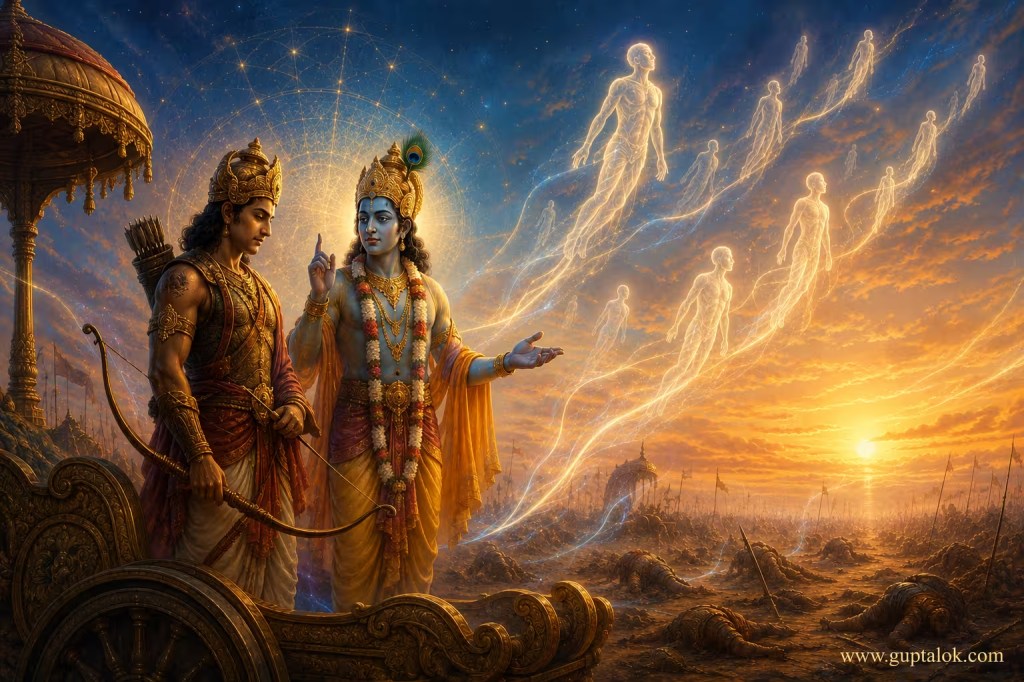
The best example of this was Arjun when he was grieved by the thought that people of his family would die. Since he was not willing to tolerate the pain that was to come after his family members (Kauravas) died, he was avoiding his fight against evil (Kauravas). Thus, he was to let evil survive and make itself even stronger. This could lead to more suppression of the innocent by evil. On the contrary, when he, with the guidance of God, decided to tolerate the potential grief due to the death of the Kauravas, he fought against them and could eliminate those who directly or indirectly supported the thought of playing with a woman’s dignity.
In modern situations, we can take an example of a family, a society, or a country where people love to kill and eat animals. Others often support or tolerate this wish and act, due to the fear that these eaters of innocent animals would be angry if criticized. They think that if meat-eaters were angry, the harmony among humans would lessen, which might lead to grief. Since they are not ready to tolerate this grief, they don’t oppose the evil that promotes eating innocent animals. If they were ready to tolerate the grief, they would speak against them and may eliminate this evil from humans sooner or later.
How may fear, if not tolerated, lead you to empower evil
The best example of this could be the example of non-muslims and non-radical muslims worldwide who fear extremist muslims. These non-muslims and non-radical muslims neither fight nor speak against the extremists because they fear the fact that the extremists would harm them and their families. Since they don’t tolerate fear, they are controlled through the same fear so as not to stand against the evil of religious radicalization. When they do not stand against the extremists, they offer room to the extremists to radicalize more people and suppress more innocent and non-radical people. Thus, the frightened people empower extremism and religious radicalization, just because they do not tolerate and fight against fear, but decide to live beneath it.
On the contrary, if they develop the mental ability to bear and go beyond fear, they can very well plan to eradicate extremism and contribute to building a healthy, humanitarian society worldwide. Such people may initially feel frightened by extremists, and get into deep uneasiness and fear of losing their lives and families. However, they soon refuse to surrender to this terror to seek false comfort, but they choose to endure the mental and emotional pain it inflicts. This resolve leads them to a defiant mindset of “we’ll see what happens,” fostering the courage to speak out and confront the evil of extremism head-on. Ultimately, this collective bravery paves the way for eradicating religious and other types of extremism.
These examples prove that the excessive indulgence in sense-based feelings leads people to indirectly support or walk on the inhuman path. Once they get themselves onto that path, they are stuck in the illusory happiness, luxuries, harmonies, etc. Conclusively, they miss the path of righteousness that leads to salvation, the absolute liberation. That is why Shri Krishna taught Arjun and us to not indulge in the sense-based feelings, but to tolerate them, and make the right decision based on righteousness through pure wisdom.
Key Learnings from Bhagavad Gita Shlok 14 and 15 of Chapter 2
These Shlokas of Bhagwat Geeta teach us the following:
- When you don’t tolerate the impulse, pain, grief, etc., incurred due to any of the sense-based matters, you are prone to act biasedly but not wisely.
- The biased decision-making would make you a soldier of non-righteousness (someone who is against Humanity), which is the biggest obstacle in the way of Salvation.
- If you practice tolerating the impulse, pain, grief, etc., you create space to think and contemplate every situation instead of immediately reacting based on sense-based feelings.
- When you have space to think and the determination to tolerate, you are more likely to find the absolutely righteous way. And when you walk on that path, you move towards salvation.
Conclusion
This article explaining Gita Shlokas 2.14 and 2.15 offers clarity on remaining free from the control of sense-based feelings. It teaches one to acknowledge every feeling but avoid acting on it impulsively. It suggests setting the feeling aside, using wisdom to reflect, and then deciding the next course of action. It suggests that one’s decisions should not be driven by sense-based feelings, but by unbiased, unpressured contemplation on all the aspects that could be affected by doing or not doing something. If this article helped you understand the Gita’s concepts better, check out our explanations of more verses. If you have any suggestions to enhance the clarity of the shloka, please use the comment section to share them.
FAQs: Bhagavad Gita Chapter 2, Verse 14 and 15
1. What is the central teaching of Bhagavad Gita Chapter 2, Shlokas 14 and 15?
Bhagavad Gita Chapter 2, Shlokas 14 and 15 teach that bodily experiences such as pleasure, pain, heat, cold, happiness, and grief are temporary. Shri Krishna advises people to tolerate these changing feelings instead of letting them control their decisions. A person who remains steady and acts through wisdom rather than emotions becomes eligible to progress towards salvation.
2. Why does Shri Krishna ask us to tolerate happiness and sorrow?
Shri Krishna explains that both happiness and sorrow arise from the body’s interaction with the external world and do not last forever. If people become attached to either, they may make biased decisions that deviate from righteousness. Tolerating these temporary experiences allows a person to think clearly and choose the path that benefits humanity.
3. Does Bhagavad Gita teach us to suppress our emotions?
No. Bhagavad Gita does not teach emotional suppression. It teaches people to acknowledge emotions such as fear, grief, anger, or pleasure without allowing them to dictate their actions. The goal is to make decisions based on wisdom and righteousness rather than temporary emotional impulses.
4. How can fear and grief lead a person away from righteousness?
Fear and grief can make people avoid doing what is right if they become unwilling to bear emotional discomfort. A person may stay silent against injustice, tolerate wrongdoing, or compromise with evil simply to avoid conflict or suffering. According to these verses, learning to endure such feelings helps one act according to righteousness instead of personal comfort.
5. What does ‘Samaduhkha Sukham’ mean in Bhagavad Gita?
‘Samaduhkha Sukham’ refers to maintaining mental balance in both happiness and sorrow. It does not mean becoming emotionless; rather, it means not allowing pleasant or unpleasant experiences to disturb one’s judgment. Such steadiness enables wiser and more righteous decision-making.
6. How do Shlokas 2.14 and 2.15 relate to Arjuna’s dilemma?
Arjuna hesitated to fight because he anticipated the grief of losing his relatives. Shri Krishna explained that allowing grief to determine his decision would prevent him from fulfilling righteousness. By learning to tolerate personal sorrow and acting according to Dharma, Arjuna could protect justice instead of allowing evil to prevail.
7. How can these teachings be applied in everyday life?
These teachings encourage people to pause before reacting to fear, anger, pleasure, or grief. Whether facing family disputes, workplace challenges, social injustice, or moral dilemmas, one should first tolerate the emotional impulse, carefully examine what is truly right, and then act with wisdom rather than emotion.
8. Why are Bhagavad Gita Shlokas 2.14 and 2.15 important for attaining salvation?
According to these verses, salvation becomes possible when a person’s decisions are guided by wisdom instead of temporary bodily sensations and emotions. By remaining steady in both pleasure and pain and consistently choosing righteousness over personal comfort, one gradually progresses toward liberation (Moksha).














Leave a Reply