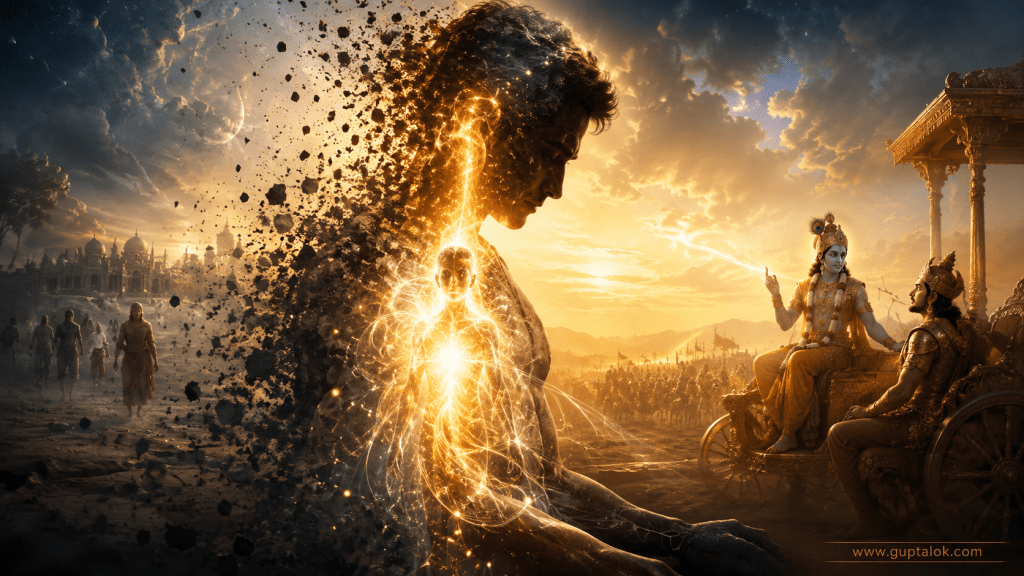
Sat is permanent, Asat is not. Soul is permanent, body is not. Tatvadarshi know each aspect of each.The Bhagavad Gita Chapter 2 Shloks 16, 17, and 18 make us aware of a universal principle that says, “nothing can survive without the existence of Satya”. It also informs us that Asat cannot prevail forever because it does not have any real basis. It talks about the internal characteristics of those who can identify the difference between the two, and are aware of the end of both. These shlokas suggest that one can attain those characteristics by knowing the indestructible element which causes the existence of everything in this material world. These shlokas also provide the information on the key difference between that indestructible element and material bodies, so that humans can know that essential and whole element.
This article decodes each aspect of these shlokas by explaining the meaning of Maya (asat) and Sat. It also explains why sat is permanent and asat is not. It deep dives into the meaning of tatvadarshis. It also describes the core element that is behind the existence of everything material and why it is indestructible. The article also explains why the knowledge of that element makes one tatvadarshi. So, let’s start our journey in the world of Geeta Shlokas 2.16, 2.17, and 2.18 with these original verses.
Bhagavad Gita, Chapter 2, Shlok 16, 17, and 18
Below are the original Sanskrit shlokas with their transliteration and translation in English.
Sanskrit Text
नासतो विद्यते भावो नाभावो विद्यते सत: ।
उभयोरपि दृष्टोऽन्तस्त्वनयोस्तत्त्वदर्शिभि: ॥ 16॥
अविनाशि तु तद्विद्धि येन सर्वमिदं ततम् ।
विनाशमव्ययस्यास्य न कश्चित्कर्तुमर्हति ॥ 17॥
अन्तवन्त इमे देहा नित्यस्योक्ता: शरीरिण: ।
अनाशिनोऽप्रमेयस्य तस्माद्युध्यस्व भारत ॥ 18॥
English transliteration
Naasato Vidyate Bhaavo Naabhaavo Vidyate Satah |
Ubhayorapi Drishto-antstvanayostatvadarshibhih ||16||
Avinaashi Tu Tadviddhi Yen Sarvamidam Tatam |
Vinaashamavyayasyaasya Na Kashchit Kartumarhati ||17||
Anta-Vanta-Ime-Deha Nityasyokthaah Sharirinah |
Anaashino-aprameyasya Tasmadyudhyasva Bharat ||18||
English translation:
There is no real existence of Asat (non-righteousness, Illusion, temporary, etc.), and there is no lack or inexistence of sat (righteousness, truth, permanent, etc.). Those who have attained absolute wisdom, purified their minds, and perceived the essence of reality, can clearly see how both of these conclude. ||16|| Understand that indestructible is that, by which, this entire world (anything physical that is there anywhere) is pervaded. No-one is capable of stamping out this everlasting element (Soul and God, here the context is soul). ||17|| The only thing that can be liquidated is this body, the bearer of this body (soul – real you and real them) is imperishable, it is immeasurable (beyond everything that is material). Therefore, Bharat (Arjun!)! You just fight.
Meaning, Central Idea, and Key Teachings:
In these Bhagavad Gita Shloks, Shree Krishna talked about Maya and Satya.
- Maya – Illusion – everything that is temporary and must change.
- Satya – That is permanent and absolute in all situations and conditions.
He said the following:
- Asat is not permanent.
- Sat can’t be eliminated.
- Tatvadarshis know the final fate of both – Sat and Asat.
- Only the body can be destroyed, but not the bearer of the body which is Soul.
- The soul is unmeasurable which means it is not material.
In order to understand the essence behind these statements and verses, we must understand the real meaning of each term. Let’s delve into them one by one.
What is Maya (Illusion)
Maya (Illusion) is that which is impermanent yet seems to be the most important part of life or existence. It is the things, feelings, thoughts, and everything else associated with the material world that induces one to ignore universal righteousness. It induces or compels one to disregard the principles of universal equity and the welfare of all living beings. Thus, it renders humans selfish and narrow-minded. This does not mean you should start hating everything that is material or physical. You simply must avoid becoming overly engrossed in or attached to such things. You should use and consume them — but without losing yourself in them.
The key is understanding. You must recognize the true utility of material objects. Ask yourself how they contribute to the well-being of humans and all other living creatures. Once you understand that purpose clearly, use those objects accordingly. But do not develop an attachment to the object itself. Do not become attached to its outcomes either. Use it for its rightful purpose and move on.
Now consider the opposite. If you fail to understand the true purpose behind the existence of the material objects around you, things go wrong. If you approach them with a narrow or selfish mindset, you will naturally become attached to them. You will begin living solely for their sake. And the moment that happens, all of these things transform into Maya. Remember, Maya retains its fundamental essence while simultaneously shifting and adapting in its material manifestation according to prevailing circumstances.
If you don’t know or don’t accept the truth about anything material and consider it something else, it is Maya (illusion). Let’s understand it with an example of Money.
We all know that money is an instrument that allows us to exchange the things of use. However, many people have created a different perspective about money. A few consider it success, and a few consider it the only purpose of life, and therefore, people are becoming slaves to money. All the material things are there for us to use, but not to be stuck just in them. When you are stuck in one or the other material thing, thought, or feeling, making it the only purpose or rule of life, it becomes Maya (Illusion). If you use that thing, thought, or feeling only where it makes a positive impact, it no longer remains Maya (Illusion).
What is Satya
Satya is made of two Sanskrit words – Sat and Ya. ‘Sat’ means right, pure, or sacred, and ‘Ya’ means ‘that’. Thus, Satya is that which is right, pure, and sacred, not just for a small group of beings but universally. This is something which, if not present, then no one and nothing would survive. Even Maya, Asat, or Evil can’t survive without the presence of Satya. Let’s understand it with an example from the Mahabharata.
In the Mahabharata, Karna, along with the Kauravas, killed the unarmed Abhimanyu, which was unethical. Though the Kauravas didn’t care about ethics while killing Abhimanyu, they wanted the Pandavas to follow the ethics in that battle. They questioned Arjun when he killed the unarmed Karna. They questioned Bheem when he hit Duryodhana below the belt. They questioned Yudhisthir when he tricked the message of Ashwatthama’s death to simplify Dronacharya’s death. Why? Because if the Pandavas would follow the righteous rules of war, then only, those soldiers of evil could survive.
Thus, Krishna’s assertion that “‘Sat’ never ceases to be” proves to be the absolute truth, because even ‘Asat’ needs it to keep surviving.
Asat is not permanent
Asat means Maya (illusion), which we have already discussed above. When God said to Arjun that Asat is not permanent, he was referring to attachment with human bodies, relationships, and semi-permanent duties (check Dharma section to understand duties). He said the following:
- These things are not universal.
- Their existence is not Satya, but Maya.
- They just seem to you to be the absolute truth, but actually they are not.
- These are the things which keep changing with time.
- Therefore you shouldn’t be much attached to them.
Let’s understand it with the example of Dronacharya.
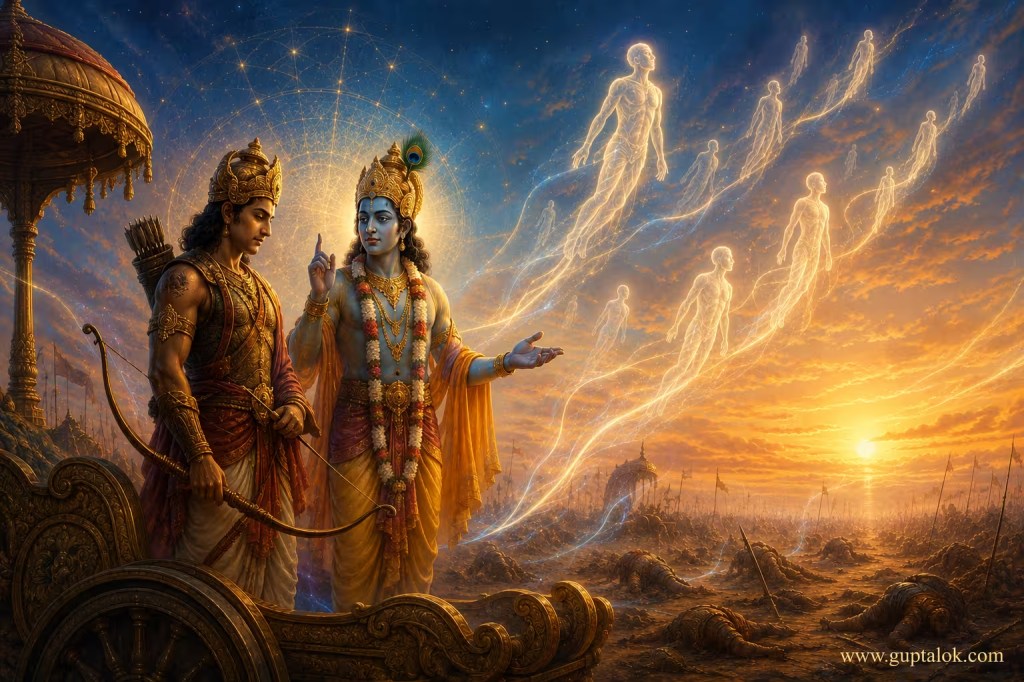
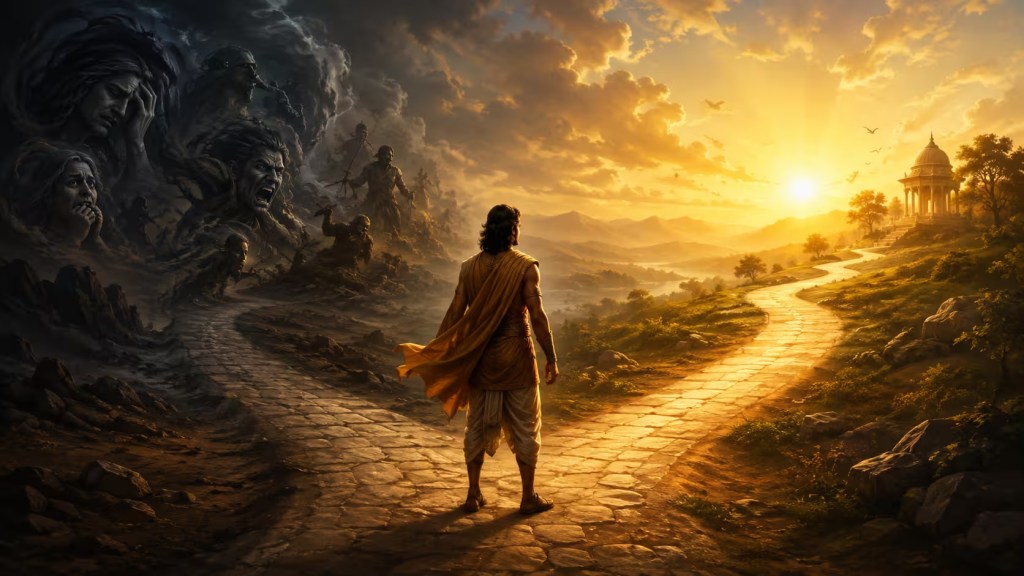
As per Krishna’s aforementioned concept, Dronacharya, for whom Arjun was highly concerned, was Asat, or Maya, or Illusion. Shree Krishna wanted to make him understand that Drona’s physical existence was not permanent, but his invisible (soul) existence was permanent. Thus, the Dronacharya, which Arjun could see and was concerned about, was asat (Impermanent, Maya, or Illusion). However, the Dronacharya, which Arjun could not see, was the soul within the body named as Dronacharya. This was Sat, which means permanent; it was the real existence of Dronacharya. Therefore, It was illogical to avoid fighting evil just to protect physical Dronacharya and others. They wouldn’t live forever anyway. On the contrary, the real them (soul) cannot be harmed or destroyed. So, why fear their death?
Conclusively, it is better to fight for right and against evil, without worrying about anyone’s existence, because their body-based existence is not forever and their real existence can’t be ceased.
Sat can’t be eliminated.
As discussed above, the context of Sat in these Gita shlokas is the real existence of all living beings. That real existence is the soul within the respective bodies. And, it is impossible to kill, harm, or eliminate the soul. Whatever harm can be done is done to the body, but not to the soul. A body is considered dead when the soul is separated from it, but not when the soul is killed.
Tatvadarshis know the final fate of both – Sat and Asat.
Tatva is a sanskrit hindi word that means an element. An element is something that makes anything. Those who know about periodic tables, which is generally introduced to kids in chemistry classes in school, should understand an element better. The periodic table is the table that lists the elements which chemical scientists have identified by now. Currently they are 118, starting from Hydrogen going up to Oganesson.
Whenever material scientists wish to know the real characteristics and/or usage of anything, they study the elements it consists of. Similarly, spiritual scientists study everything material and non-material, to know the real characteristics, usage, and/or purpose of things and people. They are always in discovery of the element that is the core element behind the existence of everything and everyone. After rigorous research and study, many spiritual scientists get to know the core element behind everything and everyone that’s there anywhere. This clarity purifies their minds and offers them an absolute wisdom that helps them perceive the essence of reality. Such people are the ones who are referred to as Tatvadarshis in Bhagavad Gita Shlok 16 of chapter 2.
This core element is ‘Sat’ which itself is God, whom anyone can claim to know. However, the tatvadarshi are those who know the basic nature, characteristics, wishes, and purposes of this core element. They are the most intelligent humans who don’t see God just as a miracle man and ‘Sat’ just as something considered to be right. On the contrary, they have reached the level of wisdom where they don’t just live on considerations and faiths, but they know that God and Sat are one. Furthermore, they discern precisely how to recognize them. Consequently, they are able to perceive when, where, and in what form God is present.
Since they have developed the wisdom to identify what is ‘Sat’, they can also identify what is opposite to that – ‘Asat’. Now, because they know what exactly ‘Sat’ is and what ‘Asat’ is, they also know how exactly they conclude in any walk of life. And that conclusion is that ‘Sat’ is permanent and ‘Asat’ is not.
Only the body can be destroyed, but not the bearer of the body which is Soul.
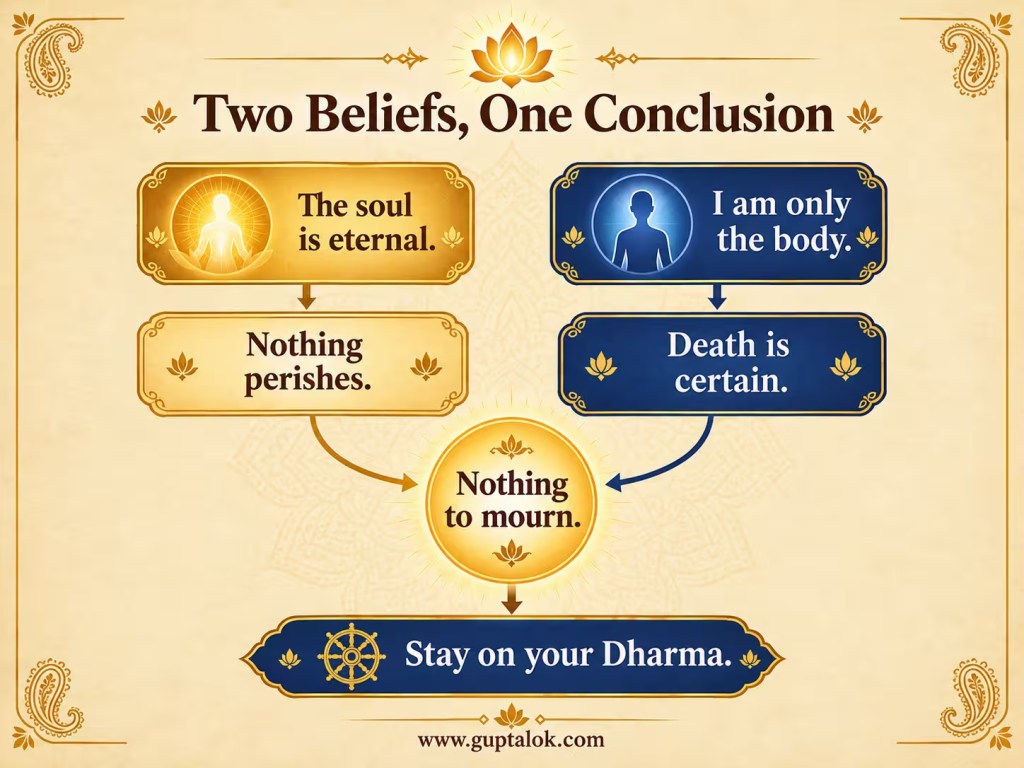
Krishna taught earlier that ‘Asat’ is not permanent and ‘Sat’ is. He further explains that the body is ‘Asat’, while the bearer of the body, which is the soul, is ‘Sat’. Thus, the soul is permanent, and the body isn’t. Since the body is impermanent, it is the only thing that can be harmed or destroyed. On the other hand, the soul – the bearer of the body – is ‘Sat’. Thus, it cannot be harmed or destroyed.
The soul is unmeasurable which means it is not material.
The next thing God spoke about is the soul, which he mentioned as the bearer of the body. He mentioned that the soul is imperishable and immeasurable, which means the following:
- The soul cannot be measured, which proves that the soul is non-physical because you can measure only the physical aspects, but not the abstract ones.
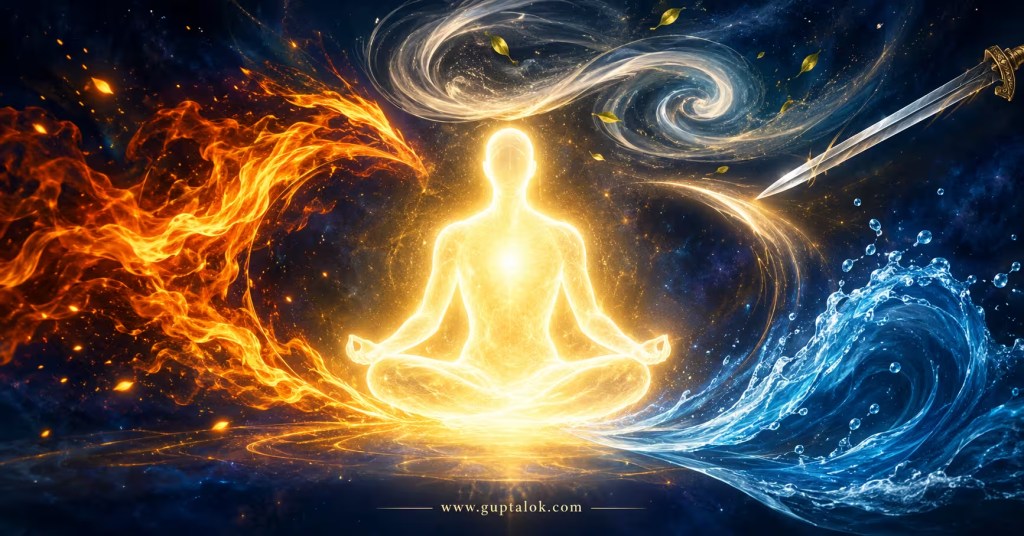
- The soul cannot be destroyed or eliminated because it is not material, and non-material things cannot be harmed or annihilated.
All these points demonstrate that the soul transcends materiality and form. Since it does not fall into the category of objects, living beings, or forces possessing mass, it—and it alone—should be placed at the center of all decision-making processes. Why? Because entities, living beings, or forces devoid of mass remain unaffected by vices such as greed, fear, ego, attachment, envy, etc. This is because every form of impurity or distortion arises solely from aspects possessing mass. Now, since the soul remains untouched by these impurities, it harbors no bias toward anyone. Consequently, all its decisions are directed solely toward the cause of universal justice—that is, toward ensuring the welfare of all human beings and animals. This constitutes the core teaching of verses 16, 17, and 18 of the second chapter of the Bhagavad Gita.
Key Teachings
The key teachings of Bhagavad Gita verses 2.16, 2.17, and 2.18 and this article include the following.
- Maya (Asat) is not the absolute truth, but it just seems to be the absolute truth due to humans’ ignorance of truth beyond it.
- Satya (Sat) alone is supremely perfect and imperishable and remains permanent regardless of humans’ acceptance or rejection.
- If Humans follow the path of Sat, they become wise and move towards salvation. If they follow the path of Asat or Maya, they become foolish and move towards mental slavery.
- The Path of Sat or Satya is something that ensures the welfare of all living beings and is the basis of everything material. Those who get to know this fact are the knowers of the root of everything that’s there anywhere (Tatvadarshi). Such people are clearly able to differentiate between Sat and Asat, and they know how each of them concludes.
- The Soul is the Sat and the body is Maya (Asat). The body can be destroyed as it is Maya (Asat); the Soul can’t be destroyed as it is Sat (Satya).
- Thoughts, actions, and statements focused on the welfare of all living beings without any bias are sat or Satya while thoughts, actions, and statements focused on welfare of a few based on biases are Asat or Asatya.
- Asat also needs Sat to remain in existence. Not even sinners can survive without using Sat as their shield.
Conclusion
This article, based on Geeta verses 2.16 to 2.18, establishes that Sat or Satya, which includes God, the Soul, and the tendency to seek the welfare of all living beings, has permanent existence. It cannot be eradicated at all because no one, including sinners and Satan, can survive without the existence of Sat or Satya. Therefore, we should always remain focused on staying on the path of Sat (Satya) while continuing to contemplate what Sat (Satya) actually is. Through deep, sustained contemplation, Sat (Satya) becomes an integral part of your character and mindset; you then realize that your true essence—your ‘Sat’—is the Soul, not the body.
When this realization settles in your consciousness not merely as a matter of belief or disbelief, but as knowledge grounded in clear experience, you begin to easily distinguish between ‘Sat’ (Satya) and ‘Asat’ (Maya/illusion). And that is when you become Tattva-Darshi: one who has the ability to take independent decisions backed by Sat (unbiasedness and universal wellbeing), to follow the path of Sat (the tendency to seek the welfare of all innocent living beings), and to protect Sat (all innocent living beings, collectively). Such People can’t be manipulated or enslaved; they are possessors of highest wisdom and clarity. So, start practicing to be a Tatva Darshi now, to give yourself a character that God wants you to have.
FAQs (Frequently Asked Questions)
What does Bhagavad Gita Shloka 2.16 mean by “the unreal has no existence, and the real never ceases to exist”?
Bhagavad Gita Shloka 2.16 states that the unreal has no existence, and the real never ceases to exist. These two phrases together explain the fundamental nature of reality as understood in the Gita.
The first phrase — “the unreal has no existence” — refers to everything physical, everything bound to the material world, and anything not aligned with universal welfare. Such things are temporary by nature; they arise, change, and eventually come to an end. No matter how solid or permanent they may appear, they carry within them the seed of their own dissolution.
The second phrase — “the real never ceases to exist” — refers to the soul, along with actions and thoughts rooted in universal welfare. These are eternal. They cannot be created, destroyed, or diminished. They existed before, they exist now, and they will continue to exist beyond any point in time we can conceive of.
Together, the verse draws a clear line between the transient and the eternal: what is temporary was never truly “real” in the first place, and what is truly real was never subject to time or destruction to begin with.
According to Bhagavad Gita 2.16, what is the difference between reality and illusion?
According to Bhagavad Gita 2.16, reality is that which exists forever — something that remains relevant and true no matter how much time passes. Reality can never become nonexistent or irrelevant; it is permanent by its very nature.
Illusion, on the other hand, refers to those things and aspects that exist for a while and then vanish. Everything physical and material falls into this category — it appears real for a time, but it is temporary and bound to change or dissolve eventually.
In essence, whatever sits behind the physical existence of anything — the abstract, unchanging power or essence that gives it life — is reality. Everything that is merely physical, and dependent on that underlying reality for its existence, is illusion.
Is the soul eternal according to Bhagavad Gita Shlokas 2.16 and 2.17?
Yes. According to Bhagavad Gita Shlokas 2.16 and 2.17, the soul is eternal and indestructible. Shloka 2.16 explains that the unreal or temporary does not have permanent existence, while the real never ceases to exist. Shloka 2.17 further states that the eternal principle that pervades the entire body is indestructible and cannot be destroyed.
Together, these verses teach that the physical body is temporary, but the आत्मा (Atman or soul) is eternal. The body may change and eventually perish, but the true self remains unaffected by physical destruction.
If the soul is eternal, why does the body die according to Bhagavad Gita 2.18?
According to Bhagavad Gita 2.18, the body dies because it is material and finite, while the soul, which dwells within it, is eternal and indestructible. The soul, being abstract and non-material in nature, has no inherent tendency toward decay or destruction — it exists beyond the physical laws that govern change and dissolution. The body, by contrast, is made of matter, and everything material carries within it the very nature of impermanence; it is bound to change, decay, and eventually perish. This is simply the nature of physical existence.









Leave a comment