Arjun was standing between two armies. He was surrounded by those he loved and those he was meant to fight. He had argued passionately, wept openly, and reasoned endlessly — all in the name of Dharma (Duty). And then, Krishna looked at him and said, “wise people do not mourn like this. Not for the living. Not for the dead.” Why? Because wisdom sees beyond the body, beyond the moment, and beyond personal attachment. Bhagavad Gita Chapter 2 Shlok 11 is the verse where Krishna begins the greatest lesson ever taught to a human being. It is the opening of Sankhya Yoga — a body of knowledge that explains everything about life and death. It defines how every thinking person should approach every decision, every loss, and every duty they will ever face. Let’s start with the Sanskrit to English transliteration of Geeta Shlok 2.11, and deep dive into its essence.
ShreeBhagwanuvaach,
Ashochyaananvashochastvam Pragyaavaadaanshch Bhashshe |
Gataasoonagataasoonshch Naanushochanti Panditaah ||
English translation:
Respected God Said,
Though you are talking like an intelligent person, you are mourning (or thinking) for those who are not worthy to be mourned for (or not worthy to be thought about). Wise people neither mourn (think) for those who have died nor for those who have not died.
Exegesis and Central Idea:
After listening to many arguments of Arjun, such as:
- Killing the kinsmen would lead to the loss of Dharma in the Clan.
- Victory and Kingdom should not be kept above family members.
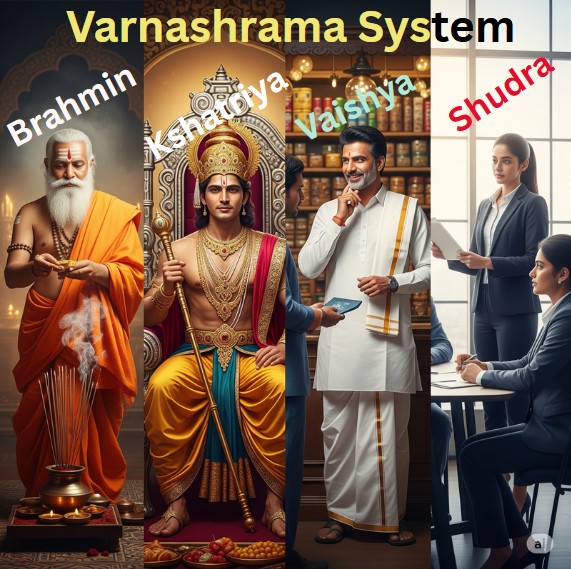
- The death of kinsmen might lead to Varna-Sankar.
- Killing gurus and elders incurs grave sin.
- War destroys the dynasty, eroding eternal traditions and dharma.
Shree Krishna responded to Arjun directly. He told him that his words sounded like those of an intelligent person. But his thinking was not aligned with that intelligence. He was mourning for people that wise people would never mourn for. Krishna made this distinction clearly. He said that those who have truly attained wisdom do not mourn much for those who have left the mortal human body. They also do not mourn much for those who are likely to leave it soon.
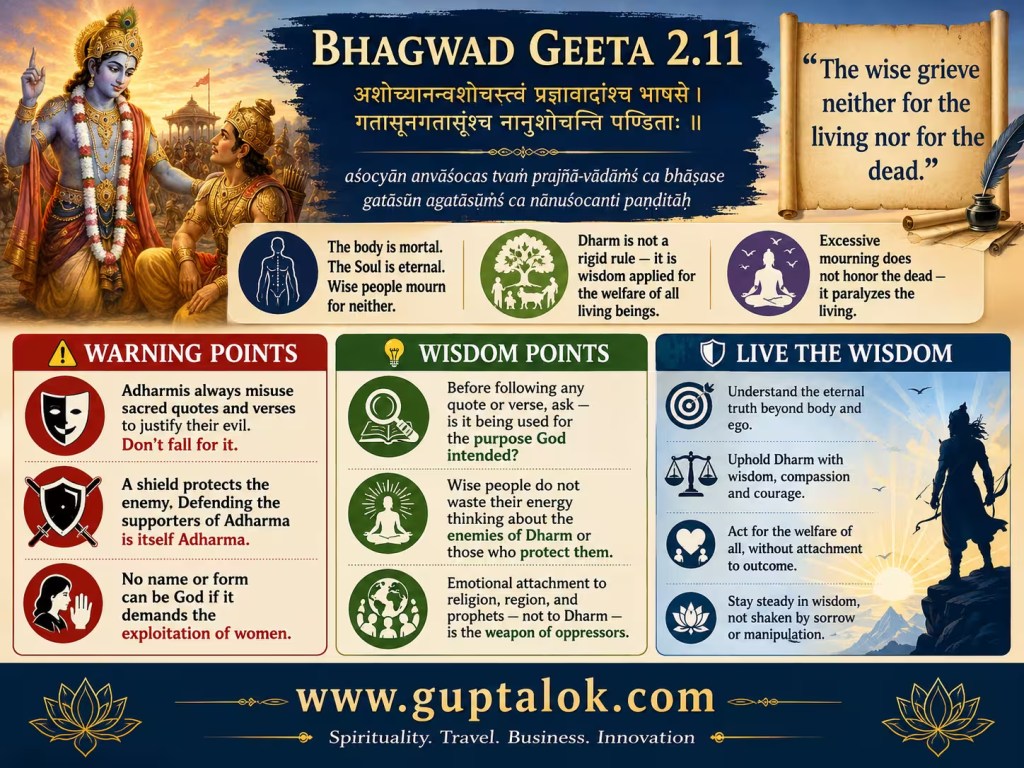
The Timeless Truth - Bhagavad Gita 2.11 TeachingsThis shloka carries two meanings. Both meanings serve the same purpose — the welfare of all living beings, present and future. Since this shloka belongs to Sankhya Yog, we will begin by exploring its meaning through that lens. Sankhya Yog means the Yoga of Discernment. It can also be understood as the path of connecting yourself with discernment — or the journey of attaining discernment itself.
Understanding Geeta Chapter 2 Shlok 11 as per Sankhya Yog
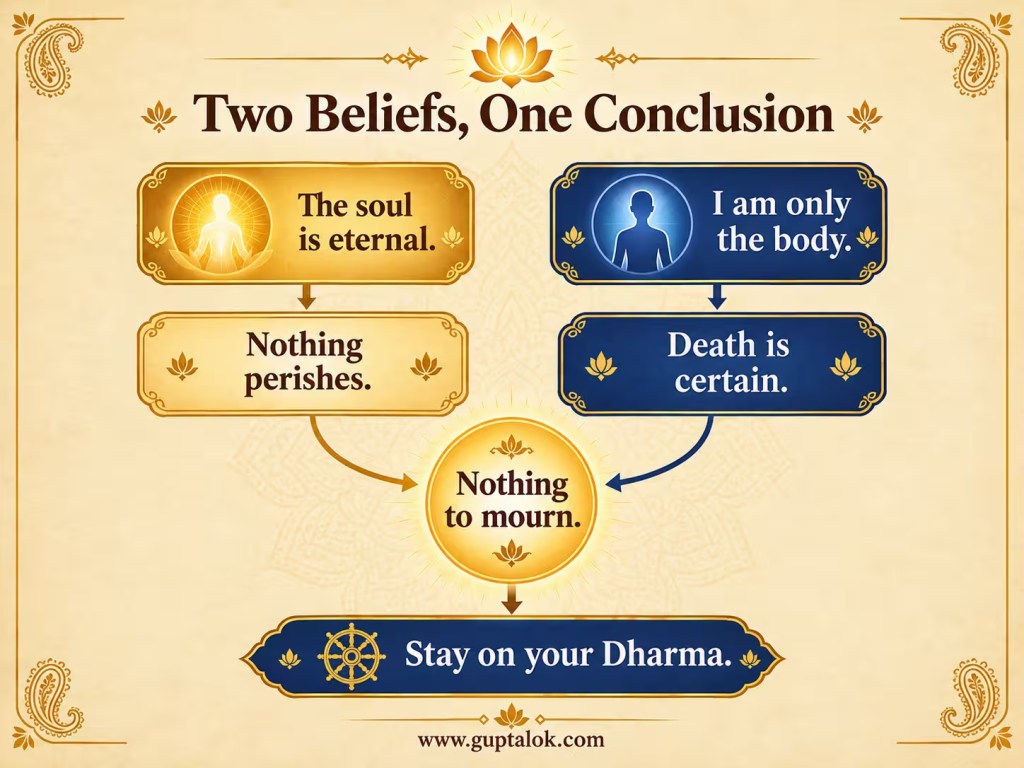
According to Sankhya Yog and Gyan Yog, wise people do not mourn much for their dead kinsmen. But why? The answer is rooted in a simple and profound truth. Every physical thing has an expiry date. And the energy within every physical thing is eternal.
In the case of humans, this principle applies clearly. The human body is the physical thing. It has an expiry date. The Soul is the energy within it. It is eternal. Once you truly understand this, mourning for a dead body loses its logic. The body has simply stopped functioning. It has decayed or been burnt. It had an expiry date from the very beginning. We all know we should not consume things that have expired. The Soul follows the same principle. It does not stay in a body whose expiry date has arrived.
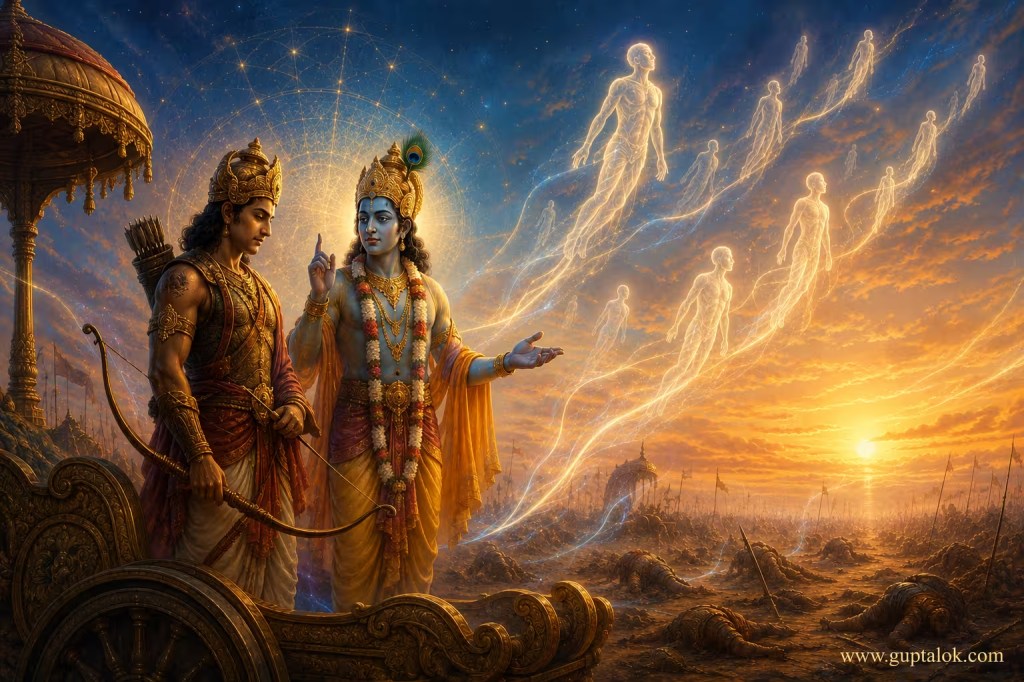
Now think about the Soul itself. The Soul is immortal. It does not die when it leaves the body. It simply moves on. It is still present somewhere in the same universe — or set of universes — where you exist. So, when a loved one leaves their body, they have not disappeared. Their body was just a cover. The real person — the Soul — is still out there, wandering in its true form.
Wise people understand all of this. That is why they do not cry much when a loved one formally dies. They see beyond the body. They see the Soul.
And this understanding carries a great practical benefit. When you stop excessive mourning for the dead or dying, you stay focused on your Dharm — your duties. You continue to function as a living, purposeful being. You move forward. Rather than turning into a zombie — physically alive but mentally and emotionally paralyzed — you remain a truly living entity, grounded in wisdom and driven by purpose.
Think Wisely, Not Emotionally
Dharm is not a rigid set of rules. It is wisdom. It is a collection of principles whose sole purpose is the welfare of all living beings. These principles are not applied mechanically. They are applied with wisdom, by carefully considering the specific circumstances and every relevant aspect of a situation.
This distinction matters greatly. Someone may try to misuse the logic of this shloka. They may try to justify harming innocent people by quoting it. Do not be swayed by that. The teaching that we should not mourn much for the dead or dying is rooted in one truth — that bodies are mortal and souls are eternal. It is not a license to kill an innocent person. It is not a justification for torturing a living being. It is certainly not a reason to rape a woman. That logic does not apply here and never will.
This point must be stated clearly because Adharmis — demonic people — frequently misuse the concepts and quotes of Dharm to spread Adharma. This is one of their oldest and most dangerous tools. They oppress innocent living beings. Then they use people, quotes, shlokas, verses, and books to keep the masses on their side. They wrap their wrongdoing in the language of righteousness. And most humans fall for it. Most people are far too emotionally attached to religions, regions, prophets, and quotes — and far too little attached to actual Dharm. This emotional weakness of the masses becomes a powerful weapon in the hands of oppressors.
This is why we must think carefully. We must not stand with someone simply because they quoted a line from a sacred text. We must go deeper. We must contemplate the real essence behind those words. We must ask one important question — is this person using this quote for the same purpose that God intended it for? That is the right test.
The purpose of God has always been one and only one. It has always been the establishment of Dharm. And Dharm means one thing — developing in human beings the tendency to act for the welfare of all living beings, present and future.
Understanding Geeta Chapter 2 Shlok 11 as per Modern Situations
In modern times, a troubling pattern has emerged. Many people, in the name of righteousness and Dharm, spend a great deal of time thinking about those who are involved in anti-human activities. They argue that even those who have harmed other humans and living beings still have the right to live like humans. This thought process is not right. In fact, it goes directly against Dharm.
We should not think about the welfare of those who support or participate in terrorism. We should not think about the welfare of those who commit or support mass crimes against women. We see this happening across the world. There are religions that continuously terrorize people in one part of the earth or another. Their primary target is almost always women. They force women to parade naked. They rape them. And they do all of this in the name of religion and God. Let this be stated clearly — no name or form can be God if it demands the sexual exploitation of women. That is not God. That is evil. That is Adharma.
Yet many people who claim to be sophisticated, intellectual, and educated spend enormous energy defending such demonic religions. They try to convince the masses that these groups should not be penalized heavily. This is deeply ironic. These so-called intellectuals are investing their concern in religious slaves whose only goal is to eradicate humanity and forcefully impose their inhuman beliefs on every person alive.
Shree Krishna’s message applies directly here. Do not think about those who are involved in such activities. Do not think about those who stand with such groups and religions either. Wise people do not spend their energy on those who worship, support, or protect such thoughts, religions, books, or people. If you wish to be counted among the wise, stop directing your concern toward such demonic forces and their followers.
Now, an important point must be understood about those followers. They may appear innocent. They may look like ordinary, poor, or helpless people. But they actively protect and support demonic forces. They serve as a shield for terrorist organizations. And that shield must be understood for what it is. No force can eliminate a terrorist group without first breaking through its shield. Righteous forces cannot defeat terrorists and rapists if the masses keep pressuring them to spare that shield. You simply cannot defeat an enemy without dismantling their protection first.
The moral is clear. Do not think at all about the enemies of Dharm. Do not think much about those who shield them either. Only then can Dharm be truly established — on this earth and within the hearts of most human beings.














Leave a Reply