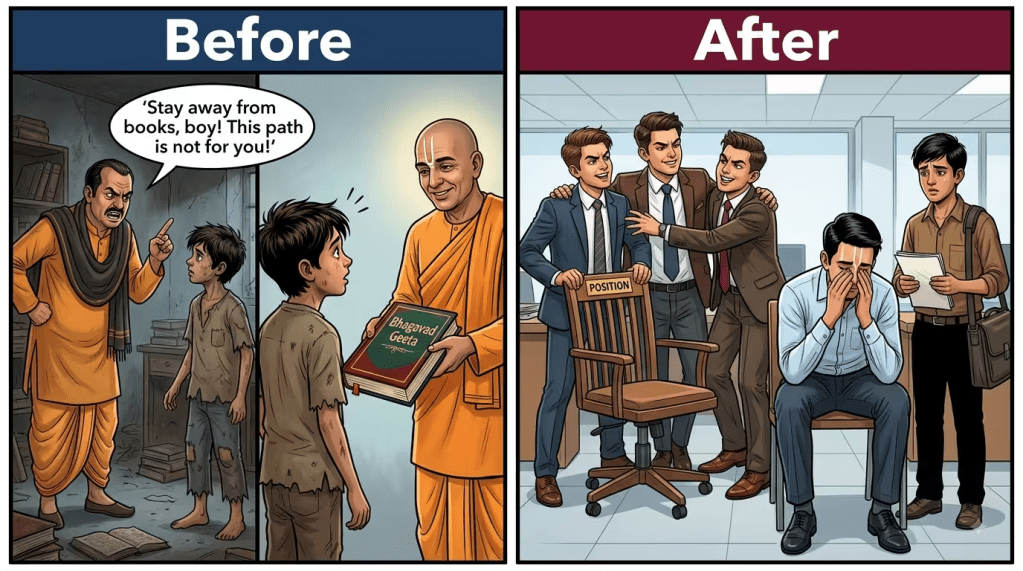
Caste-based reservation: Not the solution, just flipping the same game.Caste-based reservation is celebrated as one of the most revolutionary reforms of independent India. It is said to have been introduced to provide social justice and equity for citizens who did not have equal opportunities and rights to grow earlier. The most commonly cited reason for their lack of opportunities was the dominance of the alleged forward-class people. These forward-class people were largely identified as Brahmins, and a few as Kshatriyas. The ones who stayed backward were largely identified as Shudras.
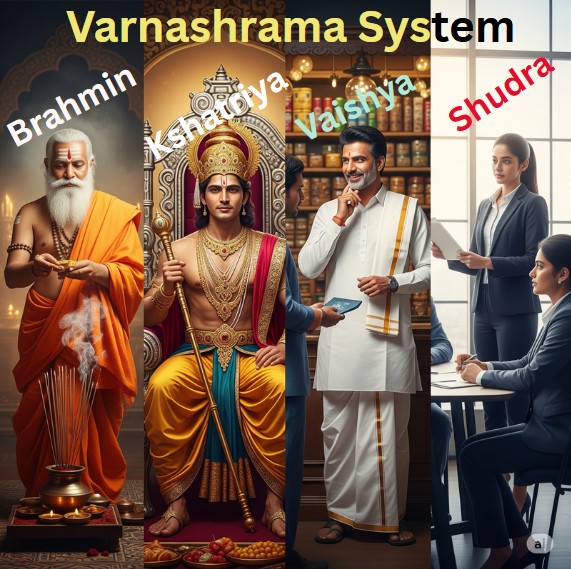
This identification was based purely on the surname or family tree of individuals. This is altogether different from the Hindu scriptural idea of Brahmin, Kshatriya, Vaishya, and Shudra. This identification was not even logical. However, a few ill-doers, wrongly identified as Brahmins because of their surnames, used these identities to prevent the children of Shudras from growing up as Brahmins, Kshatriyas, and Vaishyas.
It is worth noting that not all Brahmins and Kshatriyas were exploiters. Krishnaji Keshav Ambedkar, a Brahmin, and Maharaja Sayajirao Gaekwad III, a Kshatriya, played an important role in the education and growth of young Bhim Rao. They did this because they were Brahmin and Kshatriya because of their character, but not just due to their surname or family identity. One educated the young child, and the other supported his growth, irrespective of the child’s caste-based identity.
Later, when India or Bharata regained its political independence, the makers of the constitution decided to bring in reservations to help the backwards grow. This was also said to have been brought in to eradicate casteism. However, many aspects of reservation make us think about whether they were really brought into the picture to bring the backwards forward, or just to make the lives of the descendants of the forward classes of the pre-independence era harder. We’ll talk about them here one by one, analyzing the purpose of reservation and what we received as a country from it.
- Eliminating casteism or strengthening caste-based discrimination?
- Does it make the backwards forward?
- Is blanket caste-based reservation just?
- Are today’s alleged Brahmins really the culprit?
- Are today’s alleged lower castes really exploited?
- Is reservation really focused on making backward-categorised students scholars?
- Is it really providing room for healthy competition?
- Reform or vote-bank building?
- What could reform actually look like?
- Modi’s women reservation vs Ambedkar’s caste-based reservation?
Eliminating casteism or strengthening caste-based discrimination?
Caste-based reservation is often defended as necessary to curb discrimination against so-called lower castes. The logic is simple: casteism can be restrained by offering caste-based entitlements. But this logic contradicts itself. Reservation is itself based on caste. How can something based on caste curb casteism?
The only real difference between then and now is who is exploited. Earlier, the rights of alleged lower castes were ignored. Today, the rights of alleged upper castes are ignored. Caste-based reservation does not remove casteism. It strengthens it.
A better solution would have been a law that stops anyone from being denied education, jobs, or growth on the basis of caste. There should also have been a rule preventing the state from offering benefits or imposing penalties based on caste alone. Reservation should instead be based on financial condition and family educational background. Those who lack basic resources to grow should be given support and relaxation, regardless of caste.
The makers of the Constitution did not take this approach. They took a shortcut instead. A financial and educational criterion would have required rigorous, ongoing work to identify who is genuinely disadvantaged. Caste-based reservation freed them from that responsibility.
Does it make the backwards forward?
Caste-based reservation is said to bring backward communities forward. But how do we identify when someone has actually become “forward”? The only criterion used to identify a backward and a forward is surname or caste, which doesn’t change with the change in an individual’s or family’s condition.
If reservation truly worked, a person who benefitted from it should eventually become forward. And if he becomes forward, logic demands one more step. He should be compelled to give up the caste identity that lists him as backward. He should be moved to a caste category listed as forward. Without this step, the system quietly allows forward individuals to keep claiming backward benefits. But this rarely happens. Instead, people continue to claim backward status generation after generation, even after they have clearly moved into the forward class. This is pure injustice to the rest of the population.
After 77 years of implementation, reservation has failed to move most beneficiaries into the forward category permanently. There has been no change in their caste listing. If reservation has really worked, the migration out of backward status should have been visible by now.
The system is so flawed that it cannot even make a member of Parliament “forward.” Lawmakers and their families continue to receive backward-class benefits, even while sitting at the highest level of the country’s decision-making. Similarly, children of successful professionals and mainstream leaders across sectors continue to claim reservation benefits meant for the genuinely disadvantaged. This is not reform. It is exploitation of the rest of the population.
Is blanket caste-based reservation just?
Blanket caste-identity-based reservation is a complete injustice. It is hard to understand why the lawmakers of independent India did not see this clearly.
A blanket reward or punishment for an entire community cannot be logically just. Not everyone in a community is wrong. Not everyone in a community is right. People within the same caste differ in circumstance, effort, and need.
Rewarding alleged lower-caste individuals with a blanket approach, and penalizing alleged upper-caste individuals with the same blanket logic, is not justice. It is a mockery of it. It is not a genuine attempt to do right. It is a way to appear right, while avoiding the harder work of actually being fair.
Are today’s alleged Brahmins really the culprit?
Many argue that Brahmins were responsible for the backwardness of caste-oppressed communities. If that is the premise, the system must ask a simple question: are today’s Brahmin students the same people responsible for that historical wrong? Logically, they are not.
Anyone who benefits from reservation, and anyone who defends it, should stop treating the current generation tagged as “Brahmin” as culprits. They are not. Those who committed the actual wrongs died long ago.
Repeating that “Brahmins did wrong to us, so they deserve this” is not justice. You cannot penalise someone for another person’s wrongdoing, simply because they share a surname or caste identity. Punishing an entire caste group today for the actions of people from generations past is a basic injustice.
These students are not criminals. They are someone’s children too, born decades after the events used to justify their punishment. A person should be held responsible only for what they themselves have done, not for what someone with the same caste label did in the past.
Are today’s alleged lower castes really exploited?
Often, politically motivated voices from alleged lower-caste communities claim ongoing oppression to defend the flaws of caste-based reservation. But this claim doesn’t hold up. Today’s lower-caste citizens are not the oppressed, just as today’s upper-caste citizens are not the oppressors.
The oppressors died long ago. So did the oppressed. Neither generation is here to relive that history.
Beneficiaries of reservation should stop running the narrative that they are personally oppressed. Their forefathers may have suffered oppression. They themselves have not, at least not because of caste alone. It is time to accept this truth and move the conversation forward.
Is reservation really focused on making backward-categorised students scholars?
The biggest flaw of caste-based reservation is the relaxation in marks required for the same job or seat. It gives reserved-category students a cushion. They know they can secure a seat even with lower marks. Because the target is already set low, many students may not push themselves to do their best. This mindset discourages them from exploring more, studying more, and sharpening their wisdom. As a result, they may not become scholars. They may simply become earners. Is this really what the makers of the Constitution wanted for backward classes?
Marks relaxation offers opportunity, but it does nothing to build knowledge or wisdom. Opportunity without wisdom is not empowerment. A person given a seat but not sharpened by learning remains vulnerable. Sooner or later, some other force, person, or community will find a way to exploit that gap.
Dr. Ambedkar argued that children of uneducated parents cannot compete with children of educated parents, and that this would be unfair. There is a logical way to address this without lowering the bar. Do not make backward-category students compete with forward-category students. Let them compete only among themselves. But the required marks should stay the same.
Reserved seats should be treated as a separate track, not a lower one. To keep the reservation intact, keep a clause that these seats should be filled only by backward-category candidates who meet the required marks. If not enough candidates meet that bar, the seat should stay vacant rather than being filled by lowering the marks or by a forward-category candidate. If a student’s parents are uneducated, the responsibility should be to provide that child with resources, coaching, and tuition, and help them become a scholar. The message should never be “you don’t need to study hard, a job is already secured for you.”
Is it really providing room for healthy competition?
Lowering the required marks for reserved-category students, for the same seat, creates unfair competition for non-reserved students. Non-reserved students are citizens of this country too. They deserve to be treated as such, not overlooked in the name of correcting past wrongs.
Raising the bar for one group while lowering it for another can be deeply demotivating. Some unreserved students may think, “Why study hard, when others get the same opportunity without equal competition?” This mindset can quietly discourage merit itself.
There is a second problem. An unreserved student may develop resentment toward a reserved-category student holding the same position with a lower entrance score. This can harm both students in two ways.
First, it can deepen caste-based hostility on both sides. The unreserved student may see the reserved student as undeserving. The reserved student may sense being looked down upon. Neither feeling helps the country move past caste.
Second, this gap in preparation can follow the reserved student into the workplace. Since the non-reserved student studied and competed at a higher bar, and the reserved student didn’t, this difference in preparation doesn’t disappear after admission. It can resurface on the job. Over time, the reserved employee may struggle to keep up with better-prepared peers, and this can block their own path to further growth.
Reform or vote-bank building?
Looking at these many flaws, it seems reservation was never truly intended to improve the lives of oppressed people. It looks more like a way to build a vote bank for political leaders.
The lawmakers do not seem to have wanted to fix the country’s social imbalance. They seem to have wanted a loyal segment of the population instead. Their focus appears to have been their own political future, not the future of citizens. Otherwise, why would caste, the very root of the problem, be made the deciding factor of the solution?
Instead of creating a law that makes everyone feel equal, they drew a permanent line around reservation. That line has never let the idea of casteism die.
Had they chosen to work harder, they could have built a system that supports the truly disadvantaged, without caste as the deciding factor. This would have given the country a better future, and its people a better sense of harmony. But when the Constitution itself does not treat every citizen the same way, divide-and-rule politics becomes very difficult for politicians to walk away from. It offers too easy an advantage to give up.
What could reform actually look like?
Caste-based reservation was built on a fair intention but a flawed method. It tried to fix a social wound by reopening it in a new form, using the same caste labels that caused the wound in the first place. Seventy-seven years on, it has no exit criteria, no individual assessment, and no mechanism to stop benefits from concentrating in the same families while genuinely disadvantaged citizens are left out. It has not built scholars. It has not ended casteism. In many ways, it has kept caste identity more relevant, not less.
None of this means India should abandon the goal of upliftment. It means the method needs to change. Reservation based on financial condition and family educational background, paired with real investment in coaching and resources for those who lack them, would achieve what caste-based reservation has failed to achieve in seven decades: a system where privilege is measured by circumstance, not surname.
The good news is that India doesn’t have to imagine what a better-designed reservation looks like. It already has one draft.
Modi’s women reservation vs Ambedkar’s caste-based reservation?
Comparing caste-based reservation with the Women’s Reservation Bill, 2023, the latter appears far more intelligently drafted.
Two features stand out. First, the reservation is valid for only 15 years, not indefinitely. Second, reserved seats rotate with every election cycle.
This design does something caste-based reservation never attempted. It brings a woman forward, lets her build political space in her constituency, and then moves the reservation elsewhere. Once she has used that opportunity, she must rely on her own competence to remain politically relevant. Meanwhile, women in another constituency get their turn at the same opportunity.
Caste-based reservation has no such mechanism. Nothing stops the same family from receiving its benefits generation after generation, while other, more deserving families are left out. Due to poor drafting and weak implementation, the same families keep benefiting, decade after decade.
Another strength of the women’s reservation model is that it does not relax the vote count required to win. A woman contesting a reserved seat must still secure more votes than her competitors, who are women too. She does not win simply by contesting. She wins by earning more votes, just like any other candidate.
This is what reform could have looked like: time-bound, rotational, and merit-preserving. Caste-based reservation had 77 years to design something similar. It chose not to.










Leave a Reply