In Bhagavad Gita Shlokas 31 to 37, Krishna suggests that we should not step back from the path of dharma due to any kind of fear. He suggests that doing so can be neither fruitful in this life nor in the afterlife. He talks about different kinds of losses one faces after ignoring his/her dharma (duty). He doesn’t talk only about how ignorance of dharma impacts one’s afterlife but also his/her life on Earth.
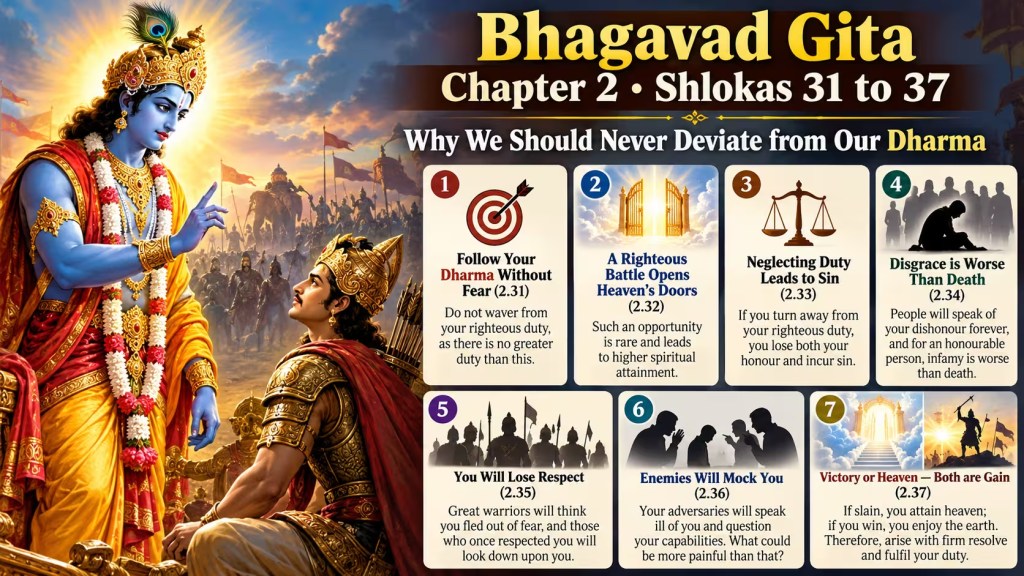
Krishna guiding Arjuna on the battlefield of Kurukshetra, Bhagavad Gita 2.31 to 2.37.We’ll explore each verse in turn, understanding their real meaning in terms of their application in different walks of our lives. Let’s start with the original verses, and then dive deeper into their descriptive explanation.
Bhagavad Gita Chapter 2 Verses 31 to 37
Below are Shlokas 31, 32, 33, 34, 35, 36, and 37 in their original Sanskrit, along with the English transliteration, and translation.
Sanskrit Text
स्वधर्ममपि चावेक्ष्य न विकम्पितुमर्हसि ।
धर्म्याद्धि युद्धाच्छ्रेयोऽन्यत्क्षत्रियस्य न विद्यते ॥ 31॥
यदृच्छया चोपपन्नं स्वर्गद्वारमपावृतम् ।
सुखिन: क्षत्रिया: पार्थ लभन्ते युद्धमीदृशम् ॥ 32॥
अथ चेतत्त्वमिमं धर्म्यं संग्रामं न करिष्यसि ।
तत: स्वधर्मं कीर्तिं च हित्वा पापमवाप्स्यसि ॥ 33॥
अकीर्तिं चापि भूतानि कथयिष्यन्ति तेऽव्ययाम् ।
सम्भावितस्य चाकीर्ति र्मरणादतिरिच्यते ॥ 34॥
भयाद्रणादुपरतं मंस्यन्ते त्वां महारथा: ।
येषां च त्वं बहुमतो भूत्वा यास्यसि लाघवम् ॥ 35॥
अवाच्यवादांश्च बहून्वदिष्यन्ति तवाहिता: ।
निन्दन्तस्तव सामर्थ्यं ततो दु:खतरं नु किम् ॥ 36॥
हतो वा प्राप्स्यसि स्वर्गं जित्वा वा भोक्ष्यसे महीम् ।
तस्मादुत्तिष्ठ कौन्तेय युद्धाय कृतनिश्चय: ॥ 37॥
English transliteration
Swadharmapi Chaavekshya Na Vikampitumarhasi |
Dharmyaaddhi Yuddhaachchhreyo-anyatkshatriyasya Na vidyate ||31||
Yadrichchhayaa Chopapannam Swargadwaaramapaavritam |
Sukhinah Kshatriyaah Paartha Labhante Yuddhameedrisham ||32||
Atha Chetatvamimam Dharmyam Sangraamam Na Karishyasi |
Tatah Swadharmam Keertim Cha Hitvaa Paapamavaapsyasi ||33||
Akeertim Chaapi Bootaani Kathayishyanti Te-avyayaam |
Sambhaavitasya Chaakeertirmaranaadatirichyate ||34||
Bhayaadranaaduparatam Mansyante Tvaam Mahaarathaah |
Yeshaam Cha Tvam Bahumato Bhootvaa Yaasyasi Laaghavam ||35||
Avaachyavaadaanshcha Bahoonvadishyanti Tavaahitaah |
Nindantastava Saamarthyam Tato Dukhtaram Nu Kim ||36||
Hato Vaa Praapsyasi Swargam Jitvaa Vaa Bhokshyase Maheem |
Tasmaaduttishta Kaunteya Yuddhaaya Kritanishchayah ||37||
English translation:
And, in accordance with your dharma (duty), you should not waver [from fighting for dharma —that is, justice], for there is certainly no greater dharma duty for a Kshatriya than to fight [for the welfare of the innocent beings]. ||31||
Partha! Encountering a battle of this kind is as good for Kshatriyas as attaining the open gates of heaven without any effort. ||32||
If you still do not wage this righteous battle, you will incur sin by forsaking your duty and your renown. ||33||
And people will speak of your disgrace forever; and for honourable people, disgrace or infamy is worse than death itself. ||34||
The Maharathis (great warriors) will consider you to have fled the battle out of fear, and in the eyes of those who once held you in high esteem, you will be reduced to a lowly status. ||35||
Your enemies will speak many things that should not be said against you and disparage your capabilities. What could possibly be more painful than that? ||36||
[By fighting this righteous war,] you will either attain heaven if slain or enjoy the pleasures of the earthly realm if victorious. Therefore, O son of Kunti, arise and resolve firmly to fight. ||36||
Meaning, Central Idea, and Key Teachings:
In these shlokas, Shree Krishna talks about why one should not deviate from his/her dharma (duty). In the shloka 31, he says that one should not step away from following his/her righteous duty because there is no better thing to do than that. As God, in his Krishna form, was addressing Arjun, he talked about Kshatriya dharma (duty of Kshatriya) which was the duty of Arjun at that moment. He said that a Kshatriya should never step back from fighting a righteous battle because that is the biggest sin. You may have a question: why is it the biggest sin? Because if a Kshatriya steps back from fighting a righteous battle, he/she indirectly works to ensure that non-righteousness prevails. But then, there arises another question: Who is a Kshatriya?
Who is a Kshatriya?
A Kshatriya is someone:
- Who is born with fighting capabilities or has attained power during life.
- Who holds a position that is meant to ensure the safety, protection, and wellbeing of the masses.
Such people commit sin when they fight only to gain things for themselves rather than for the welfare of all. They also commit a sin when they step back from defending innocent people out of fear, attachment, ego, or greed. For such a person, no duty is higher than fighting for dharma (righteousness). Remember, too, that a battle is not always physical. It can be any struggle aimed at establishing dharma, meaning a mindset and an environment that protect the welfare of all innocent beings. This includes political battles, speaking out against adharma, and similar efforts.
How can a Kshatriya attain heaven or supreme abode of God?
The Bhagavad Gita verse 2.32 suggests that a Kshatriya can attain heaven or supreme abode of God by fighting a righteous battle. The thorough study of Bhagavad Gita teaches that God himself is dharma. And it is well-known that people can attain lotus feet of God by completely devoting themselves to God. And since Dharma itself is the abstract form of God, when humans devote themselves to Dharma, they attain liberation or supreme abode of God. Thus, when a Kshatriya stays true and immutable to his/her dharma, he also attains the same state which saints attain by chanting the name of God.
How to Devote Yourself to Dharma?
If you want to devote yourself to dharma, you must first thoroughly understand exactly what it is. Remember that Dharma is not a fixed set of pre-established rules. It is every act and thought intended for the welfare of all living beings, including animals and birds. Dharma says that if it is not possible to do something that ensures the wellbeing of all living beings, then you should act for the greater good. This means doing what will ensure the welfare of maximum innocents and future generations of all living beings. If things are currently out of order and there is no way to set them right for the welfare of all, then at least do what will bring order for the welfare of future generations.
To act in this way, you will have to be a good evaluator and decision maker. This requires a lot of reasoning and contemplation, which in turn requires using your wisdom well. That is possible only when you have eliminated bias and prejudice from yourself. Our guides to identifying Dharma and the real God can help you recognize your real Dharma in real time, so please take a look at them. Once you have learned to identify which actions are in line with Dharma and act accordingly, you will have devoted yourself to this incorporeal form of God.
What Happens When You Don’t Act According to Your Dharma?
Here, Krishna talks about two types of impacts of not following or ignoring your dharma: absolute impact and worldly impacts. It is worth noting that Krishna addresses the absolute impact first, as the knowledge of these spiritual consequences keeps a person steadfast on the path of dharma. Conversely, when an individual focuses solely on worldly impacts, they may easily deviate from their dharma upon finding other material gains more appealing or necessary.
Let’s have a look at what the Lord has talked about in either of the sections.
Absolute Impact
Absolute Impact is the root of every worldly impact. Those who understand Absolute Impact and act with it in mind are highly unlikely to stray from the path of righteous conduct. On the other hand, people who focus only on worldly impact may stray from the path of Dharma if they are persuaded to act for a different worldly impact than the one that leads to universal righteousness.
In verse 2.33, Krishna talks about absolute impact: If you don’t fight, you’ll abandon your dharma (duty), which will lead to losing your Keerti (reputation) and incurring sin. Arjun’s act of stepping back from the battle for righteousness (Universal Justice) would have ultimately led him to abandon his dharma (duty), making him incur sin. Sin is the absolute impact here precisely because it cannot be physically identified. Sin itself can be known only through understanding, not perceived through the senses. Its material derivations, however, can be felt through the senses and the body, but these are only its worldly effects, not sin itself.
Note: Absolute Impacts are those that cannot be felt through the body or mind, but can be understood through contemplation. By contemplating whether an action is meant for universal welfare, you can know its Absolute Impact. If it is not, the result is sin. If it is, the result is virtue.
H4- worldly Impacts
In verses 34, 35, and 36, Shree Krishna describes the worldly Impacts of abandoning Dharma. These include defamation, condemnation, and a decline in class and status. He says that a person who abandons Dharma (duty) endures defamation in society, and people call them a coward. He also says that those against whom you are fighting will ridicule you with words that wound your heart and mind. Even those who respected you for your integrity will consider you a deserter, and their respect for you will diminish. For those who are deeply attached to materialism, defamation and disrespect are even more painful than the fear of death.
Note: Worldly impacts are those you can feel through or in your body and mind.
Why Does Krishna Speak of Both Worldly and Absolute Impacts to Arjun?
Though Krishna wants people to act with the Absolute Impact in mind, he also speaks of worldly impacts because not everyone is wise and strong enough to work for the Absolute Impact. Most people are deeply attached to materialism, and their minds are not pure enough to focus on the Absolute. Yet God wants them, too, to act in line with Dharma, which is why he also describes the worldly impacts of not doing so.
What Happens When You Follow Your Dharma?
In verse 2.37, Shree Krishna speaks about the results of following Dharma. He tells Arjun that fighting for dharma (righteous duty) will bring him heaven if he is martyred, and the enjoyment of the earth if he wins the battle. It would have been a win-win situation for Arjun if he had thought a little differently. It looked like a losing game to him because he focused only on material matters and exclusive relationships, and held a mistaken picture of heaven. In the Bhagavad Gita, however, Krishna teaches us to focus on the Absolute, which can be understood through the following distinctions:
- Material matters vs. universal matters: Material matters are largely about your rights and the fulfillment of your worldly wishes. Universal matters are largely about your duty toward the universe, meaning every living being.
- Exclusive vs. inclusive relationships: Exclusive relationships arise from your family or community identity and make you responsible for the satisfaction of a handful of people. Inclusive relationships arise from your identity as a responsible living being and make you responsible for the wellbeing of every living being.
- Mistaken heaven vs. actual heaven: The mistaken picture of heaven is a place full of worldly pleasures, such as delicious food, sensual enjoyment, and liquor. Actual heaven is where souls reside who enjoy working for the welfare of all living beings, irrespective of what they get in return.
If we keep these distinctions in mind, it becomes a win-win situation for us as well. We work for the welfare of all, considering everyone our family, and make the world a better place for every living being. Since we are part of the same universe, we also work for our own welfare and that of our future generations. We will enjoy working for our family of all living beings, and after death we will attain heaven, because the tendency to work for others is the crucial quality needed to enter it.
Key Teachings
The key teachings of this article on Bhagavad Gita Shlokas 2.31, 2.32, 2.33, 2.34, 2.35, 2.36, and 2.37are as follows:
- Dharma is not a fixed set of rules. It is every act and thought intended for the welfare of all living beings, now and in future generations.
- Widen your view of duty. Look beyond personal rights and desires to your duty toward all living beings, beyond exclusive relationships to inclusive ones, and beyond a heaven of pleasures to the heaven of those who work selflessly for the welfare of all.
- Wisdom requires freedom from bias. Acting for universal welfare takes reasoning, contemplation, and the removal of bias and prejudice.
- Focus on the Absolute Impact. The real result of an action is virtue or sin. Virtue comes only from Dharma, and sin only from adharma. Neither can be felt through the body or mind, but both can be understood by contemplating whether the action is meant for universal welfare.
- Worldly impacts are unreliable guides, but they have a temporary use. Wealth, fame, and comfort can be gained through both Dharma and adharma, so they cannot tell you whether an action was right. Still, Krishna describes the worldly consequences of abandoning Dharma, such as defamation and loss of respect, because not everyone is ready to act for the Absolute Impact at first. These consequences can help a materially attached person begin to follow Dharma.
- Grow from worldly impacts to the Absolute Impact. Over time, shift your focus to the Absolute Impact, because only it reliably points toward Dharma.
Conclusion
The conclusion of Bhagavad Gita verses 2.31 to 2.37 is that we should focus on the Absolute Impact of our actions, which is virtue or sin. If we do so, we are far more likely to follow Dharma. If we focus on worldly impacts instead, we are far more likely to deviate from the path of Dharma. This is because worldly gains can be attained through both Dharma and adharma, whereas virtue is attained only through Dharma, and sin only through adharma. For example, wealth or fame can be earned through honest work or through deceit, so the mere fact that an action brings them tells us nothing about whether it was right.
This does not mean worldly impacts have no use. For a person who is deeply attached to materialism, the Absolute Impact may be too abstract to motivate action at first. In such cases, worldly impacts can be used to persuade them to follow Dharma. Over time, however, that person should be guided to act with the Absolute Impact in mind, because only the Absolute Impact reliably points toward Dharma.
FAQs (Frequently Asked Questions)
What exactly is Svadharma, and how do I find mine?
Swadharma means one’s own duty. A person can find their absolute duty by understanding who they truly are. Everyone’s identity has layers: first a living being, then a human being, and then a position holder, a family member, and so on. Always fulfill your duty while keeping in mind your identity as a living being and as a human being. If any duty goes against these two identities, it is not your Swadharma.
How can a war be considered “righteous” (dharma-yuddha)?
A war is a righteous war (dharma-yuddha) if it is fought to protect the wellbeing of all innocent living beings.
Does this verse justify violence in the name of religion?
No, this verse does not justify violence in the name of religion. Rather, it teaches that a war may be fought only to protect Dharma, which means the tendency to seek the welfare of all living beings in society and to act accordingly. The purpose of such a war is the welfare of all, not the promotion of any religion, group, or personal gain.
How can choosing non-violence be a sin?
Choosing non-violence is not a sin in itself. However, choosing it in the face of those who exploit women, humanity, and innocence is a sin, because it does not make you non-violent. Rather, it makes you a silent spectator of the violence and atrocities taking place around you. Such inaction fails to serve the welfare of all, and therefore carries the Absolute Impact of sin.
Why is Krishna appealing to reputation instead of purely spiritual wisdom?
Krishna is not appealing to reputation instead of spiritual wisdom. He is addressing both types of people: those who can understand spirituality, and those who are deeply attached to materialism. To the first group, he speaks of the spiritual wisdom. To the second group, he speaks of worldly impacts such as defamation and loss of respect, because these are easier for them to feel. The aim in both cases is the same: to keep the person on the path of Dharma.
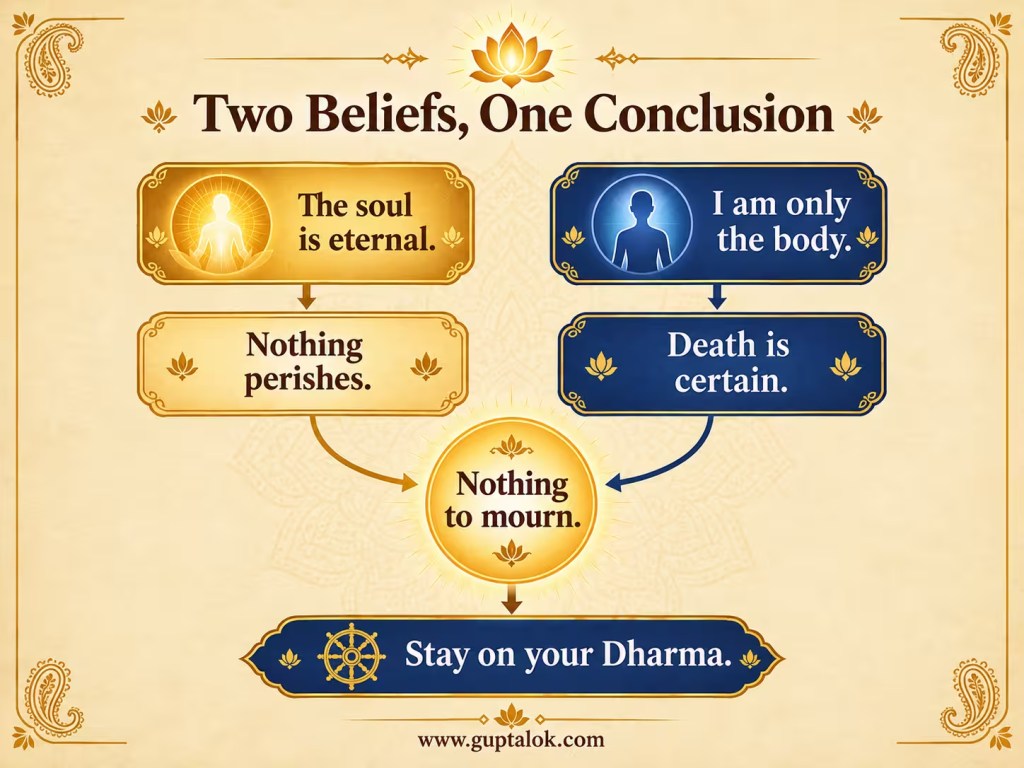

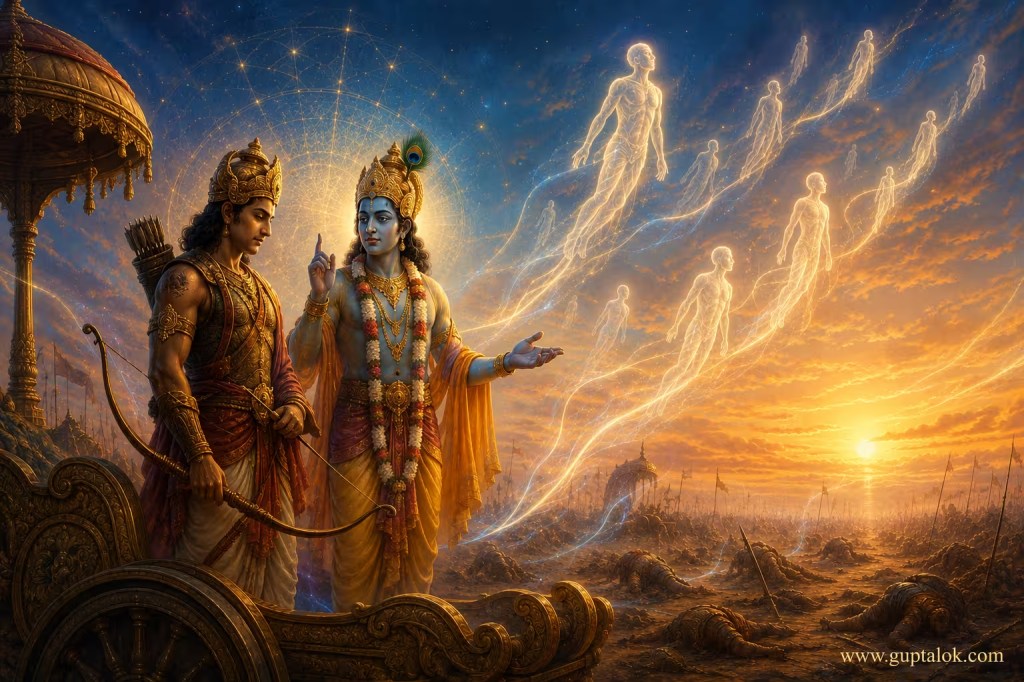




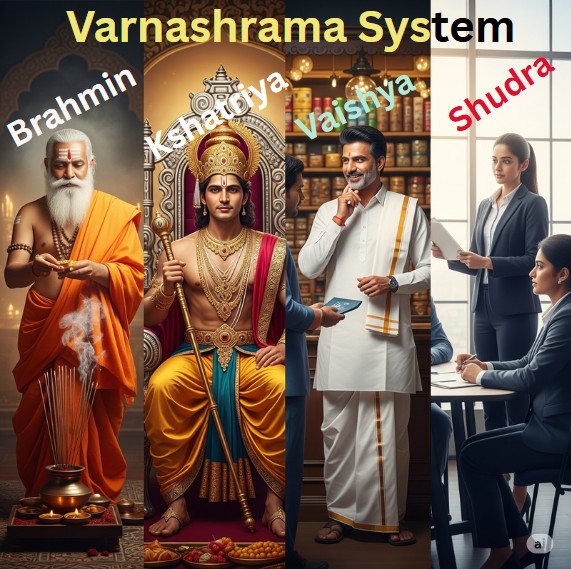








Leave a Reply