Robots have been dominating automotive assembly lines for decades, but they were fixed, caged, and highly task-specific. The new wave is different. It brings robots that walk, wheel, see, and learn. They are arriving on factory floors not as curiosities but as production assets. Two recent complementary stories from opposite ends of the industrial world reveal just how fast this transition is accelerating. The data below gives quite a lot of understanding of how the deployment of physical AI is planned by industries.
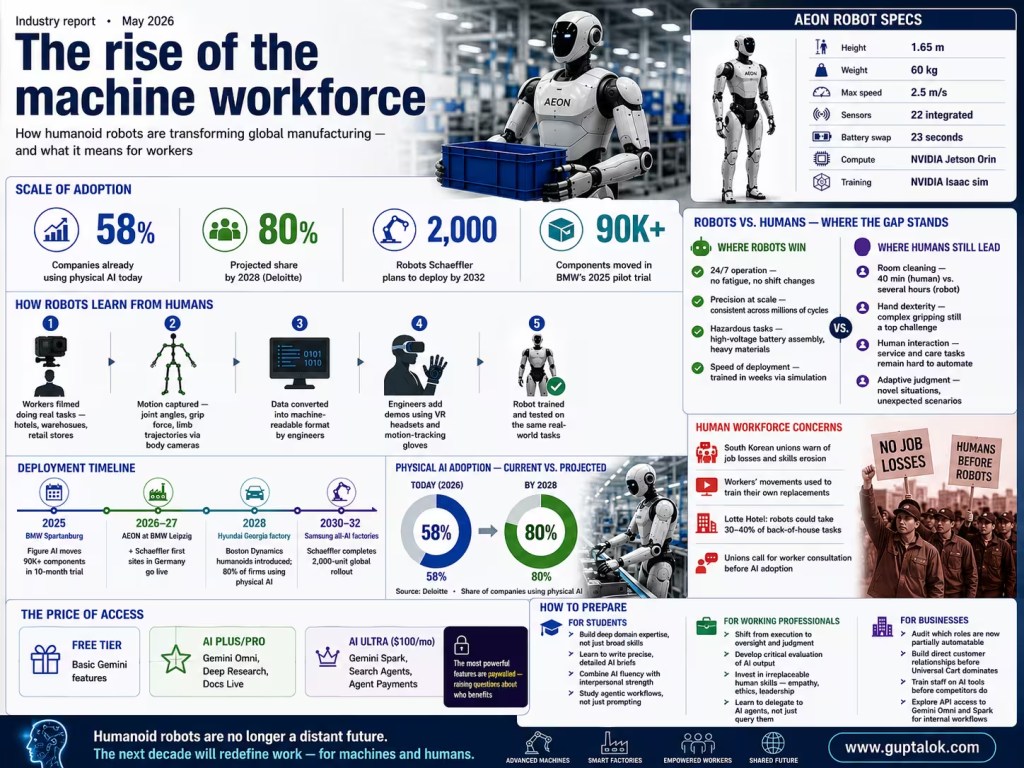
- Schaeffler plans to deploy 2000 Humanoid robots by 2032.
- A report suggests that 58% companies are already using physical AI.
- The projection is that 80% of companies will deploy physical AI robots by 2028.
Built to Work, Not to Demo
Most humanoid robots unveiled at trade shows earlier were designed for applause, not production. Hexagon Robotics’ AEON unit breaks that mould. It stands 1.65 metres tall, weighs 60 kilograms, and forgoes legs for wheels. The legs are replaced by wheels deliberately to maximize speed to go up to 2.5 metres per second. This also makes them energy efficient on the flat surfaces of a factory floor. Below are the most striking operational features of the AEON.
- It autonomously swaps its own battery in just 23 seconds, enabling continuous, around-the-clock deployment without human intervention.
- It has a 22-sensor suite, encompassing peripheral cameras, time-of-flight sensors, infrared, SLAM cameras, and microphones. This gives it 360-degree real-time spatial awareness.
- It runs on NVIDIA Jetson Orin onboard computers and can dock a wide variety of grippers and scanning tools. Thus, it handles everything from quality inspection to complex assembly.
“Industrial Physical AI has moved past the laboratory phase into real-world production — AEON is the physical layer of a much larger digital infrastructure.”
AEON’s deployment at BMW plants
BMW’s Leipzig plant is its most technologically comprehensive site, which the Bavarian carmaker chose as AEON’s proving ground. This rollout is built on lessons from a 2025 trial at BMW’s Spartanburg facility. At the Spartanburg facility, a Figure AI robot moved over 90,000 components in ten months.
BMW has also established a dedicated Centre of Competence for Physical AI in Production. It is to consolidate expertise across the group and create a defined evaluation path for technology partners–from lab testing through to full pilot phases. BMW also replaced fragmented data silos with a uniform data platform, in order to ensure consistent and accessible information for AI agents
AEON has now been assigned to high-stakes tasks, including high-voltage battery assembly and exterior component manufacturing. The Humanoid was largely trained through NVIDIA’s Isaac simulation platform, which compressed months of development into weeks.
A Global Deployment Wave
BMW is not alone. British technology company Humanoid has signed an agreement with German industrial supplier Schaeffler too. Schaeffler plans to deploy between 1,000 and 2,000 robots across Schaeffler’s global manufacturing sites by 2032. The first deployments are scheduled between December 2026 and June 2027 at two German sites. These deployments are planned for box handling tasks in Herzogenaurach and near-full-scale factory testing in Schweinfurt.
The Machine Workforce Is Here. Global Manufacturing Will Never Be the Same.The commercial logic runs deeper than mere automation. Under the deal, Schaeffler will become Humanoid’s preferred supplier for joint actuators through 2031. This will cover more than half of Humanoid’s demand for its wheeled humanoid platforms and an estimated one million actuators over the period. This supply-chain integration ties the two companies’ futures together.
Teaching Machines by Watching Humans
In South Korea, a different — and more intimate — frontier of physical AI is opening. Startup RLWRLD is collecting motion data directly from human workers in hotels, logistics centres, and retail settings. Here are a few examples of Physical AI training.
- At Lotte Hotel Seoul, food and beverage staff are filmed folding banquet napkins and preparing tableware.
- At CJ logistics warehouses in South Korea, workers are recorded lifting and handling goods.
- At Lawson convenience stores in Japan, staff movement during food display organisation is captured.
The data harvested is granular. It includes joint angles, grip force, and precise limb trajectories, captured via body cameras, VR headsets, and motion-tracking gloves. Engineers then convert this footage into machine-readable form and use it to train robot systems. The robot systems being trained, also include humanoids guided by human operators wearing control devices. The different demonstrations of this training were as follows:
- A wheeled robot with metal hands moved cups at a minibar.
- A humanoid opened a box, inserted a computer mouse, resealed it, and placed it on a conveyor belt.
During these processes, RLWRLD’s engineers have identified hand dexterity as the critical challenge for industrial and service tasks alike.
Where Robots Outpace — and Where They Fall Short
The performance calculus is already clear in some domains. AEON can operate continuously — 24 hours a day, seven days a week — without fatigue, pay, or safety concerns in hazardous environments. Its sensor array perceives the world with consistency no human worker can match across an extended shift. For repetitive, high-precision tasks like component handling or battery assembly, the efficiency gains are unambiguous.
In service settings, the gap is starker. A current humanoid robot would require several hours to clean a hotel room that an experienced human worker completes in roughly 40 minutes. Lotte Hotel nonetheless hopes robots will be ready for some cleaning and back-of-house support tasks by 2029. One hotel worker involved in training estimates that humanoids could eventually take over 30 to 40 per cent of event preparation work. Tasks requiring nuanced human interaction, he notes, remain far harder to automate.
The Human Cost of Physical AI
Labour unions in South Korea have raised formal concerns about robot deployment. They warned that it could reduce employment and weaken the pipeline for skilled workers. Kim Seok, policy director at the Korean Confederation of Trade Unions, has called on employers and the government to actively engage workers in AI adoption decisions. “Skilled work,” he said, “remains a human achievement.”
The concern is not hypothetical. Hyundai Motor plans to introduce Boston Dynamics humanoids at its factories globally. It plans to begin with its Georgia plant in 2028. Samsung Electronics has stated its intention to convert all manufacturing sites into “AI-driven factories” by 2030. Samsung plans to keep humanoids and task-specific robots central to its production lines. As Deloitte’s data shows, 58 percent of companies are already using physical AI. This share is expected to reach 80 per cent by 2028.
BMW’s leadership frames this transformation as a “symbiosis” of engineering and artificial intelligence — a collaboration between human expertise and machine capability. That framing is optimistic, but not without basis: AEON required BMW’s institutional knowledge to be deployed effectively, and RLWRLD’s robots are, quite literally, built on the recorded movements of human workers. For now, the machines still learn from us. The question the coming decade will answer is how long that dependency lasts.











Leave a Reply