If you’ve been putting off buying an electric vehicle because of range anxiety, charging delays, or patchy charging infrastructure on highways, there’s a category of cars built specifically to solve that problem: plug-in hybrid electric vehicles, or PHEVs.
A plug-in hybrid car combines a petrol engine with a large, externally chargeable battery and an electric motor. It’s a genuinely innovative engineering solution. The car drives purely on electricity for your daily commute. Then it switches seamlessly to petrol power when you go beyond the electric range. You never need a public charging station if you don’t want to.
In a country like India, city traffic is dense. But highway charging infrastructure is still developing. Plug-in hybrids arguably make more practical sense today than a full EV for a large number of buyers. Here’s why.
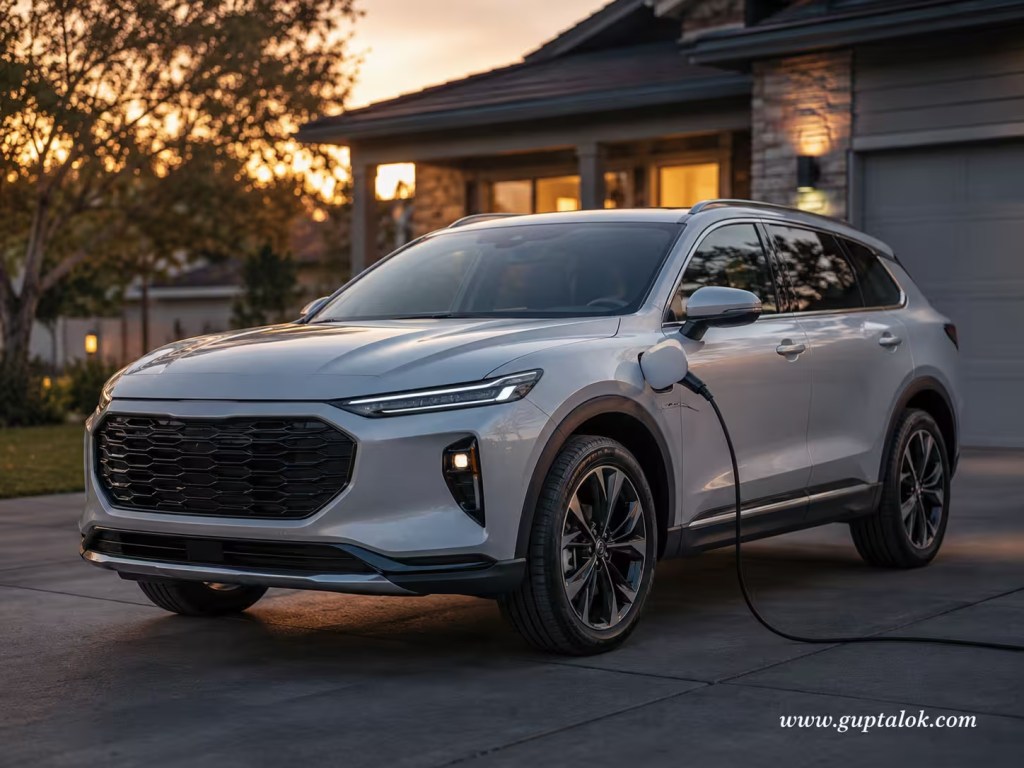
Plug-in hybrid cars can be charged right at home overnight, just like a full EV, making daily commutes completely petrol-free.What Makes Plug-in Hybrid Cars the Best of Both Worlds
The appeal of a plug-in hybrid comes down to one thing: it doesn’t ask you to compromise. Full EVs are great in the city but can make long trips stressful. Petrol cars are effortless on highways but expensive and polluting in daily city traffic. A PHEV solves both problems with a single drivetrain. Here’s how.
1. Zero Petrol for Your Daily City Commute
This is the single biggest advantage of a PHEV. A regular “strong hybrid,” like a Toyota Hyryder or Maruti Grand Vitara, only uses its battery for very short bursts. It still depends heavily on petrol. A plug-in hybrid is different. It carries a much larger battery. Large enough to deliver a genuine electric-only driving range, anywhere between 40 km and 125 km, depending on the model.
You charge this battery at home overnight. Exactly the way you’d charge a regular EV, using a wall socket or a home charger. Once charged, your daily office commute, school runs, and errands around the city can be completed entirely on electric power. The petrol engine doesn’t even switch on.
Most urban Indian drivers have a daily round-trip commute of 30–60 km. For them, a PHEV can realistically run on zero petrol, day after day. Purely on the electricity you’ve charged at home.
2. No Dependence on Public Charging Infrastructure for Long Trips
This is where a plug-in hybrid pulls ahead of a full EV. Once you go beyond your car’s electric range, say on a highway trip from Delhi to Jaipur or Mumbai to Pune, the petrol engine takes over automatically. There’s no need to plan your route around charging stations. No waiting at a charger. No anxiety about whether the next town has a working fast-charger.
This single factor solves the biggest psychological and practical barrier that keeps many Indian buyers away from full EVs today: the inconsistency of public charging infrastructure outside major metros. A PHEV gives you EV-like running costs in the city. And petrol-car-like convenience on the highway. Without compromise on either.
3. Better Fuel Efficiency Even on Long Drives
Even after the battery runs out on a longer trip, a PHEV doesn’t simply turn into an ordinary petrol car. Most plug-in hybrid systems continue to use the electric motor intelligently. They recover energy through regenerative braking. They assist the petrol engine during acceleration. They top up the battery during cruising or deceleration. This mixed petrol-electric operation means your highway fuel efficiency is still noticeably better than a comparable pure-petrol car. Even with a depleted battery.
In short: charge it regularly, and your city driving costs approach those of an EV. Take it on a long trip, and it still outperforms a conventional petrol car in fuel economy. That makes the PHEV one of the most versatile drivetrains available today.
Plug-in Hybrid Cars Available in India
The PHEV segment in India is still niche. But it’s growing quickly. Most current options sit at the luxury end of the market. Several mass-market models are confirmed for launch through 2026.
1. Mercedes-Benz S 450e
The flagship Mercedes S-Class is available in India as a plug-in hybrid, the S 450e, priced ex-showroom from ₹2.2 crore. It pairs a turbocharged six-cylinder petrol engine with an electric motor and a battery pack for a combined output of around 429 bhp. It offers a genuine all-electric driving range of up to 115 km for city use. It’s one of the clearest examples of how even ultra-luxury sedans are embracing plug-in hybrid technology without sacrificing performance.
2. BMW XM
The BMW XM is BMW’s flagship plug-in hybrid performance SUV, priced ex-showroom from around ₹2.55 crore in India. It pairs a 4.4-litre twin-turbo V8 with an electric motor and a 25.7 kWh battery, producing a combined output of around 644 bhp and 800 Nm of torque. That’s enough for a 0-100 km/h sprint in just 4.3 seconds. Despite this performance focus, it offers a genuine all-electric range of up to 85-88 km on a full charge. Owners can use it as a near-silent electric SUV for city commutes before unleashing the V8 on the highway.
3. BMW M5
The seventh-generation BMW M5 is also a plug-in hybrid sedan, priced from ₹2.10 crore in India. It retains the signature 4.4-litre twin-turbo V8 but adds an electric motor, together delivering a combined 717 bhp and 1,000 Nm of torque. That’s enough to launch from 0-100 km/h in 3.5 seconds, despite the added weight of the hybrid system. Its 18.6 kWh battery offers an all-electric range of around 67-69 km. It runs silently through city traffic before transforming into a full-blooded performance sedan on the open road.
What’s coming next
India’s PHEV lineup is set to expand significantly through 2026. New entrants include the JSW Motors Jetour-based SUV, BYD’s Sealion 6 and Leopard 8, and MG’s upcoming three-row PHEV SUV. All aimed at bringing plug-in hybrid technology closer to the mid-size SUV segment rather than just luxury cars.
Popular Plug-in Hybrid Cars Available Overseas
Globally, plug-in hybrids are a far more mature and mainstream segment than in India. Mass-market and luxury options exist across nearly every body style. One important thing to know: the same car can have a different name, battery size, and electric range depending on the country it’s sold in. Manufacturers tune PHEVs to local emissions tests and regulations. Here’s a market-by-market look at the most popular ones.
United States
- Toyota RAV4 Plug-in Hybrid (formerly RAV4 Prime) — America’s best-selling PHEV SUV. It offers an EPA-estimated all-electric range of up to 52 miles (about 84 km) along with 324 combined horsepower. One of the quickest and most practical PHEVs sold in the US.
- Kia Sportage Plug-in Hybrid — A value-focused mid-size SUV. Roughly 32 miles (51 km) EPA-estimated electric range.
- Hyundai Tucson Plug-in Hybrid — A close rival to the Sportage. Similar electric-only range and family-friendly packaging.
- BMW X5 xDrive50e — BMW’s premium PHEV SUV in the US lineup. Longer electric-only range than most rivals in its segment, along with strong highway performance.
United Kingdom / Europe
- Toyota RAV4 Plug-in Hybrid — Sold exclusively as a PHEV in the UK. No regular hybrid option. WLTP-rated electric range of up to 85 miles (about 137 km) on the latest generation. Among the longest electric ranges of any PHEV in its class.
- Volvo XC60 Recharge — A consistent European favourite. WLTP electric-only range in the region of 80–90 km, paired with Volvo’s signature safety and design.
- Volkswagen Tiguan eHybrid — A mainstream, mass-market PHEV SUV. Popular across the UK and continental Europe. Competes directly with the RAV4 and Tucson on price.
Note: Electric range figures vary by testing standard. The US uses EPA ratings, while the UK and Europe use WLTP, which tends to report higher numbers for the same car. Always check the figure for your specific market before comparing models.
These models show just how far plug-in hybrid technology has matured internationally. They also offer a glimpse of what’s likely headed to the Indian market in the next few years, as local manufacturing and demand increase.
Final Thoughts: Are Plug-in Hybrids the Best Cars for Today?
Plug-in hybrid cars are arguably the most practical answer to where we are right now, in the shift toward electric mobility. Home charging is easy. But public charging infrastructure is still catching up, especially in a country as vast and varied as India.
They let you drive electric every single day in the city, without spending a rupee on petrol. They completely remove the anxiety of long-distance travel that comes with full EVs. Add in the fuel-efficiency benefits even after the battery is depleted, and it’s easy to see why automakers worldwide, and increasingly in India, are betting big on plug-in hybrid technology. It’s the practical middle ground between petrol cars and full EVs.
If you’re someone who commutes daily within city limits but also takes the occasional long highway trip, a plug-in hybrid might just be the most sensible car you can buy today.











Leave a Reply