Every time you use an AI, a chip processes your words. Those words are broken into tokens — the atomic unit of AI data. And the AI you are talking to belongs to one of three branches: it either converses with you, acts on your behalf, or moves through the physical world.
These concepts feel separate. They are not. They form a clear chain — from the hardware that powers AI, to the data format it speaks, to the three branches it has grown into. This article walks that chain in order, simply and clearly.
Table of Contents
- The CPU: Your Computer’s General Manager
- The GPU: The Parallel Processing Powerhouse
- The MPU: The Chip inside Everything Else
- The TPU: The Chip Built Purely for AI
- The Token: The Fundamental Unit of AI Data
- The Robot: A Machine That Follows Instructions
- Language Models: AI That Reads and Converses
- Agentic AI: AI That Takes Action in the Digital World
- Physical AI: AI That Acts in the Real World
- Robot vs Physical AI — The Essential Difference
- How It All Connects – From silicon to intelligence — the full chain
The CPU: Your Computer’s General Manager
The CPU (Central Processing Unit) is the primary chip in any computer. It executes instructions one after another — managing apps, running logic, handling your keyboard, and controlling the whole system.
Think of the CPU as the general manager of a company. It oversees everything. It handles your browser, your files, and your operating system. It does many different tasks — but one at a time, or a few at a time.
A modern CPU has 4 to 64 cores. Each core is a separate processing lane. More cores means more tasks handled simultaneously. But even 64 cores is a small number compared to what comes next.
CPUs are fast and flexible. They are built for complex decisions with many steps. They are not built for doing the same simple calculation millions of times at once. That is where the GPU comes in.
Analogy: A CPU is a highly skilled chef who can prepare any dish on the menu — but only a few plates at a time. Perfect for a dinner party. Not ideal for a factory.
The GPU: The Parallel Processing Powerhouse
The GPU (Graphics Processing Unit) was originally designed to render images in video games. Now it is the engine behind AI training. A GPU contains thousands of small cores that perform simple calculations simultaneously — in massive parallel.
A modern GPU has thousands of cores — sometimes over 10,000. Each core is simpler than a CPU core. But they all work at the same time. This parallelism is exactly what AI needs.
Training an AI model means doing the same type of math — matrix multiplication — billions of times. The CPU handles it slowly, sequentially. The GPU handles it fast, in parallel. This is why NVIDIA became one of the most valuable companies on earth.
When you use ChatGPT, Claude, or Gemini, a GPU processes your words. When those AI models were trained on billions of text examples, GPUs did the heavy lifting — for weeks or months.
Analogy: If the CPU is a skilled chef, the GPU is a factory with 10,000 workers each assembling one piece of a product simultaneously. Less flexible. Enormously faster at repetitive tasks.
The MPU: The Chip inside Everything Else
The MPU (Micro-processing Unit) is a small, self-contained processor designed for embedded systems. It is found in washing machines, traffic lights, medical devices, car dashboards, and industrial sensors. It is built for specific, low-power, real-time tasks.
An MPU is not designed to run your apps or train AI. Its job is narrower. It reads a sensor. It controls a motor. It responds to a button press in real time.
MPUs are the nervous system of physical machines. They sit inside robots, industrial equipment, wearables, and IoT devices. When a robot arm receives a signal to stop, an MPU processes that instruction in milliseconds.
This is where the MPU connects to our larger story: in physical AI systems — robots and intelligent machines — MPUs handle the real-time edge tasks. They work alongside more powerful chips like GPUs and TPUs, which handle the heavy AI thinking.
Analogy: If the CPU is the general manager and the GPU is the factory floor, the MPU is the foreman on each specific machine — small, precise, always watching, always responding.
The TPU: The Chip Built Purely for AI
The TPU (Tensor Processing Unit) is a chip designed by Google specifically to run AI and machine learning workloads. It accelerates the core mathematical operation behind AI — tensor computation — faster and more efficiently than a GPU for AI-specific tasks.
The word “tensor” refers to the multidimensional arrays of numbers that AI models use. Every layer in a neural network — every calculation that makes an AI smarter — involves tensors.
Google built the TPU because even GPUs, as powerful as they are, were not optimised enough for the specific math of AI. The TPU strips away everything unnecessary and focuses entirely on tensor operations. The result: faster AI inference and training at lower energy cost.
TPUs power Google Search, Google Translate, Google Photos, and Gemini. When you ask Gemini a question, a TPU is processing your tokens — which brings us to the next fundamental concept.
The Token: The Fundamental Unit of AI Data
TOKEN is the fundamental Unit of AI Language. A token is a small chunk of text that an AI language model reads and processes. It is roughly a word, part of a word, or a punctuation mark. All text in AI systems is broken down into tokens before the model can understand or generate it.
Computers do not read words the way humans do. They read numbers. To make text readable by a machine, it is broken into tokens, and each token is assigned a number.
The word “unbelievable” might become three tokens: un + believ + able. The word “cat” is one token. A space is often a token. A punctuation mark is a token.
Tokens are what GPUs and TPUs process. When you ask an AI a question, your words are tokenised first. The AI processes the token sequence. It predicts the next token, then the next, until the answer is complete. Every response you have ever received from an AI was built one token at a time.
Analogy: Imagine reading a sentence by looking at syllables rather than whole words. Each syllable is a token. The AI reads those syllables rapidly and predicts what comes next — until it has built a full, coherent sentence.
Why tokens matter
AI models have a “context window” — a limit on how many tokens they can process at once. GPT-4 processes up to 128,000 tokens. Gemini 1.5 can handle 1 million tokens. A longer context window means the AI can read and reason about more information in a single conversation. Tokens are the unit that makes AI usage — and AI billing — measurable.
“Every response from an AI was built one token at a time — on chips designed to process exactly that kind of repetitive, parallel computation.”
From Silicon to Intelligence: Now that you understand chips and tokens, we look at what they power: the three branches of AI — and the robot that predates all of them.
The Robot: A Machine That Follows Instructions
A robot is a programmed physical machine that executes pre-defined instructions to perform physical tasks. It uses sensors, actuators, and a controller — often an MPU — to interact with the world. Robots are precise and consistent, but they follow fixed rules. They do not learn or adapt on their own.
The word “robot” comes from the Czech word robota, meaning forced labour. It was first used in a 1920 play. Today, robots are everywhere: car assembly lines, warehouses, surgical theatres, and space probes.
A traditional robot is programmed for a specific task. A welding robot welds. A packaging robot packages. It does its job brilliantly — as long as everything goes to script. Change the object’s position by an inch, and it may fail completely. It does not adapt. It has no understanding. It executes instructions.
The chips inside most industrial robots are MPUs and CPUs. They read sensor data, calculate movements, and send signals to motors. There is no AI involved. There is only precise, deterministic programming.
This is why the robot matters as a starting point. It shows us exactly what AI is not — and makes clear what each of the three AI branches adds on top.
Analogy: A robot is like a very precise recipe follower. It executes every step perfectly — but only the steps it was given. Hand it an ingredient it has never seen, and it stops.
The Three Branches AI Grew Into
When researchers added learning, reasoning, and language to machines, AI branched into three distinct directions. Each branch answers a different question about what an intelligent machine should do.
BRANCH 1: Language Models – AI that reads, writes, and converses. Lives on a screen. Answers questions.
BRANCH 2: Agentic AI – AI that executes digital tasks on your behalf. Acts in software. Does, not just says.
BRANCH 3: Physical AI – AI that perceives and acts in the real world. Lives in a body. Moves, grips, adapts.
Language Models: AI That Reads and Converses
A language model is an AI system trained on vast amounts of text data, and thus it understands and generates text. It learns the patterns of human language — grammar, facts, reasoning, tone — and uses that learning to read, understand, write, summarise, translate, and answer questions. It lives entirely in the digital world, communicating through text or voice.
Language models are the branch most people encounter first. ChatGPT, Claude, Gemini, Llama — these are all language models. They have no body. They take no action in the world beyond producing text. But they changed everything about how humans interact with computers.
How they work: a language model is trained on billions of tokens — chunks of text from books, websites, code, and conversations. Using a GPU or TPU, it learns which tokens tend to follow which other tokens. When you ask it a question, it predicts the most likely next token, then the next, until a full answer is formed.
The key chip here is the GPU or TPU. Training a language model requires processing trillions of tokens in parallel. Running one — called inference — requires fast matrix operations. Both are what GPUs and TPUs do best.
Language models are remarkable at conversation, reasoning, writing, and summarising. But they do not act. They do not browse the web on your behalf, send your emails, or book your meetings. That is the job of the next branch.
The well-known language models are ChatGPT by OpenAI, Claude by Anthropic, Gemini by Google, Llama by Meta, and Grok by xAI.
Analogy: A language model is like the world’s most well-read advisor. It has absorbed more information than any human ever could. Ask it anything — it answers thoughtfully. But it stays at the desk. It does not go out and do things for you. That is the agent’s job.
Agentic AI: AI That Takes Action in the Digital World
Agentic AI is the branch of AI that executes tasks autonomously. An AI agent is a system that does not just answer questions — it takes a goal, breaks it into steps, and executes those steps independently. It can browse the web, read and write files, send emails, fill forms, run code, and coordinate multiple tasks in sequence, without you managing each step.
The difference between a language model and an AI agent is the difference between a very smart advisor and an employee who actually gets things done.
You tell a language model: “Draft an email to my client about the delay.” It drafts the email. You still have to send it.
You tell an AI agent: “Email my client about the delay, check my calendar for a new meeting time, and update the project tracker.” It does all three — on its own, in sequence, while you do something else.
Agentic AI uses the same language models as Branch 1 — but wraps them in a system that can use tools, access apps, remember context, and loop through tasks. The language model is the brain. The agent framework is the hands and feet.
This branch includes both large commercial products and open-source community tools. OpenClaw (also known as Clawbot) is one such open-source agent framework. It runs on your own computer or server, and lets you build your own autonomous digital worker without relying on a commercial platform.
Important Clarification — The Two Clawbots
The name “Clawbot” refers to two unrelated things. The software Clawbot (OpenClaw) is an Agentic AI tool — it belongs here in Branch 2. It has no body. It acts on data. The physical Clawbot is a robotic gripper — it belongs in Branch 3 (Physical AI). Same name, completely different worlds.
Analogy: If a language model is a brilliant advisor who stays at the desk, an AI agent is the advisor and capable assistant combined. It decides what needs to be done, walks out the door, and gets it done on your behalf — without waiting to be managed at every step.
Physical AI: AI That Acts in the Real World
Physical AI is the embodied artificial intelligence. It is an AI system that perceives the physical world through sensors, reasons about what it observes, and takes physical action in response. Unlike a traditional robot, a Physical AI system learns from experience, adapts to unexpected situations, and handles tasks it was never explicitly programmed for. This is where AI meets the physical world. Not a screen. Not a server. A body.
A traditional robot executes instructions using an MPU and fixed code. A Physical AI system runs a trained neural network — processed by a GPU or TPU — and decides what to do based on what it observes. It was not told what to do in every situation. It learned from millions of examples. It adapts.
Chips matter deeply here. Physical AI systems combine MPUs for real-time sensor reading and motor control, with GPUs or TPUs for AI inference. Tokens connect here too: some systems are controlled by language models, where a spoken instruction is tokenised, processed, and converted into a physical action.
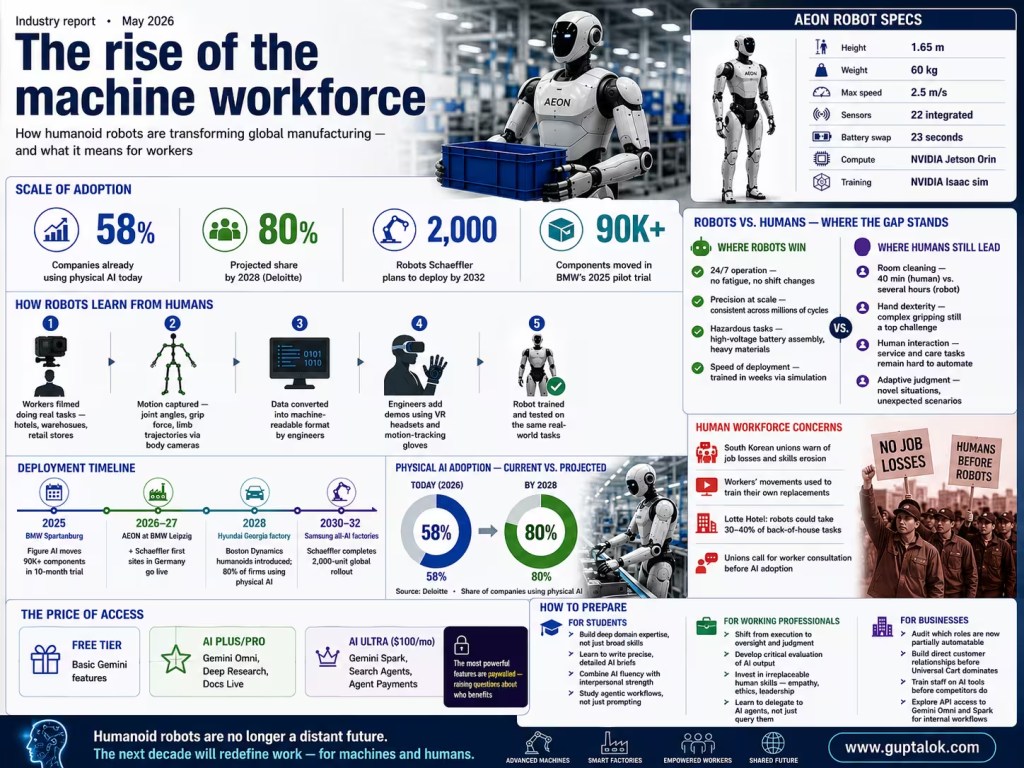
Examples in 2026: Hexagon Robotics’ AEON at BMW’s Leipzig factory, Boston Dynamics humanoids at Hyundai, and Humanoid robots deployed at Schaeffler’s global sites. These machines perceive, reason, and act.
Robot vs Physical AI — The Essential Difference
Robot: told exactly what to do in every situation. Fails when the situation changes.
Physical AI: trained to understand situations. Adapts when things change. A Clawbot with AI inside it is Physical AI. A Clawbot without AI is just a robot.
Analogy: A traditional robot is a factory worker who follows a manual to the letter. A Physical AI is a worker who has done the job long enough to handle surprises — a dropped component, a new box size, an unexpected obstacle — without stopping to ask for instructions.
How It All Connects – From silicon to intelligence — the full chain
Now that every piece is defined, here is how they all relate in one continuous thread.
Everything begins with chips. The CPU manages the overall system. The GPU trains AI models using parallel computation. The MPU controls physical machines in real time. The TPU accelerates AI-specific math faster than any other chip.
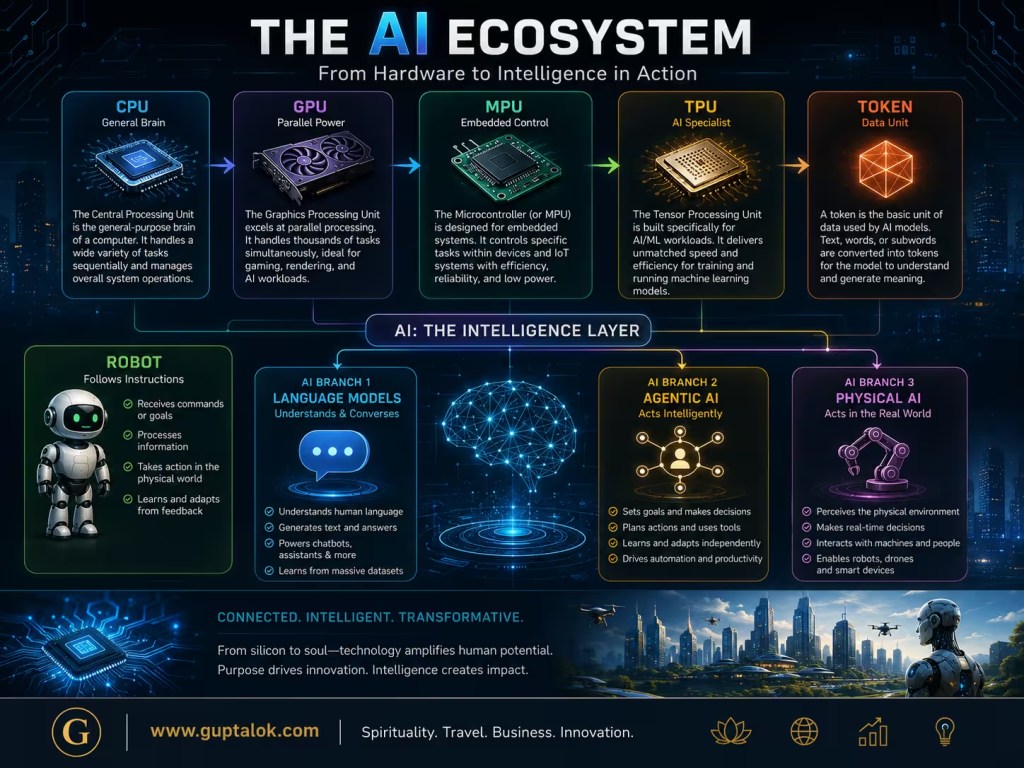
The AI Ecosystem Explained: From Hardware Infrastructure to Intelligent AI SystemsThose chips process tokens — the atomic unit of all AI data. Every word you send an AI is broken into tokens. Every word an AI sends back was predicted one token at a time. Tokens are the common language between human input and machine output.
That token-based learning produces trained AI models — which split into three branches. The first branch, Language Models, gives AI the ability to converse and reason. It lives on screens and servers. The second branch, Agentic AI, gives AI the ability to act inside digital systems — browsing, writing, automating, and executing tasks on your behalf. The third branch, Physical AI, gives AI a body — combining the reasoning power of trained models with the physical capability of robotic hardware.
Connecting all branches is the traditional robot — the predecessor that shows us what AI replaced. A robot follows scripts. AI learns patterns. That distinction separates every programmed machine from every branch of modern AI.
The Clawbot appears in two places on this map. The physical Clawbot is a gripper-based Physical AI application — focused on the deceptively hard problem of grasping objects with the right force and angle. The software Clawbot (OpenClaw) is an Agentic AI tool — a self-hosted digital worker that executes tasks on your machine. Same name, two branches, two entirely different worlds.
The token is the thread that ties everything together. Human knowledge was written in words. Words were converted to tokens. Tokens trained language models. Language models were given tools and became agents. Agents were given bodies and became physical AI. From chip to token to conversation to action to the physical world — it is one unbroken chain.










Leave a Reply