Shlok – 3
Pashyaitaam Panduputraanaamaacharya Mahteem Chamoom |
Vyoodaam Drupadputren Tav Shishyen Dheemta ||
English Translation:
Respected Acharya! Watch this huge army of the Pandu’s sons, which has been strategized by your intelligent pupil and the son of Drupada, Dhrishtadyumna.
Shlok – 4
Atra Shoora Maheshwasa Bheemaarjunasama Yudhi |
Yuyudhano Viraatashch Drupadashch Maharathah ||
English Translation:
In this Army, [there are] valorous warriors, similar to Bheem and Arjun in the battle, with their mighty bows, including brave Yuyudhan (Satyaki) and Virat and greatest warrior Drupad.
Shlok – 5
Dhrishtketushchekitaanh Kaashirajashch Veeryavan |
Purujitkuntibhojashch Shaibyashch Narpungavah ||
English Translation:
[There are] Dhrishtketu and Chekitan and Valiant Kashiraj, Purujit, and Kuntibhoj, and best in humans Shaibya.
Shlok – 6
Yudhamanyushch Vikrant Uttamaujaashch Veeryavaan |
Saubhadrau Draupadeyaashch Sarv Ev Maharathaah ||
English Translation:
And chivalric Yudhamanyu, and valiant Uttamauja, son of Subhadra and [sons of] Draupadi, all of them are Maharathis (Greatest Warriors).
Shlok – 7
Asmaakam Tu Vishishtaa Ye Taannibodh Dwijottama |
Naayaka Mam Sainyasya Sangyaartham Taan Braveemi Te ||
English Translation:
Respected great brahman, understand them who are leading in our army. For your information, I am telling you about those who are the commanders of my army.
Shlok – 8
Bhavaan Bheemashch Karnashch Kripashch Samitinjayah |
Ashwat Thaamaa Vikarnashch Saumadattistathaiv cha ||
English Translation:
[He Continues] You (Dronacharya), and Bheeshma, and Karn, and victorious in battle Kripacharya, and similarly Ashwatthama, Vikarn, and Somdatta’s son Bhurishrava.
Shlok – 9
Anye Cha Bahavah Shoora Madarthe Tyaktajeevitaah |
Naanaashashtrapraharnaah Sarve Yuddhavishaaradaah ||
English Translation:
[He Continues] And many more valorous warriors, who are ready to leave the wish of living for me, are equipped with different types of weapons and all are versed in the battle.
Shlok – 10
Aparyaaptam Tadasmaakam Balam Bheeshmaabhirakshitam |
Paryaaptam Twidmeteshaam Balam Bheemaabhirakshitam ||
English Translation:
So, our force, that is safeguarded by Bheeshma, is more than enough while their force, that is safeguarded by Bheem, is just enough.
Shlok – 11
Ayaneshu Cha Sarveshu Yathaabhaagamavasthitaah |
Bheeshmamevaabhirakshantu Bhavantah Sarv Ev Hi ||
English Translation:
Therefore, all of you, being firm on your respective positions, from all the fronts, undoubtedly safeguard only to Bheeshma.
Exegesis and Central Idea:
From this shlok, Duryodhan speaks to Dronacharya about the warriors, strategies, and positioning of the enemy-army.

Duryodhan explaining Dronacharya about warriors and armies on both sides In these shloks, he commands Dronacharya to have a look at the strategically placed enormous army of Pandavas. He also emphasizes Dronacharya’s intelligent pupil Drishtadyumna (Commander-in-Chief of the Pavdavas’ Army), who had planned and strategized the positioning of the Pandavas’ Army. He emphasized this point for two reasons:
- As Dronacharya was the Commander-in-Chief of the Kauravas’ army, he must know who was the Commander-in-Chief of the Pavdavas’ Army.
- He wanted to make Dronacharya realise that his (Dronacharya’s) pupil Drishtdyumna was fighting against the kingdom. This way, he was, perhaps, trying to make Dronacharya furious at the enemy’s army.
Duryodhan further speaks about the warriors of Pandavas’ army. He informs Dronacharya about the warriors in Pandavas army for Dronacharya being his commander in chief. He compares them with Bheem and Arjun, who were considered best in terms of muscle power and Archery, respectively.
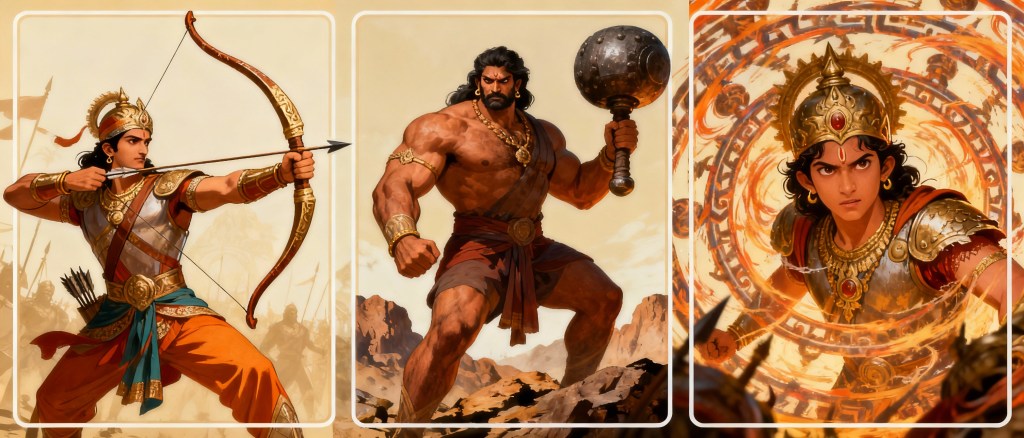
Depiction of Arjun, Bheem, and Abhimanyu from Pandavas' ArmyHe calls them as Maharathi. Maharathis are those who are genius in using all types of weapons, including divine weapons. Here Duryodhan names the mightiest warriors of Pandava’s army and also informs Dronacharya about their capabilities. He further talks about the warriors of his army.
Duryodhan briefs Dronacharya about the commanders of his own army. He names his main warriors including Dronacharya and speaks about their capabilities.
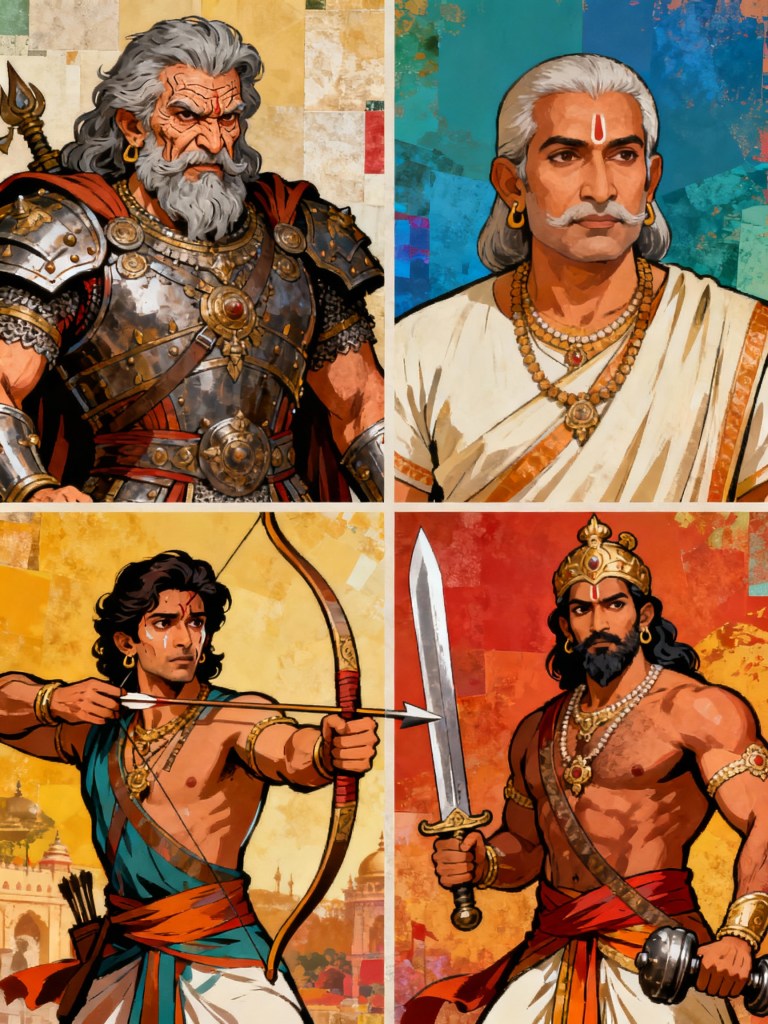
AI-Generated depiction of Bhishma, Drona, Karna, and DuryodhanaHowever, he emphasizes more on the presence of his grandfather Bheeshma, perhaps, because:
- He was highly confident that Pandavas would not be able to defeat Bheeshma because Bheeshma was blessed to decide the time of his own death. It means he would not die unless he himself wants so.
- He wanted to instill enthusiasm in Bheeshma to fight with his best efforts. Thus, he was avoiding any scope for defeat.
After that, he commands all his commanders, including Dronacharya, to safeguard Bheeshma because he, perhaps, wanted to avoid what happened with Bheeshma later on. He also told them to protect Bheeshma from their respective position, in order to avoid a loose end at any front.
There is one more noticeable thing here that is Duryodhan’s comment on both armies. He claims that Pandavas’ army is just sufficient and theirs is more than enough to win the battle. There could be two reasons for him saying this.
- Perhaps, he was over-confident that he would win the war because he had Shree Krishna’s Narayani Sena and all well versed and top-class warriors in his side.
- Perhaps, he wanted to instill confidence and enthusiasm in his warriors so that they fight the battle with their best efforts.
How did this briefing from Duryodhan impact his warriors is described in following shloks.
 Gupt Alok
Leave a comment