Shlok – 1
Dhritrashtra Uvach,
Dharmkshetre Kurukshetre Samveta Yuyutsavah |
Mamkaah Pandavashchaiv Kimkurvat Sanjaya ||
English Translation:
Dhritrashtra Said
Hey Sanjay, what are mine and Pandu’s children, who have gathered in the battlefield – the place of Dharm – with the will of war, doing?
Exegesis and Central Idea:
Dhritrashtra is the blind king of the Hastinapur kingdom and father of the Kauravas (Duryodhan, Dushasan, etc.). Sanjay is Dhritrashtra’s advisor, who has been awarded the science of seeing the battlefield from the palace itself by one of the greatest sages, Ved Vyas.
In this Shlok (Verse), Dhritrashtra asks Sanjay about what is happening in the battlefield. He asks what his and Pandu’s sons were doing at that moment.
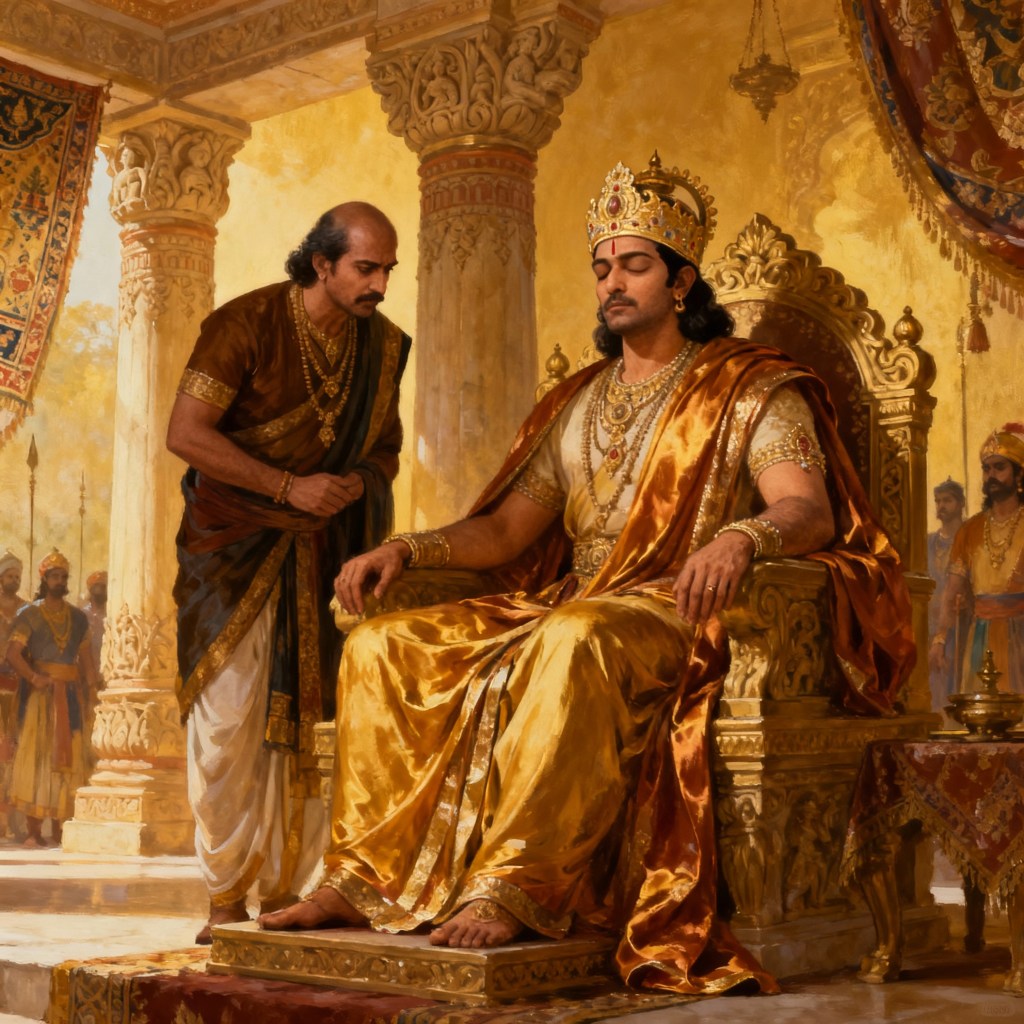
Depiction of Dhritrashtra conversating to SanjayIn his question, he mentioned the battlefield as the field of Dharm. He said that because he considered himself as Kshatriya and a Kshatriya goes to the battlefield to establish Dharm by eradicating Adharm and Adharmis. Now, you may have a question,
“When Dhritrashtra knew Dharm, why did he support Duryodhan?”
Actually, he was well informed about Dharm (Responsibility) of a Kshatriya but misinformed about the meaning of Dharm (Righteousness). If he would have had the complete understanding of Dharm, he would know that:
- Misbehaving with a woman is an extreme level of Adharm (Sin).
- Awarding the throne of a kingdom to an Adharmi (Sinner) is an Adharm (Sin).
If he would know these basic concepts of Dharm, he would not have stood with his sons. On the contrary, he would have stood with the sons of Pandavas who were fighting with those:
- Who tried to strip off a woman publicly.
- Who considered the throne of the kingdom as their right but not their responsibility.
- Who were not the righteous people to rule over the people of the kingdom.
Let’s have a look at the perspective of Dhritarashtra. Why was he so convinced that he and Kauravas were on the side of Dharm? It was because:
- His misconception was that the throne of the kingdom was his right, but because he was blind, he was not initially given that right of him. However, the truth is that the kingdom is not a right, but a responsibility, and therefore should only be given to the capable one.
- He also thought that his son (Duryodhan) was not offered to be the king for being his (Dhritrashtra’s) son. While the truth is that Duryodhana was not worthy of becoming a king.
- He also thought that Yudhishthir (A Pandav) was being offered the kingdom just because he was the son of Pandu. While the truth was that Yudhishthira had a greater knowledge of Dharm than Duryodhana, so he was being made king.
He thought that way, perhaps, because he was taught that way by the people around him. Another possibility could be that no-one thought of providing him proper understanding of Dharm (Righteousness), so he considered Dharm as those acts that he found fruitful or favoring for himself. Today also, people think that way, and therefore, they are more focused on doing those things that satisfy their material wishes. They rarely care about what is universally right. However, if humans closely study and understand Shri Krishna’s Geeta, they would understand what is right and what is not.
Let’s move on to the second shlok (verse), which is:
Shlok – 2
Sanjay Uvach,
Drishtwa Tu Pandavaneekam Vyoodham Duryodhanastada |
Acharyamapasangamya Raja Vachanamabraveet ||
English Translation:
Sanjay Said,
After seeing the strategically placed army of Pandavas, King Duryodhan went to Acharya (Dronacharya) and said these statements.
Exegesis and Central Idea:
In this verse, Sanjay refers to Duryodhan as King because Kauravas were fighting this battle to ensure the position of King for Duryodhan. It was also because Duryodhan was leading the battle from the King’s (Dhritrashtra’s) side.
Sanjay informs Dhritrashtra that Duryodhan looks or analyses the strategic placement of Pandavas’ Army and then goes to Dronacharya, who was chief of Karuva’s army, and says,
What he said to his Army chief would be explained in the following Shloks (verses).


 Gupt Alok
Leave a comment