In this Bhagavad Gita shloka, Arjuna compassionately tells Krishna that he would rather face hardship than kill his elders. We’ll explore Arjuna’s viewpoint, discuss why he feels this way, and what one should do in such dilemmas. We’ll also unpack the meaning of “luxuries and utilities tainted with blood” using real-world examples. Let’s begin with the Sanskrit to English transliteration of Bhagavad Gita Chapter 2, Verse 5.
Guroonhatva Hi Mahaanubhaavan-
shreyo bhoktum bhaikshyamapeeh loke |
Hatvaarthkaamaanstu Gurunihaiv
Bhunjeeya Bhogaanrudgur-pradigdhaan ||
English translation:
Living upon even the alms in this world and not killing the Gurus (teachers) is certainly better for great souls (righteous people). On the contrary, killing Gurus (teachers and elders) for the fulfilment of desires would only lead to live upon the utilities [that are] tainted with [their] blood.
Exegesis and Central Idea:
Here, Arjun is talking about a great moral value, but he is missing a few key considerations. He is very right on:
“Killing your elders, teachers, and anyone for your personal benefits, personal bliss, and selfishness is not right.”
The point he was missing was that he was not made to stand in that war by God to fulfil his (Arjun’s) personal needs, but to take over the kingdom from the non-righteous people. It was neither for the Pandavas’ nor against the Kauravas’, but to crush the rule of unrighteousness and establish the rule of righteousness.
In the second part of the verse, it has been mentioned that killing someone for the fulfilment of your desires would be eating bloody food and enjoying bloody luxuries. What does that mean? Let’s understand:
What are utilities and luxuries tainted with blood?
Those things are the utilities tainted with blood that have been obtained by killing a living being for the bliss of a person, a family, a few people, a community etc. It contains everything that you obtain by killing any innocent being. Let’s understand with in terms of power tainted with blood.
An example of ‘power tainted with blood’ could be the power you seize by killing such a king or a head of state, who ensures the well-being of all citizens and causes no harm to the innocent. It is an act of grave injustice – an absolute adharma. On the contrary, if the king or ruler is exploiting its position and people, killing him could be an act of Dharma because that would lead to welfare of the masses. However, it should be keenly observed and identified that the ruler is really adharmik (non-righteous), and the fighter against him is really Dharmik (righteous) but not someone who is fighting for his personal bliss/hate or religious/communal stubbornness. It should also be ensured that this aspiring king is focused on the rights and welfare of each citizen but not only a few, based on caste or religion-based biasness.
It is not as easy to identify these things as written but are very much possible through wise and unbiased contemplation.
Let’s understand it by an example of current India (2014-2026).
Narendra Modi – A Religiously Biased Leader or an Intelligent Righteous Leader
Currently (2014-2026), the prime minister of India talks a lot about religion and wins the elections with great mandate due to religious polarisation. The statements he passes while campaigning for elections seems like he is inclined towards the Hindus (Indians) who still consider themselves Hindus and hates those Hindus (Indians) who consider themselves Arabian. Many people say that he wants to eradicate all those Hindus (Indians) who have adopted Arabian or western cultures and religions, which does not seem true to me after listening to him and observing his working style. Why is it so? Because I never saw him working to eradicate religious slaves, he just wants them to free themselves from that boundation and become mentally independent.
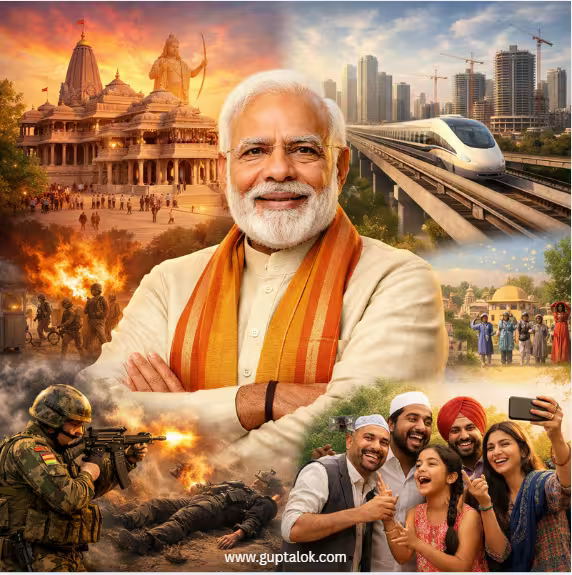
A symbolic depiction of Narendra Modi at the center, surrounded by key themes of his IndiaHis target is to ensure that all Hindus (Indians) remain deeply connected with their roots, which is Dharm (working for welfare of all). And it can be ensured by doing these things:
Introduce Your People to India’s ancient humanitarian history
You can do this by teaching them the Ramayana, Mahabharata, Shiva Purana, Bhagavata Purana, etc. Though, many historians do not consider this ‘history’ because their vision of time and ideas has been narrowed by modernity, and they have, in a way, fallen prey to modern conservatism. So, ignore them as fools and work to develop in future generations a wisdom that is based on ancient Indian values and that is inclusive, humanity-centered, and focused on the welfare of all.
Make people admire our real heroes who loved innocents and hated oppressors
We should make our people know the heroes of our history and human forms of God such as Shree Ram, Shree Krishna, Mahadev, etc. If they’d know these figures, they will likely remember the teachings of these heroes. This is why Narendra Modi and many other great Kings built temples and established the statues of these heroes. This practice helps future generations keep the image and character of these figures in their minds and shape up themselves too, like them. And anyways, when God comes on the earth in a human form, we must not forget his plays because he did those plays to establish Dharm (tendency of universal welfare).
Make Your People Respect Your Righteous Culture
Indians have been taught for quite some time that India (or Bharat or Human Population in India) is just born after 1947 or a couple of thousands of years ago, which is not true. It has been there for millions of years, and that history of millions of years is also our own history. And our future generations must remember that history because that teaches universal welfare. We can’t ignore the highest level of wisdom that was displayed by our ancestors.
Ram, Krishna, and Mahadev are our ancestors, and their acts of wisdom have been documented in the scriptures like Ramayan, Mahabharat, BhagwadGeeta, and Puranas in their time itself. Our ancestors were Atri, Agastya, Ved Vyas, Valmiki, etc., too who have attained wisdom from Rigved, Yajurved, Atharvaveda, and Samaveda. We should make our people respect these books of history so that they can be motivated to study them, which would teach them to work selflessly but not selfishly.
To ensure these things, Prime Minister of Bharat (India) Mr. Narendra Modi has developed monuments related to these historical people and did other things to promote ancient Indian history through different channels. He knows that these monuments, known as temples, would make people think of who these people were, and to know them, they would study the books written by our ancient and intelligent historians who are widely known as sages in India. These books are known as Dharm Granth in India, and they possess the highest level of knowledge and provide supreme wisdom and intelligence to its readers.
So, if even 10% of the Indian population studies them and understands the real essence of them, they would be enough to make the world a great place to live. And, if 100% of India’s population acquired the knowledge and essence of these scriptures and began to act accordingly, suffering and evil would vanish completely.
That is the target of Mr. Modi who is following real Kshatriya Dharm in current (2014-2029) India. But now the question arises: why does Narendra Modi raise so much Hindu/Muslim controversy? Let’s take a look at this aspect as well.
Why does Narendra Modi do so much of Hindu-Muslim in domestic political battles?
We earlier spoke that Narendra Modi celebrates temples and ancient Indian (Hindu) history and culture a lot. We discussed that he celebrates them because he wants Indians to recall their rich history, culture, and traditions. We also discussed that he wants Indians to recall this because this would enhance their intellect, making them seekers of universal welfare.
So, he has an impressive plan to make people great by persuading them into intellect-offering content from Indian ancestors. However, this plan needs to be actioned to be fruitful, and action will happen when Narendra Modi has authority. For authority, he needs to win elections which happens through the votes of people. But people (voters) don’t vote for you just for your righteous politics, they want you to satisfy the evils within them. They possess evils like greed, jealousy, ego, fear, etc., which are often satisfied by non-righteous politicians as they don’t care of nationwide welfare. Since, non-righteous politicians use one or more of such evils of voters to persuade them in favour, Modi also have to use a similar weapon. That weapon is religious polarization, through which he defeats his opponents and also unites Hindus, solving two problems by single act.
So, Narendra Modi and his opponents, both are using evils (greed, jealousy, ego, fear, etc.) in voters to win elections. Narendra Modi unites Hindus, broken into castes, to vote for him in a polarized way. On the other hand, his opponents unite Muslims and divide Hindus in a surname or clan-based castes to vote for them in polarized way. If we compare them both, we find that Narendra Modi is still doing better job by not dividing anyone but jus uniting Hindus.
Since, opponents do Muslim-caste-Muslim to win over Narendra Modi, he has to do Hindu-Muslim to win elections. Now, the question may arise why I support Narendra Modi when he uses the similar tactics as others to get votes. Here is my Answer:
Narendra Modi – Not a Religiously biased leader but a crusader of caste biases
The difference between Narendra Modi and others is that Mr. Modi does it to get an opportunity to work for the welfare of current and future Indian generations while the others do it to get the opportunity to work for the welfare of themselves, their family, and their loved ones, and to get an opportunity to eradicate the possibility that may help current and future Indian generations obtain knowledge and wisdom of ancient India.
So, the moral of this Narendra Modi story is that we should not oppose a person just because he says something that doesn’t seem right, but we should also look at whether what he does is actually right or wrong. If he says something which is not right, just to get support of those who are not right, but does something that is absolutely right, we should support such a king, politician, or head of the country or state. On the contrary, if a politician talks a lot of good things or he talks bad things and also has such a work-policy that is absolutely wrong, we should not get trapped by his/her words but keenly observe his/her real moto and make the decision accordingly.
It means you should make yourself wise and a keen observer to work in line with Dharm. Remember, rules can’t be right for all the potential situations, but wisdom helps you decide the right in every situation. By studying the concepts of BhagwadGeeta, you can enhance your decision-making capability and walk on the path of righteousness (Dharm).
This was an example of how complex it can, sometimes, be to identify that a person is right or wrong. Therefore, put a lot of effort into identifying if a politician is right or wrong before offering your support or opposition to him/her.
Looking at all the aforementioned aspects, it’s easy to identify that Narendra Modi brings nothing on his plate that is tainted with blood, but he is doing everything to establish Dharm (righteousness) in every Indian individual. He doesn’t walk his talk when he talks a lot about religion (dividing people) but he ensures to walk his talk when he talks about Dharm (welfare of all).
Let’s now move onto another example of utilities tainted with blood.
Eating food obtained by killing Animals
Tainted with blood means to be an absolute adharma. The meal that includes the meat of an animal is a luxury tainted with blood because it involves killing of those who are neither harming anyone nor willing to harm anyone.
Though we have mentioned only two examples of ‘utilities and luxuries tainted with blood’, they are not limited to these two only. One can identify them with the use of their unbiased wisdom. Remember, killing anyone for your personal bliss or communal/religious rigidity would bring you everything tainted with blood. On the contrary, killing anyone to establish dharma (policy of universal welfare regardless of caste, creed, breed, religion, faith, etc.) doesn’t bring anything that is Adharm or tainted with blood.

 Gupt Alok
Leave a comment