The Bhagwat Gita shlok 2.4 is Arjun’s follow-up question after Krishna asked him to rise above petty emotional blockages. When God told him that receding from the battle was cowardice, defaming, and ignorance of righteousness, Arjun talked about moral values. Here, we will learn to identify the difference between morals that obstruct duty and morals that facilitate duty. We’ll put ourselves into Arjun’s shoes while keeping the principles of God in mind, to understand Arjuna’s dilemma and its righteous solution. This Bhagavad Gita Chapter 2 Shloka 4 explanation will delve into Arjun’s situation, and help us identify what and why we should do when stuck in such situations. Let’s start with the Sanskrit to English transliteration of this Gita verse.
Arjun Uvaach,
Katham Bheeshmamaham Sankhye Dronam Cha Madhusoodana |
Ishubhih Prati Yotsyaami Poojaarhaavarisoodana ||4||
English translation:
Arjun Said, oh Madhusoodan (Krishna)! How would I attack Bheeshna and Dronacharya with arrows in the battle? Oh Arisoodan (Destroyer of Enemies – Krishna)! They are worthy of worship [for me].
Exegesis and Central Idea:
In this shlok, Arjun again starts to give excuses to avoid fighting with his family and relatives. Now because Shree Krishna had preached him to not get into the influence of bodily feelings, he mixed some society-made morals in his excuses. Now, his excuses became a blend of bodily feelings and man-made non-universal morals.
What are moral values and why are they important?
Morals are rules that were made by social leaders to initiate understanding of righteousness in undiscerning people. They were often made for kids because their decision-making capability remains in the development phase, and therefore, they need guidance. Later, when these kids grew older, they were made to start making decisions in different walks of life, with the guidance of their wise elders. This practice helped them to develop decision-making capabilities, which was known as wisdom in ancient times. When they continued making independent decisions regularly, while being watched by wise elders, they became wise enough to independently decide what is right and what is not. After that, they didn’t need morals to live their life by, but their decisions fell in line with most of the moral values. It was because the moral values were made by wise people and these kids, who became adults later, also took decisions based on wisdom.
The same process was followed to instill wisdom in the kids of the next generation, and so on. So, the morals were the initial lessons in the school of wisdom in ancient times, but they were not the rigid rules for lifetime.
Should morals be strictly followed?
As mentioned above, the students who were taught moral values initially didn’t follow them forever. Instead, they used wisdom to differentiate between right and wrong because decisions based on moral values can’t be precise. The reason behind this is that you cannot make a rule that is accurate in all situations and conditions. Moral values can be accurate in all conditions only when you live in an ideal world where everyone is perfect. Now, because we don’t have perfect people to live with, we must have the wisdom to decide what is right in what condition, instead of blindly following the rules and values. Even if you involve morals in your decision-making process, you must check that the final decision is correct ethically, too.
What is the difference between morals and ethics?
- Morals are already established social rules and values, while ethics are universal humanitarian principles that must be identified and determined in real-time.
- Morals are subjective and objective, while ethics are abstract universal laws.
- Morals are derived from ethical thinking for a particular personality, position, things, act, etc., while ethics are the thoughts of universal righteousness.
- Moral values can be defined in advance for future generations, while ethics are identified through unbiased, wise contemplation.
- Morals tell us what is right generally, while ethics confirm what is right in a specific condition.
- Morals are the value system set by the wise, while ethics are the principles identified by the wise.
- Morals offer a one-sided approach, while ethics are determined by a multi-dimensional approach.
- Morals are fixed, while ethics are dynamic.
- Morals can be different for different people and communities, while ethics remain the same irrespective of community and belief systems, even if you don’t accept it.
- Morals are like religion, while ethics are like dharma (the thought of universal welfare).
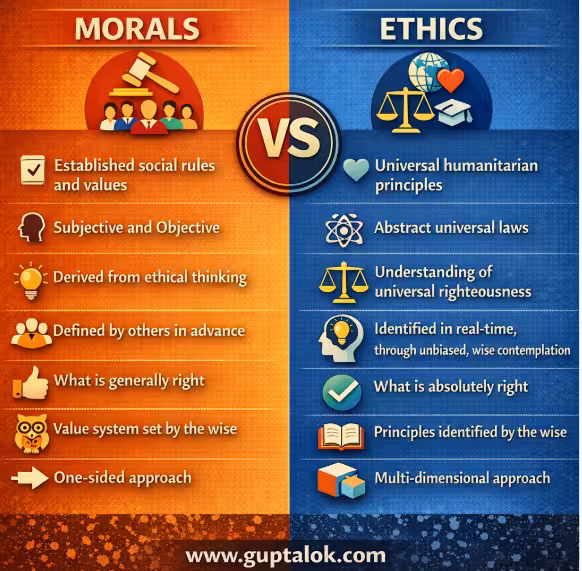
Difference Between Morals and Ethics – Understanding Social Values vs Universal Principles of RighteousnessLet’s analyze a couple of moral values in situations when they clash with ethics.
Respecting and Obeying Your Elders
Respecting and obeying your elders is a moral which should be overridden when it goes against ethics. You should respect, worship, and obey your elders until they are ethically right but not when they are ethically wrong.
Ethics suggest that we should neither exploit the dignity of a woman nor support those who are involved in doing so. Ethics suggest that we should neither sexually abuse or exploit any woman nor support those who are involved in doing so.
If your elders are supporting those who are the exploiters of a woman’s dignity, you should not follow the moral of respecting them. WHY? Because if you do so, you’ll be nurturing the thought that might lead to the sexual abuse of millions of women who already exist or will be born in future. Therefore, in such situations, you should skip the moral of respecting and obeying elders and go with ethics.
Should we stop respecting and obeying our elders?
You don’t need to just continue following the values like respecting and obeying elders blindly but also focus on whether they are righteous. Similarly, you should not stop following values such as obeying and respecting your elders just because some of them were Adharmik (non-righteous). You should closely examine their thought process, and if they are Dharmik (righteous), obey them, and if they are non-righteous, wage a war against them.
Remember, if a moral value is becoming a shield for the Adharm (non-righteousness), then how can it be a moral value because all the moral values must be there to perform, protect, and spread Dharm (righteousness). If a moral value is protecting adharma (non-righteousness) and adharmis (sinners), it is not moral but immoral value.
Killings of Civilians and Children in a war is immoral.
It is widely understood moral that civilians and children should not be attacked in any war, and we must adhere to that. However, when there is a situation where parents and/or custodians of those children are terrorists and rapists, and they are hiding behind innocent woman and kids, you may have to sacrifice the thought of receding from the battle to safeguard these innocents, because if terrorists and rapists are spared for any reason, they are going to make the lives of these and many other innocents hell.
Moral suggests that children of the war country should be protected from death, but ethics suggest that the children of entire earth should be protected from religious or any other type of radical exploitation.
When you are fighting with the radical religious terrorist countries and groups, you cannot expect them to behave morally. Why? Because their religious morals and rules are like follows:
- They say that women, with open face and head, are sinners, and therefore, they rape and kill such women, bypassing the ethics that not even a naked woman is entitled to rape and/or death.
- They say that everything is fair in process of expansion of their radical religious thought-process and religious-identity-based community, including mass-killings (including children), rapes, tortures, brainwashing, etc.
Now because you are fighting against such radical forces, you can’t make any mistake that leads to the boon of life for them, because if they are spared, they will do mass destructions worldwide. The best you can do is to continue fighting with the terrorists and radicals, with striving to ensure minimal loss to the lives of those innocent civilian and children who are used as shields of them.



 Gupt Alok
Leave a comment