It is said that Humans are the most capable and intelligent species on Earth. However, they are often controlled by emotions and thus fail to perform what they are best at. It happens due to the loss of the inner courage that incurs due to ignorance of inner wisdom. The essence of Bhagavad Gita Shlok 2.3 provides the solution to this anomaly in Humans. The spiritual teachings of Krishna in this verse helped Arjun, and can also help us, to get free from emotional bondages. Here, God talked about the absolute truth of everyone living that sets them free from petty emotional blockages. Let’s dive deeper into the Bhagavad Gita Chapter 2 Shloka 3 meaning to get more clarity on this.
Klaivyam Maa Sma Gamah Paarth Naitatvayyupapadyate |
Kshudram Hriday-daurbalyam Tyaktot-tishth Parantap ||3||
English Translation:
Parth (Arjun)! Don’t let your Purushatva (Valour) go [off yourself], it is not right for you. Oh conqueror of enemies! Leave this petty heartily (emotion-based) infirmity and get up [to perform your dharma].
Exegesis and Central Idea:
In this Bhagavad Gita sloka, Shree Krishna asks Arjun to not let the Purushatva (tendency to do right) vanish from himself. We should also not let it vanish from ourselves, but, for that, we must know the meaning of Purush and Purushatva in Bhagavad Gita:
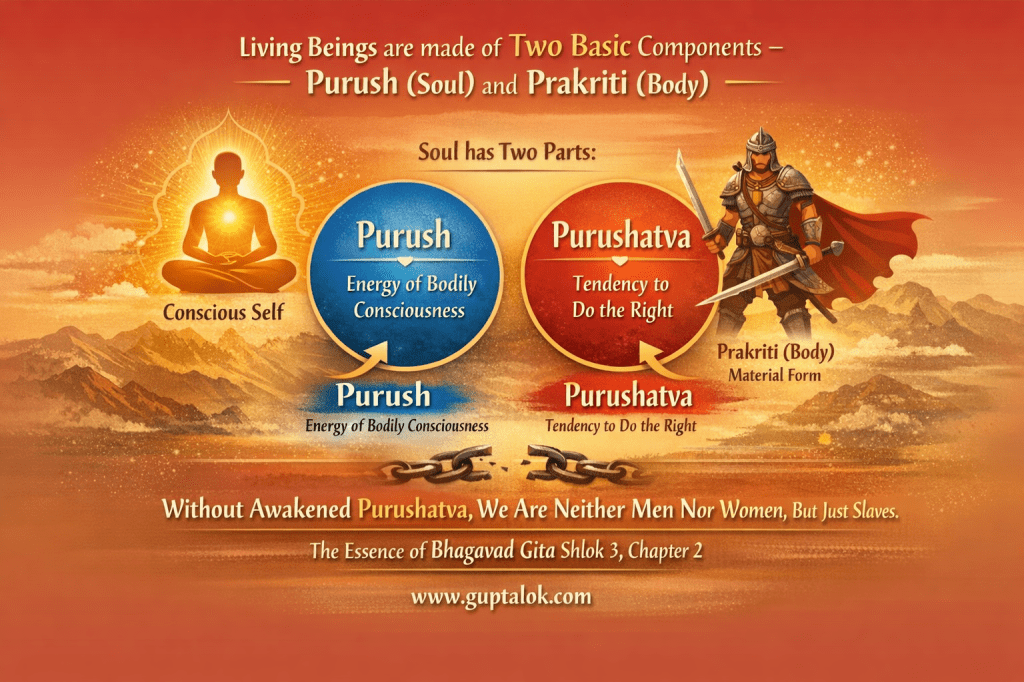
Infographic on the essence of Gita 2.3, explaining Purush, Purushatva, and Prakriti, and the call to awaken true inner strength.Everything in the universe is made of two major components:
- Purush (liveliness).
- Prakriti (Visible Form).
What does Krishna mean by Purushatva, often referred to as unmanliness, in Gita 2.3?
In general terms, it has been established in Indian minds that Purush means a man and similarly Purushatva means manhood. This understanding is true only for the physical form of Humans, where a male is known as Purush and a female is known as Stree. However, when you dig into spirituality, Purush does not mean a gender but it means liveliness of bodies of living beings. This Purush is the one which is also referred as Atma (Soul or Spirit), and it has two parts:
- An energy that ensures the body’s functioning. This is Purush.
- A consciousness that ensures righteous decision-making. This is Purushatva.
Atma (Soul) – The Energy Part – Purush
This part of Atma is there to take care of body functioning. It can also be referred to as physical (bodily) consciousness. It looks after the tasks which are needed for a being to remain alive, such as breathing, sensing, giving quick threat reactions, restricting the decay of body tissues, etc.
Atma (Soul) – The Mental Consciousness Part -Purushatva
This part of Atma takes care of the righteous decision making in all the beings. Every time you make a decision, this consciousness part is the one that suggests you the righteous way while the senses and external thoughts provoke you to choose the non-righteous way. This is the situation that’s often referred to as a dilemma. This is when your discretion comes into picture to help you identify which way is suggested by the mental consciousness part of Atma (Soul). In order to identify this, you must contemplate deeply to determine why each of the ways being suggested to you.
The Non-Righteous Way
The way, your brain, mind, or heart is suggesting due to external Influences and material impacts, is the non-righteous way. This path is suggested to you purely because of the following reasons.
- It will favour the caste (Name, Surname, or Clan-based identity), you belong to or you are inclined towards.
- It will favour the religion (Madhhab), you belong to or you are inclined towards.
- It is based on the thoughts of the personalities, people, or groups who you are inclined towards or are connected with through some channels.
- It is going to lead to your personal bliss.
- It is going to lead to your personal benefit.
- It is anything that is for the welfare of only a part of beings but not for all the beings (current and future generations).
The Righteous Way
The way, your brain, mind, or heart is suggesting due to internal wisdom, is the righteous way. But the question is that how would you identify that the way is suggested by the internal wisdom – the antaratma (conscience). It is very easy; it would be based on no bias. Let’s understand what it means to be unbiased.
- It means that the decision you are making is not because you are against or inclined towards a caste (Name, Surname, or Clan-based identity), but because that is for the welfare of all innocent lives (current and future generations).
- It means that the decision you are making is not because you are against or inclined towards a religion or a person holding a specific religious identity, but because your decision is based on doing right (Dharm) with all innocent living beings of the current generation and many future generations.
- It means that your decision is neither based on blindly following nor blindly opposing to a quote from a renowned personality, a verse from a book, or a thought of a group or community, but it is based on the willingness to work for the welfare of all those who are not trying or willing to harm anyone intentionally.
- It means that the decision you are making is not just focused on your personal, communal, or family-oriented bliss and benefits, but it also ensures that it is not going to harm any other living being.
- It means that the decision is not based on any type of Raag (affection) or dwesh (hate and jealousy) towards any community or group of people or other beings.
- This means that any of your actions or decisions should not be driven by internal or external pressure, but rather by a desire for the well-being of all those who are and will be. A few examples of internal pressure are ego, anger, attachment, jealousy, etc. Examples of external pressure could be the pressure of society, system, ideology, institution, religion, any type of identity, etc.
- It means anything that you do not just for the welfare of only a part of beings but for all the beings (current and future generations).
So, based on spirituality, Purush is not a physical man but the energy that ensures liveliness of each and every body we see around us. It is also the one who ensures that we, living beings, take righteous decisions at every point in life. And therefore, Shree Krishna said to Arjun to not let go of his Prushatva which means not let his righteous decision-making die, just because of the heart’s pull of attachment. Because this attachment was forcing him to leave the righteous way, which is suggested by the Purush (conscience or anter-aatma or inner soul). And if you are not listening to the suggestions of that Purush, you are letting it go into a deep sleep, after which it gradually stops giving you suggestions, and then, you become a slave of Maya (Illusion) etc. That’s what God means by the loss of Purushtva and therefore he suggests not letting it go.
Prakriti meaning in Gita
Though, there is no mention of Prakriti in this shlok but because we learned about Purush, we should also understand Prakriti. The Prakriti is everything that can be seen and that is physical. The prakriti is the medium provided to the soul (Purush) to perform Karma. It means that the soul (Purush) is the owner of the body (prakriti) and it should use the body to reflect itself (Aatma – the truth). However, when it does not use the body to reflect itself (reflecting itself means doing right) but starts to consider itself as body, it slips on the path of Adharm (non-righteousness). And all the biased decisions are taken by it only when it thinks it to be the body which means when it forgets the real self. And that is what has been called as “loss of Prushatva” by Krishna, when Arjun had started to think himself just a body and wanted to change his decision to fight for Dharm due to bodily (prakriti-based) feelings.
Real meaning and essence of the Gita Shlok 2.3
Don’t let your Purushatva get into the sleep just because of the prakriti-based feelings or reasons because these external rules, traditions, and bodily feelings are the obstructors on the path of Dharm while Purushatva (the voice of inner soul) is the facilitator of Dharm (righteousness – the path of justice for all).

 Gupt Alok
Leave a comment