Shlok – 44
Utsannakuldharmaanaam Manushyaanaam Janaardana |
Narke Niyatam Vaaso Bhavateetyanushushruma ||
English Translation:
Oh Janardan! (Krishna!) I have heard that the human whose clan and breed-based duties have been destroyed (stopped performing) lives in hell forever.
Exegesis and Central Idea:
Arjun mentioned that when humans stop performing their clan-based Dharm (righteous duties), they reside in hell forever. Why does it happen? Why was this said in old times?
Why Humans Who Don’t Perform Clan-Based Duties Go to Hell?
It happens because when you don’t know what is right to do, you are more likely to do many wrong things in life. And when you perform wrong (non-righteous) practices in life, your life becomes hell, though you may not realize it initially. And if you are a complete idiot and your contemplation capability is extremely weak, you may not even realize it ever. However, you would continue to remain stressed, unhappy, egoistic, and, perhaps, a complaint box too. This is what the real-life hell is.
In the afterlife situation too, you must be residing in hell because that is what the concept of Karm, explained by Shree Krishna, suggests.
Shlok – 45
Aho Bat Mahatpaapam Kartum Vyavasitaa Vayam | Yadraajyasukhlobehn Hantum Swajanmudyataah ||
English Translation:
Alas! How strange it is that we have decided to perform such a sin, which involves our readiness to kill our kinsmen, just because of the greed for the pleasures of the kingdom.
Exegesis and Central Idea:
After giving all such justifications to prove that the decision of fighting with Kauravas was wrong, Arjun said that it’s very saddening to be ready to kill own kinsmen just for the greed of luxuries and kingdom. He was partially right because killing anyone (not only kinsmen) for any type of greed is Adharm (non-righteous/sin) but killing any Adharmik (non-righteous) ruler to snatch kingdom from him is Dharm (A good deed), provided your intention is to work for the welfare of all living beings in that kingdom. Remember, the kingdom is not the king’s right but it’s his responsibility.
Shlok – 46
Yadi Maamprateekaaramashashtram Shashtrapaanayah |
Dhaartraashtaa Rane Hanyustanme Kshemtaram Bhavet ||
English Translation:
If the sons of Dhritaraashtra, with their weapons, kill me on the battlefield, even when I am not retaliating and don’t hold any arms, that too will be good for me.
Exegesis and Central Idea:
In this Shlok, Arjun said that he would find it good for him if armed Kauravas kill him when he is unarmed and not retaliating.
Arjun, here and in previous Shlok, was trying to go with a few rules, already set by society, instead of following Dharm. All these things are done by humans today also, because they generally don’t trust themselves and don’t use their wisdom, but follow the rules set by others. Let’s understand why it happens and how it can be avoided.
Self-Defense is not Just Your Right but Responsibility too.
He said that he would be happy being killed by kauravas if he is unarmed and not retaliating. This is not right. Remember, doing nothing for self-defense when an Adharmi (non-righteous) person is trying to hurt you is also an Adharm (Sin). Therefore, you should not think that you are being great by not defending yourself from the wrong doers. By doing so, you are promoting them to do the same with more people which is not at all Dharm (righteousness).
Being a Coward on the Name of Non-Violence is Adharm.
In India, there have been a few leaders who projected Ahinsa as an attitude that wants you to do nothing against those who are torturing and killing you and your family and even raping your women. Those leaders and their slaves have propagated this attitude as Ahinsa (non-violence) but it is not ahimsa (non-violence), it is actually giving-wings to criminals and Adharmik (non-righteous) people to do more violence. Ahimsa (non-violence) does not only mean that you do not do Hinsa (violence), but it is also to ensure that Adharmik (non-righteous) people also do not perform Hinsa with innocents. Remember, doing Hinsa (violence) with someone who is likely to do and promote Hinsa (violence) with the innocents and masses is ahimsa (non-violence).
Shlok – 47
Sanjay Uvaach,
Evamuktvaarjunah Sankhye Rathopasth Upaavishat |
Visrijya Sasharam Chaapam Shoksamvignamaanasah ||
English Translation:
Sanjay Said,
After saying this, mentally troubled with grief, Arjun left the arrow and the bow and sat on the chariot.
Exegesis and Central Idea:
As this live story of Kusrukshetra was being narrated by Sanjay, he told Dhritarashtra that after giving so many arguments, engrieved Arjun left the arrow and the bow and sat on the chariot.
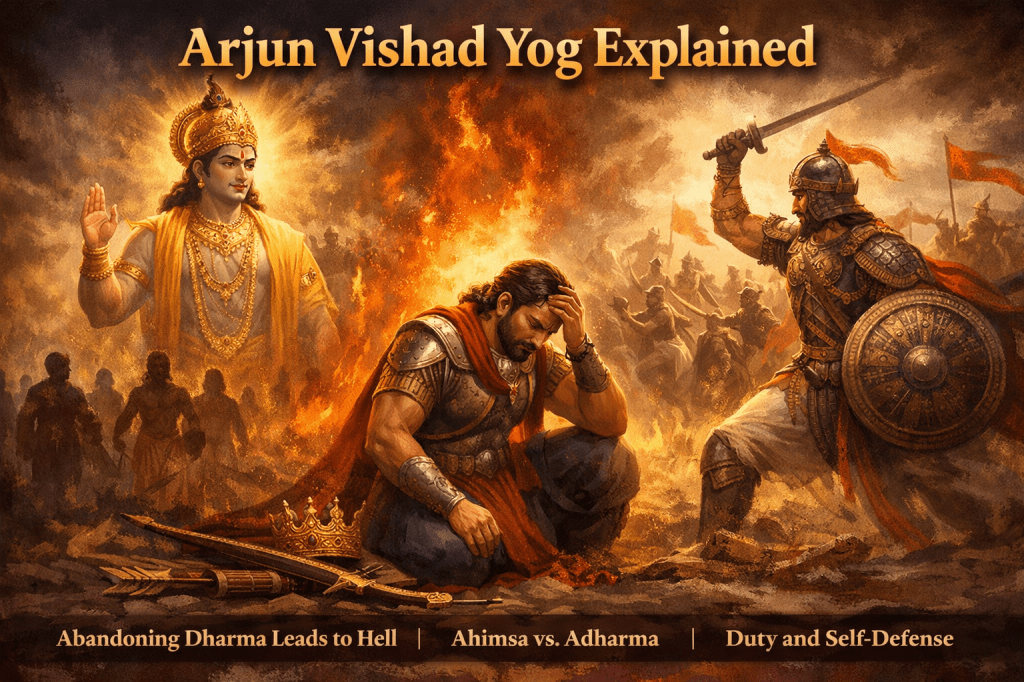
An AI-generated image displaying Arjun’s moral collapse on the battlefield as Krishna stands sereneThat is what happens with every human being when he/she is in the possession of Moh (Attachment). He/She gives all the logics, that look very right but are against Dharm, to avoid fighting those loved ones who do Adharma (non-righteous acts).
Anyways, what happens next would be explained in chapter two as the chapter one “Arjun Vishad Yog” ends here.
 Gupt Alok
Leave a comment