Shlok – 42
Sankaro Narkaayaiv Kulaghnaanaam Kulasya Cha |
Patanti Pitaro Hyeshaam Luptapindodak-kriyaah ||
English Translation:
The Sankar (Ignorance or unawareness) takes the deceivers of the clan and the clan into hell itself. This [also] leads to the decline and [even] loss of shraaddh and tarpan (respect-giving rites after death) for ancestors.
Exegesis and Central Idea:
Here, Arjun mentioned that when the family gets into a situation of Varna-Sankar (unawareness of one’s righteous duty towards society), it becomes a hell-like situation for the family. Let’s understand what Arjun emphasized on the most.
Varna-Sankarism Makes the Lives of Descendants Hell
Arjun mentioned that Varn Sankar takes the clan into a hell-like situation because those people, family, groups, communities, etc., who do not know dharm (what is right for every innocent living being), live the life of a mental slave. And being a slave is no better than being in hell.
Ancestors of Varna-Sankar Descendants Go to Hell
Arjun also mentioned that those members of the family who are the reasons for Varn Sankar are known as clan-deceivers and suffer forever in hell. He said that for himself, considering that he would be the reason for Varn Sankar if he kills his relatives in the Kauravas’ army.
Who Were Accountable of Varna-Sankarism in Kuru Dynasty and Why?
The actual clan-deceivers were Duryodhana, Bheeshma, and other such people who misunderstood Dharm (righteousness and duties) and supported each other in performing Adharma.
Bheeshma was the reason for Varn Sankar because he himself misunderstood his duty as a kshatriya. He thought that his duty was to protect the king and his family but actually the duty of a kshatriya is to protect the kingdom and the public. Protecting the kingdom and the public means ensuring that the king and his family take every decision for the welfare of the public (current and future generations). It means ensuring that the king follows dharma (righteousness), and if he does not, then ensure that the power is transferred to a real kshatriya. I mentioned real kshatriya because many people think that a kshatriya is someone who is born into the kshatriya family but actually a kshatriya is a person who protects the public and ensures no-one, within them and from outside, does Adharma (non-righteous acts) with them.
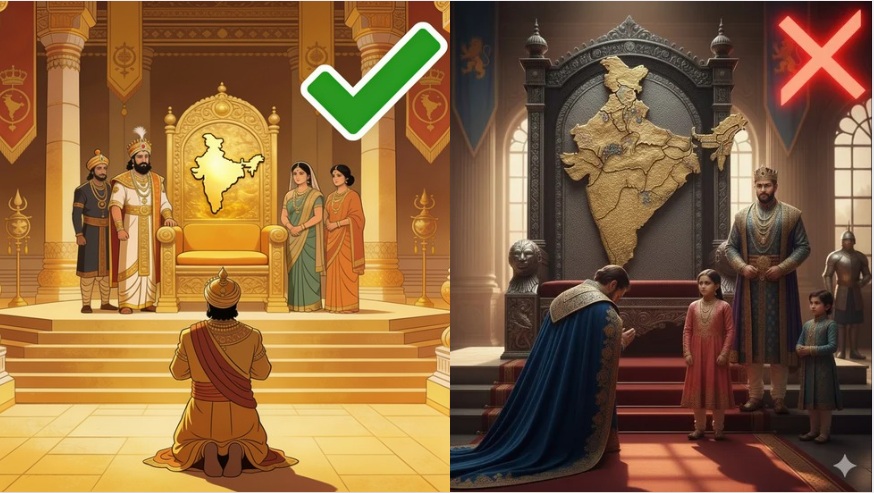
A portrayal of the true and false Patriot— the true bows before the throne that represents the country, while the false bows before the king and his family. Duryodhana was also a direct reason for Varn Sankar because he had become self-centric while a kshatriya and a brahman must be highly public-centric. He thought that the kingdom was his right but actually the kingdom is always the responsibility of a kshatriya. A true kshatriya is someone who holds the position for the welfare of the public and doesn’t even hesitate to leave his position for the welfare of the public. The duty (dharma) of a kshatriya is to protect the woman and her dignity but Duryodhana wanted to kill those whose woman’s dignity was exploited in public by him.
Thus Duryodhana, if he would have won, would have transferred the kuru dynasty the situation of Varn Sankar because then, his descendants would also play with the dignity of women rather than protecting it.
What Condition Would Have Made Arjun Accountable for Varna-Sankarism?
Arjun would have been the reason for Varn Sankar if he would not fight with Kauravas, because then, Kauravas would teach the descendants a history where sexual exploiters of women rule the people. This might make the descendants of the kuru dynasty to behave similar to Duryodhana with women which is not the Dharm (duty) of a kshatriya. And if you don’t know what your Dharm (righteous duty) towards society is, you are into Varn Sankar.
Impact of Varna-Sankarism on After-Death-Rites of Ancestors
Arjun also mentioned that the descendants, after reaching the Varn Sankar situation, are very less likely to do the after-death-rites of the dead seniors. This degrades the position or respect of the dead seniors. Actually, in each of the cases of Varn Sankar, the descendants of the clan are sure to not get a chance to learn the family traditions, just as they don’t get the chance to learn Dharm (righteousness and duty both). Therefore, they are very less likely to perform respect-paying rites for their ancestors.
Understanding Declination of Ancestors
The declination/degradation of the ancestors can be understood better in the living world situation than in the after-life situation. It is like a business that grows well and keeps the name of the founder of the business intact in the society until the descendants of the founder run it well and continue paying homage to him.
On the contrary, if the descendants are not well-versed in the business tactics and ethics, they would not be able to take it to the new heights, or they may even degrade the brand/business positioning. And, as the business positioning declines, the legacy of the founder also starts to decline. In the same way, the legacy of the ancestors declines when the descendants do not perform their ancestral duties well and do not remember the ancestors from time to time.
In the afterlife situation, it is very simple. It is already established in Hindu/Bhartiya/Indian civilization that those souls remain in peace whose descendants perform their ancestors’ after-death-rites well and regularly. And those souls go into hell whose descendants don’t perform their ancestors’ after-death-rites well and regularly. This is what degradation/declination means in an after-life situation.
Shlok – 43
Doshairetaih Kulaghnaanaam Varnsankarkaarakaih |
Utsaadyante Jaatidharmaah Kuldharmaashch Shaashvatah ||
English Translation:
Thus, due to the wrongdoings of the deceivers of the clan, which lead to Varnsankar (Ignorance or unawareness of one’s duty), the duties of the clan and the duties of the human-breed are missed out [by the descendants].
Exegesis and Central Idea:
In this Shlok, Arjun mentioned that such wrong-doers (deceivers of the clan), when performing such misdeeds, lead to the interruption in performing duties based on jati (breed) and clan.
What does Caste-Based Dharm Mean?
Caste (Jati)-based-Dharm has been widely misunderstood by most people today. Actually Jati, here, does not mean your identity based on your clan or a surname that you hold. Jati, here, means the breed, so our Jati (Caste) is human and therefore Jati-based-Dharm, here, means one’s duties as a human being. So, actually Arjun is saying that due to Varn Sankar and deaths of most senior men of the family, the transfer of knowledge of Dharm (Righteousness – one’s duty as a human), to the descendants, would be interrupted, leading them away from performing their dharma as human.
What does Kul-Dharma (Clan-based Duties) Mean?
The next point Arjun mentioned was that performing Clan-based Dharm (duties) would also be interrupted. Actually, in ancient times, Indian families generally transferred their heritage to their descendants like today. The only difference in their heritage and today’s heritage is that they used to transfer the understanding of performing their social responsibility to their children, while today’s Indians just have either arrogance of an identity or physical wealth, as heritage for their descendants. So, “clan-based dharma would be interrupted”, here, means that the descendants would stop doing those activities for the welfare of society which their ancestors have been doing for long. And why would that happen, according to Arjun? Because the descendants would not have that understanding of what their social responsibility is.


 Gupt Alok
Leave a comment