Shlok – 30
Gaandeevam Stransate Hastaat Tvakchaiva Paridahyate |
Na Cha Shaknomyavasthaatum Bhramateev Cha Me Manah ||
English Translation:
Gandeev (Arjun’s Bow) is slipping from my hand, and my skin seems like it is burning, and I am unable to keep myself steady, and my mind seems to be highly confused.
Shlok – 31
Nimittaani Cha Pashyaami Vipareetani Keshava |
Na Cha Shreyoanupashyaami Hatvaa Swajanmaahve ||
English Translation:
And all the omens seem to be adverse to me, Keshav (Shree Krishna)! And I don’t see any goodness in killing my own kinmen.
Shlok – 32
Na Kaangkshe Vijayam Krishna Na Cha Raajyam Sukhaani Cha |
Kim No Raajyen Govind Kim Bhogairjeeviten Vaa ||
English Translation:
Oh Krishna! I neither want victory nor I want the luxuries of a kingdom. Oh, Govind (Krishna)! What will I do with the luxuries, kingdom, and even being alive?
Shlok – 33
Yeshaamarthe Kaangkshitam No Raajyam Bhogaah Sukhaani Cha |
Ta Ime-avasthitaa Yuddhe Praanaanstyaktva Dhanaani Cha ||
English Translation:
For whom we [generally] want kingdom, luxuries, and things of comfort, they themselves have gathered here to battle [with me], by sacrificing their life and wealth.
Shlok – 34
Aachaaryaah Pitarah Putraastathaiv Cha Pitaamahaah |
Maatulaah Shvashuraah Pautraah Shyaalaah Sambandhinastathaa ||
English Translation:
They include teachers, father figures, child-likes, and even grand uncles, maternal uncles, father-in-laws, grandchild-likes, and other relatives.
Shlok – 35
Etaanna Hantumichchhaami Ghnato-api Madhusudhana |
Api Trailokyiraajyasya Hetoh Kim Nu Maheekrite ||
English Translation:
Oh Madhusoodan! (Krishna!) Even if they all come to kill me, and even if I am to get the kingdom of three types of realms by killing them, I don’t want to kill them. Then what is the point of killing them just for a part of the earth?
Shlok – 36
Nihatya Dhaartaraashtraannah Kaa Preetih Syaajjanaardana |
Paapmevaashrayedasmaanhtvaitaanaatataayinah ||
English Translation:
Oh Janardan (Krishna)! What kind of happiness are we going to get by killing these sons of Dhritraashtra? On the contrary, we will be doing only sin by killing these oppressors because they are our kinsmen.
Shlok – 37
Tasmaannaarhaa Vayam Hantum Dhaartraashtraansvabaandhavaan |
Svajanam Hi Katham Hatvaa Sukhinah Syaam Maadhava ||
English Translation:
That’s why it is not right that we kill our kinsmen – the sons of Dhritaraashtra. Oh, Maadhav (Krishna)! How can we be happy by killing our kinsmen?
Shlok – 38
Yadyappyete Na Pashyanti Lobhopahatachetasah |
Kulkshayakritam Dosham Mitradrohe Cha Paatakam ||
English Translation:
Although they can’t see the evil in harming (killing) the kindreds and the sin in the malignancy, with their friends, due to their conscience being covered with greed.
Exegesis and Central Idea:
From the second part of Shlok 28, Arjun starts speaking about what he felt after seeing his kinsmen. He tells Krishna that he was feeling uneasiness. He tries hard to convince Shri Krishna that killing his family members is absolutely wrong even if they are the sinners and want to kill you. Most of the people behave the same way when they have to fight for Dharm. They claim that:
- Taking care of the family is the first duty (Dharm) of humans.
- Protecting family members is the main Dharm of humans.
- Going against family and society is the biggest sin.
Family is Important but Humanity is the Must
These and many other thoughts like this are unrighteous because humans’ first duty is to do and promote those acts which are right for all innocent living beings. If your family and any of the family members are in the business of doing those things which are harmful for the masses (including current and future generations), your duty is to stop them from doing such things. If they don’t leave that path of unrighteousness, you must wage a war against them.
The next thing is that you should protect your family members and all those who are innocents. However, if any of your family members is indulged in non-righteous activities, you should either take him/her away from that path or stop protecting them. On the contrary, you must fight against them.
The third claim mentioned above is going against family is the biggest sin, but it’s true only if they are innocents and righteous. However, if they are Adharmik (non-righteous), being with them becomes the biggest sin.
Kingdom is not for Personal Bliss, It’s for Public Service
In verses 32 and 33, Arjun pleads not to fight by saying what would he do with the kingdom when his kinsmen are going to die in this battle. Which is the thought process of most people in today’s world. They think that they have got a position just to provide satisfaction to their family members. However, the truth is that a kingdom is not to provide luxuries to the family of the king but to provide essentials to the public.
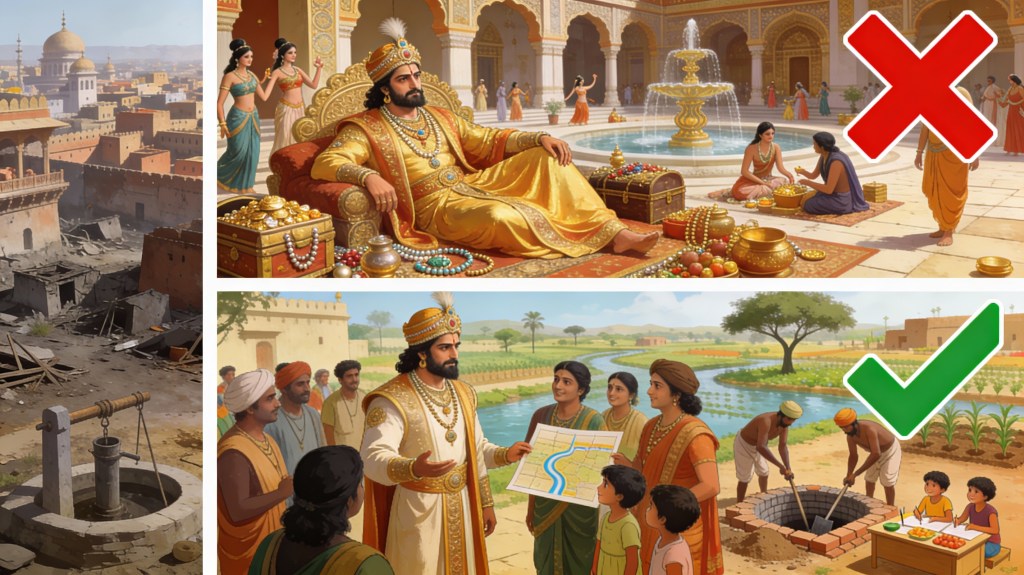
Illustration contrasting selfish luxury versus people-focused kingdom welfareThe other truth is that you should fight for a position when the person holding that position is not doing what is right for all. And once you win the position, you should use that position to do what is right for all living beings and natural habitats. The welfare and luxuries for your family are the byproduct of your righteous work. In case you don’t get the luxuries for your family after doing right for all, don’t refrain from fulfilling your duty towards that position righteously, because that is why you are born in this world.
Neither for Position, nor for life, Fight only for the Right
In the verse 35, Arjun also mentions that he doesn’t want to kill them even if they were to get the kingdom of all three realms. He also said that he didn’t want to kill them even if they came to kill him. He was actually right because one should not kill anyone if he/she is going to get something material in return. However, if someone or some people are fighting to establish the kingdom of Adharm (non-righteousness), one must kill them to establish the kingdom of Dharm (Righteousness).
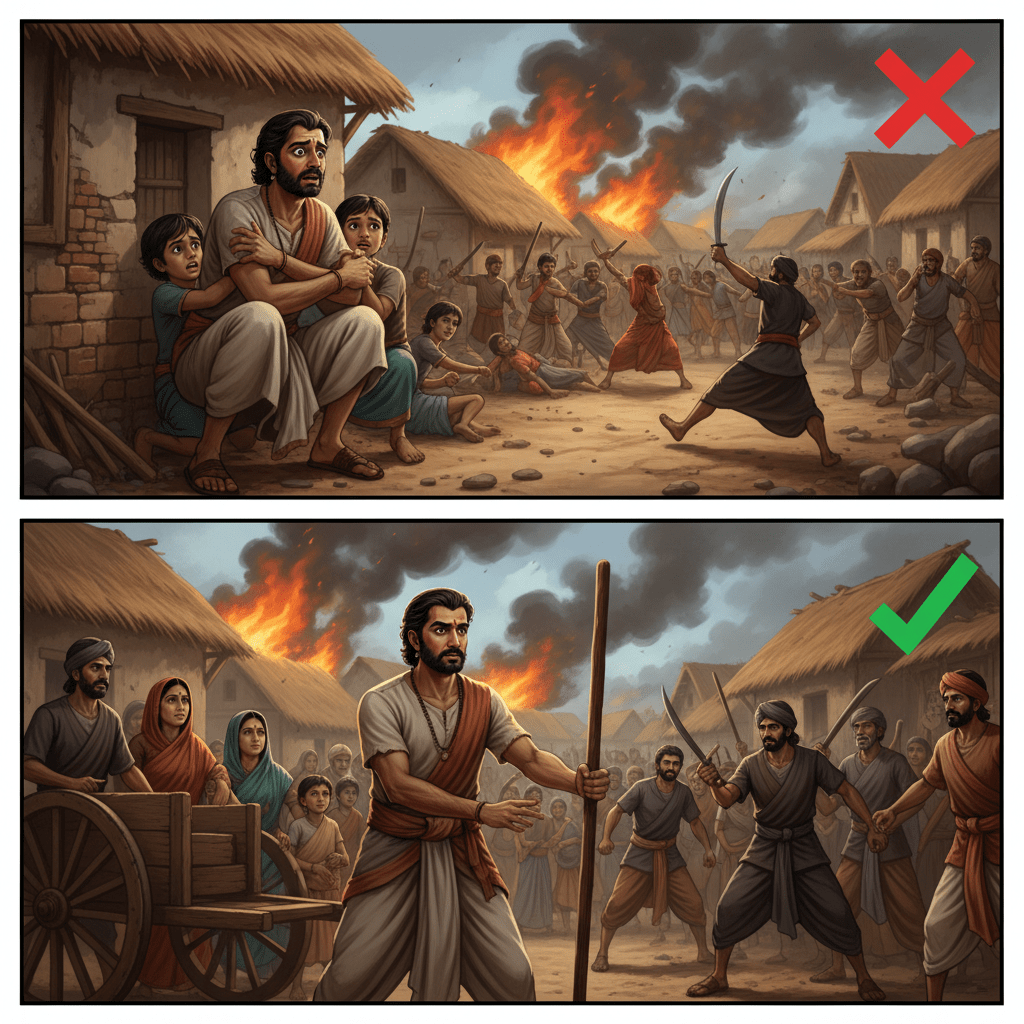
Contrast between a man cowardly hiding with his family during oppression and the same man bravely defending villagers while keeping his family safe Another point is that one should also not kill someone who comes to kill him/her, but he/she should not surrender either. On the contrary, you should try your best to defend yourself if it’s possible to do it without killing them. And if killing them is the only option to defend yourself, then you have no choice.
However, in the case of Arjun, these were not the cases. Arjun neither needed to fight to get the kingdom nor to keep himself alive. Actually, he needed to fight to ensure that the kingdom of Dharm gets established in Hastinapur. And Shree Krishna makes him understand this thing by telling him Geeta-Gyan.
Never Cherish or Protect Opposers of Dharm (Righteousness)
In the verse 38, Arjun mentions that he cannot be satisfied by killing his kinsmen, even if they have become Adharmi (non-righteous) due to greed, and don’t understand that deceiving family and friends is wrong. Most of the humans also think the same way due to their infatuation with the people who are related to them due to some known physical bond. This thought process is also not right, and Shree Krishna spoke about this in the upcoming chapters. Let’s have a look at why we should not think this way.
No Need to Be Good for the Bad
We must not think of protecting our kinsmen physically if they are on the path of Adharm (non-righteousness). On the contrary, we should try to bring them onto the path of righteousness, to protect them. However, if we fail in doing so, we must stand against them.
Family is yours only until it is on the path of Dharm (Righteousness)
Many people would not agree to this point because they think that it is their Dharm (duty) to stand with their family and friends in all conditions. No, it is not right, you should stand with your family and friends only in those conditions which may bring grief and problems in your life, but they do not take you to the path of non-righteousness (Adharm).
Duty as a Human is Bigger than Duty as Anyone Else
Now, your question could be that not supporting your family is itself Adharm, then what Adharm am I talking about? Actually, I am talking about the Adharm that you would be performing as a human being. Before having a duty as a family member, you have a duty as a human. Now, because you are first a human and then related to any other human being, therefore, you should first focus on your duty as a human and then your duty as a relative to anyone or anything. And, as a human, your duty is to do only those things which are right for the masses (current and future generations).



 Gupt Alok
Leave a comment