Shlok – 21
Hrisheekesham Tadaa Vakyamidmaah Maheepate |
Arjun Uvaach,
Senayorubhayormadhye Ratham Sthaapaya Meachuta ||
English Translation:
[Sanjay Continued],
Oh King! Then [Arjun] said these statements to the controller [or God] of senses (Shree Krishna). Arjun Said, Oh Achyut (Krishna)! Set up my chariot between both the armies.
Shlok – 22
Yaavadettaannireeksheham Yoddhukaamaanavsthitaan |
Kairmayaa Sah Yoddhavyamasmiranranasamudyame ||
English Translation:
Until I properly examine these seekers of battle and understand with whom I need to fight in this business of battle.
Shlok – 23
Yotsyamaanaanveksheaham Ya Ete-atra Samaagataah | Dhaartaraashtrasya Durbuddheryuddhe Priyachikeershavah ||
English Translation:
I’ll see to those who have gathered here with the wish of supporting the interests of brainless sons of Dhritsraashtra in this battle.
Shlok – 24
Sanjay Uvach
Evamukto Hrisheekesho Gudaakeshen Bharat |
Senayorubhayormadhye Sthaapyitva Rathottamam ||
English Translation:
Sanjay Said,
When the controller of sleep [Arjun] said such words to the God [or controller] of senses [Krishna], that great chariot [of Arjun] was set up in between both armies [by Shree Krishna],
Shlok – 25
Bheeshmadronapramukhtah Sarveshaam Cha Maheekshitaam |
Uvaach Paarth Pashyaitaansamavetaankurooniti ||
English Translation:
Specifically in front of Bheeshma, Drona, and other main warriors. Then [Shree Krishna] said, Oh Parth (Arjun)! Watch these successors of the Kuru dynasty who have gathered here.
Shlok – 26
Tatraapasyatsthitaanpaarthah Pitrinath Pitaamahaan | AachaaryaanmaatulaanBhratrinputraanpautraansakheenstatha ||
English Translation:
Parth (Arjun) [then] looked at his father figures, grand uncles, teachers, maternal uncles, brothers, sons [from his brothers], grandsons [from his brothers’ children], and friends, who stood firm there.
Shlok – 27
Shwasuraansuhridashchaiv Senayorubhayorapi |
Taansameekshya Sa Kaunteyah Sarvaanbandhoonavasthitaan ||
English Translation:
He also looked at in-laws and well-wishers participating in either of the armies. After seeing his kinsmen, settled for battle like that, he, son of Kunti (Arjun),
Shlok – 28
Kripayaa Parayaavishto Visheedannidamabraveet |
Arjun Uvach
Drishtvemam Swajanam Krishna Yuyutsum Samupasthitam ||
English Translation:
[Arjun] filled with graciousness and grief, said this. Arjun Said, Oh Krishna! Seeing these kinsmen as my enemy warriors,
Shlok – 29
Seedanti Mam Gaatraani Mukham Cha Parishushyati | Vepathushcha Shareere Me Romaharshashcha Jayate ||
English Translation:
is making my limbs quiver, and my mouth dry up, and my body shiver, and goosebumps all over.
Exegesis and Central Idea:
In these Shloks, Arjun said to Krishna to set up his chariot in the middle of both armies, as Krishna acted as Arjun’s charioteer. He told Shree Krishna to keep the chariot positioned between them until he properly analyzed the warriors of the Kauravas. He said that he wanted to check on those warriors who want to support the cause of the foolish Duryodhan. He said that because:
- He was, perhaps, surprised by the fact that such powerful and so-called intelligent people could support the performers of Adharm (Unrighteousness).
- He wanted to understand what kind of warriors are on the other side because everyone needs to know the strengths and weaknesses of his/her opponents before starting to battle against them.
Sanjay further explains to Dhritarashtra the situation of Arjun when he asked Shree Krishna to set up the chariot between both armies. Sanjay says that Shree Krishna, whom he referred as Hrishekesh, sets up the chariot of Arjun, whom he referred as Gudakesh, in the middle of both armies.
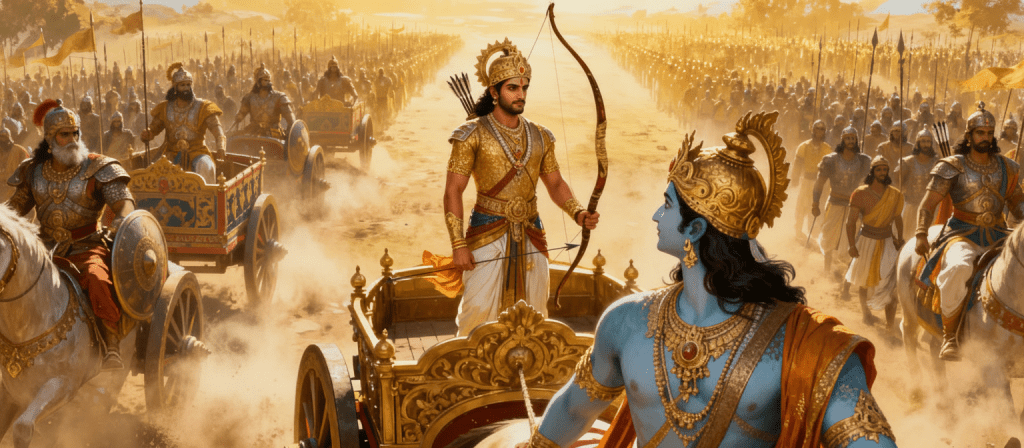
AI-Generated Image of Krishna and Arjun Standing between both ArmiesHe informs that Shree Krishna sets it up at the location from where main warriors of the Kauravas’ army, such as Bheeshma, Drona, etc., can be seen clearly. After setting up the Chariot there, Shree Krishna also said to Arjun,
“Look at these warriors of the Kuru Dynasty, who have gathered here to battle with you.”
Krishna said this to give Arjun the confidence to battle by making him aware that he is not the one who wants the war, but the Kauravas want the same. After that, Arjun looks at all his kinsmen, like father figures, grand uncles, teachers, maternal uncles, brothers, nephews, children of nephews, friends, etc., and gets filled with graciousness and grief. And then, he starts speaking about what he felt after seeing his kinsmen. He, further, tells Krishna that he was feeling uneasiness and a lot more. But before moving forward, let’s understand why Arjun and Krishna were referred as Gudakesh and Hrishikesh, respectively.
Meaning of Gudakesh
Arjun has been referred to as Gudakesh, which is made of two words – Gudak and Ish, which means the lord or controller of sleep. Sleep, here, is used as a simile to Agyan (ignorance), which means lack of understanding of righteousness. It was not just a name given to Arjun for no reason, but Arjun proved that he had a strong will to win over Agyan (lack of understanding of righteousness). That is the reason why Arjun surrendered himself to Shree Krishna and asked questions about what is right from that human form of God.
Meaning of Hrishikesh
Here, Shree Krishna has been referred to as Hrishikesh, which is made of two words – Hrishik and Ish, which means the controller or lord of senses. Shree Krishna has been referred to as controller of senses because none of the senses can force him to perform Adharm (Unrighteous Acts, decisions, and thinking). Now because he can’t be forced to do or support Adharm by any bodily sense or external impact, he is sure to perform Dharm (righteousness) and teach the same to everyone. That is what proves Krishna to be God, but not just his ability to resurrect Uttara and Abhimanyu’s son – Pareekshit.
We’ll close this article here and speak about what else Arjun says to Krishna after observing both the armies, in next verses.
 Gupt Alok
Leave a comment