Shlok – 12
Tasya Sanjanayan Harsham Kuruvriddhah Pitaamahah |
Sinhnaadam Vinadyochchaih Shankham Dadhmau Prataapvaan ||
English Translation:
[Then] The oldest one in all Kauravas, [Kauravas’] grandfather, blew the couchshell in a high note, roaring like a lion and bringing joy to the heart of Duryodhan.
Shlok – 13
Tatah Shankhaashch Bheryashch Panvaanakgomukhaah |
Sahsaivaabhyahanyant Sa Shabdastumuloabhavat ||
English Translation:
After that, suddenly, Couchshell and Nagaras (one-sided drums), Panav, Aanak, Gomukh, etc., different types of instruments started to play.
Shlok – 14
Tatah Shwetairhyairyukte Mahati Syandane Sthitau |
Maadhavah Paandavashchaiv Divyau Shankhau Pradadhmatuh ||
English Translation:
The combined sound of all those instruments was quite loud. Then Madhav (Shree Krishna) and Arjun, sitting on a chariot of white horses, blew their respective divine couche shells.
Shlok – 15
Paanchjanyam Hrishikesho Devdattam Dhananjayah |
Paundram Dadhmau Mahaashankham Bheemkarmaa Vrikodarah ||
English Translation:
Controller of senses (Shree Krishna) blew the couche shell named Panchjanya, Dhananyaya (Arjun) blew his couchshell named devdatta, and big-task-doer wolf-bellied (Bheem) blew his great couchshell named Paundram.
Shlok – 16
Anantvijayam Raajaa Kuntiputro Yudhishdhirah |
Nakulah Sahdevashch Sughoshmanipushpakau ||
English Translation:
[After that] son of Kunti King Yudhisthir blew a couchshell named Anantvijaya, Nakul and Sahdev blew the couchshells named Sughosh and Manipushpak, respectively.
Shlok – 17
Kaashyashcha Parameshvaasah Shikhandi Cha Maharathah |
Dhrishtdyunmo Viraatashcha Saatyakishchaaparaajitah ||
English Translation:
Great Archer Kashiraj, Great Warrior Shikhnadi, Dhrishtadyumna, and Virat, and undefeatable Satyik,
Shlok – 18
Drupado Draupadeyaashch Sarvashah Prithivipate |
Saubhadreshch Mahaabaahuh Shankhaandadhmuh Prithak Prithak ||
English Translation:
Drupad, and sons of Draudapi (Pandavas), Oh king of the land! and Mahabahu (Big Armed) son of Subhadra (Abhimanyu), all of them separately blew their couchshells.
Shlok – 19
Sa Ghosho Dhaartraashtraanaam Hridyaani Vyadaarayat | Nabhashch Prithiveem Chaiv Tumulo Vyanunaadayan ||
English Translation:
That huge sound, echoing in the sky and the earth, tore the hearts of the sons of Dhritarashtra apart.
Shlok – 20
Ath Vyavashtinaandrishtvaa Dhaartraashtraankapidhvajah | Privratte Shashtrasampaate Dhanurudyamya Paandavah ||
English Translation:
Then, at the beginning of the collision of arms, the Pandav, having the flag of monkey symbol (or the flag having seated Hanuman Ji in it), looking at the sons of Dhritaraashtra who were strategically positioned in front of him, put an arrow on the bow.
Exegesis and Central Idea:
In these shloks,
Sanjay describes to Dhritrashtra how both armies indicated their readiness for the battle. As Duryodhan asked his warriors to protect Bheeshma, Bheeshma was the first to blow his conchshell, pleasing Duryodhan. After that, warriors of both armies started to blow different types of instruments. It included conchshells, Nagadas (Kettle Drum), Panav (Small Drum or Tabor), Anak also known as Dumdubhi (A drum with smaller underbelly space), and Gomukh (A wind-instrument like a bull horn).
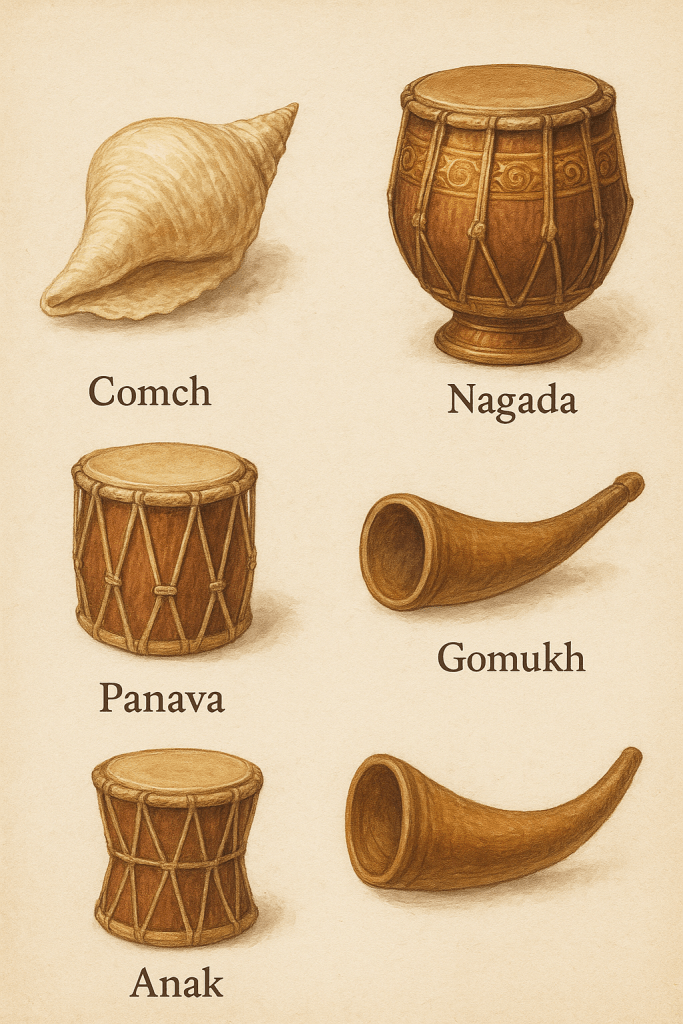
AI-generated image of Conch, Nagada, Panava, Anak, and GomukhWhen all these instruments were played together by both armies, it created a huge sound in the battlefield.
In this process, Shree Krishna and Arjun also blew their divine conch shells named Panchjanya and Devdatta, respectively. This way they addressed the Pandavas’ army that battle is beginning, be ready. The other warriors acknowledged this intent and also spread the message to the army on their side by blowing their conch shells. This sound of conch shells was joined by that of the Bheem’s Paundram named Conchshell, Yudhishthir’s Anantvijay named conchshell, Nakul’s Sughosh named conch shell, and Sahdev’s Manipushpak named conchshell. It was further joined by other warriors like Kashiraj, Shikhandi, Dhrishtdyumna, Virat, Satyaki, Drupad, Abhimanyu, and sons of Draupadi.
The combined sound of all of them was so profound that it echoed in the entire sky and the earth. Don’t take it literally that it echoed the entire earth and sky, but that part of the earth and sky where the battlefield was set up. After listening to this huge sound, the sons of Dhritarashtra obviously got a little bit frightened, or you can say disheartened. It happens. You feel good when you make a sound or roar while fighting, but the moment the opposition starts roaring, fear and pessimism start knocking within you.
As this was the confirmation to begin the battle, the noise of collision of the arms started and Arjun also took his position by putting his arrow on the bow. The kauravas were also well-aligned in front of him.
Here, Arjun is addressed as a Pandav who had the Kapidhvaj. Let’s understand the meaning of it.
- Kapidhwaj is made of two Sanskrit words – Kapi and Dhwaj.
- Kapi means Monkey, and Dhwaj means flag – it means his flag may have had the symbol of a monkey, which seems a little illogical to be mentioned.
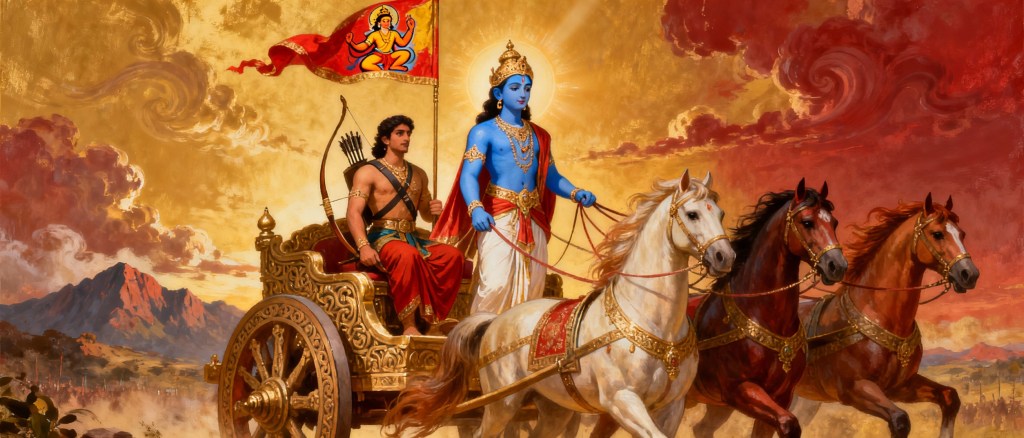
Arjun's Chariot with a Hanuman Flag, Krishna as Charioteer on Battlefield
- Kapi also means Hanuman ji, which means the flag of Arjun’s Chariot may have had the symbol of Hanuman ji. This one seems to be the logical meaning of Kapidhwaj.
- The third meaning of the Kapidhwaj could be that Hanumanji, in invisible form, was sitting on the flag of Arjun’s Chariot to protect it because Dharm (Righteousness) and God (Shri Krishna) were on Arjun’s side.
So this was about Arjun’s chariot and the beginning of the battle. What happens next would be described in the following shloks.
 Gupt Alok